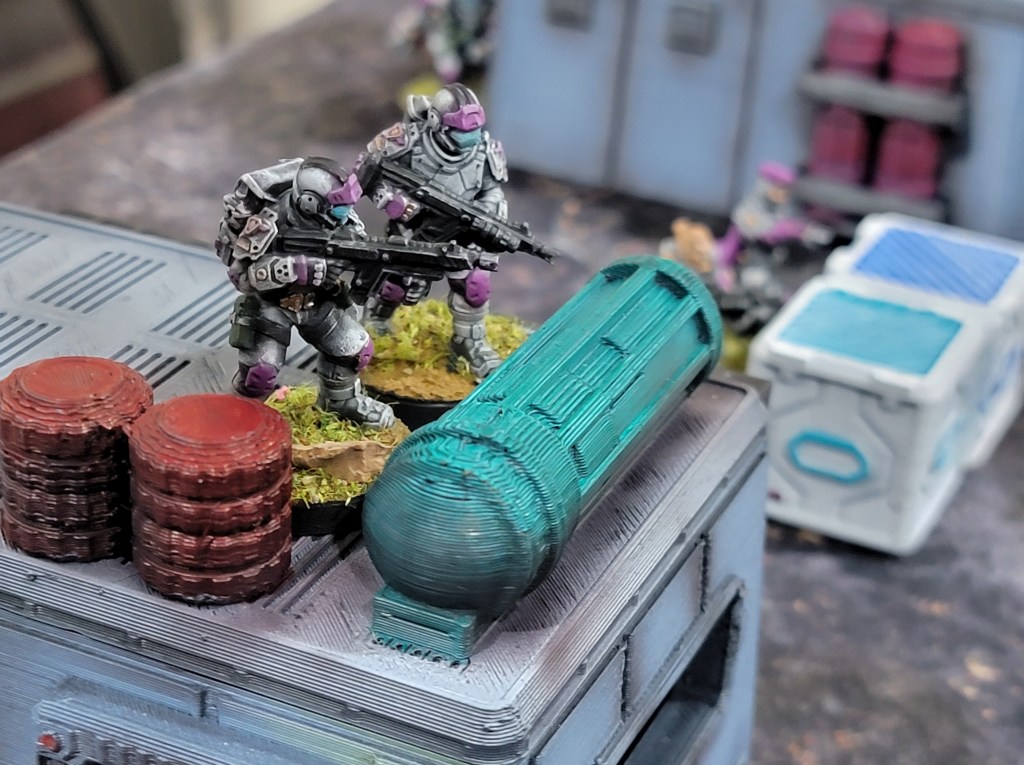
As I mentioned in my last post, I’ve spent a lot of my time lately working on two games: Death by Plasma Strike and Desiderium. One is a fast-moving scifi skirmish game I’m developing with my son and the other is a fantasy warband game I’m developing with my buddy, Paul Bussard. The fun part of this has been learning things about why games make the decisions they do in their designs. Let’s take a look at a few.
Size Matters
Last year, Paul and I got into Dragon Rampant for a spell. I made a list builder, we played a bunch of games, came up with some fun lore, and then abandoned the game altogether because it just didn’t do quite enough. But one core thing stuck with us: why do we have to dictate a unit size?
There’s tradeoffs, really. A smaller unit fits in more places and concentrates power but struggles to control a wide area. A big unit has a harder time fitting but gladly blocks more of the game board. Arguably, there’s reasons to skew either way—and my co-designer maintains this line.
I think it’s bunk.
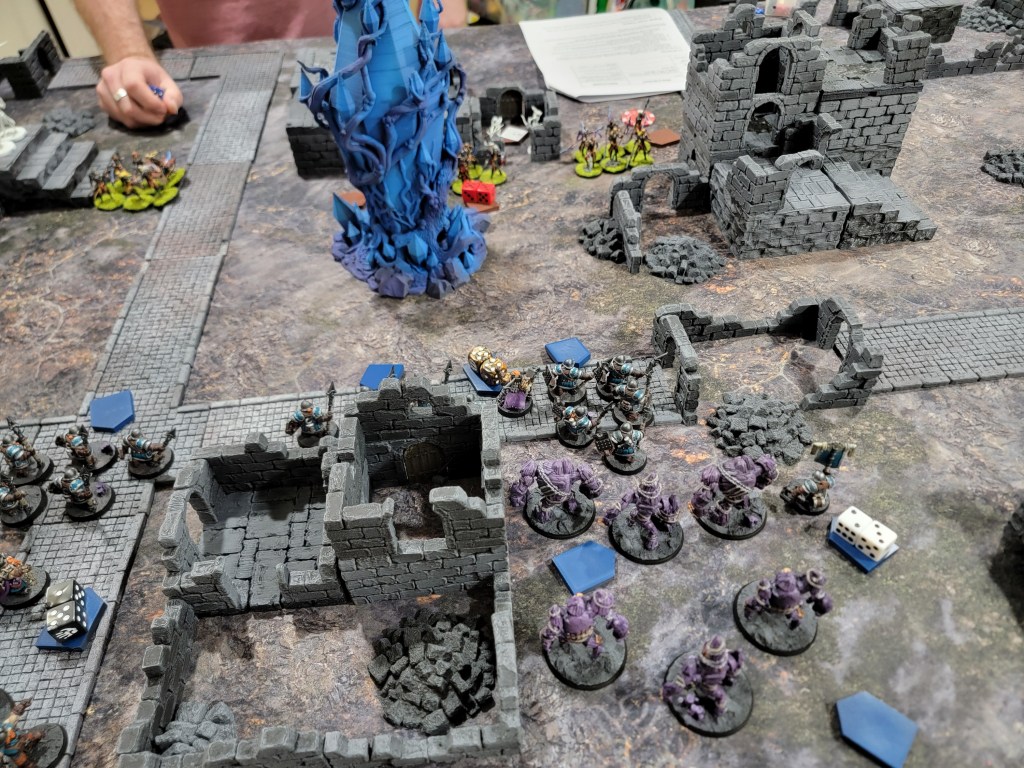
In our test game, we ended up pressed between a rock and a hard place—and I couldn’t get my golems into the fight if I wanted to, but he had the ability to slip another single model leader in there. It hit me that if I had opted to make my dwarves units of 2 men instead of 5 (which our ruleset does not currently prohibit) I could have readily gotten a golem in there.
Granted, on a “Don’t be a jerk” scale, sizing my units to game the system is obviously a jerk move.
But I better understand now why we set unit sizes or charge by the model. It just prevents a lot of problems, especially in games that skew more competitive.
The Problem With Action Economy
When building DPS, I chose to explore allowing players to fully customize their own units. I debated between this and an easier to manage system where I provide unit types. Ultimately, the freedom to create your own vision of a party really felt central to the game and the concept of Vectors as fireteams built to a task. Full customization just makes sense.
It also makes problems.
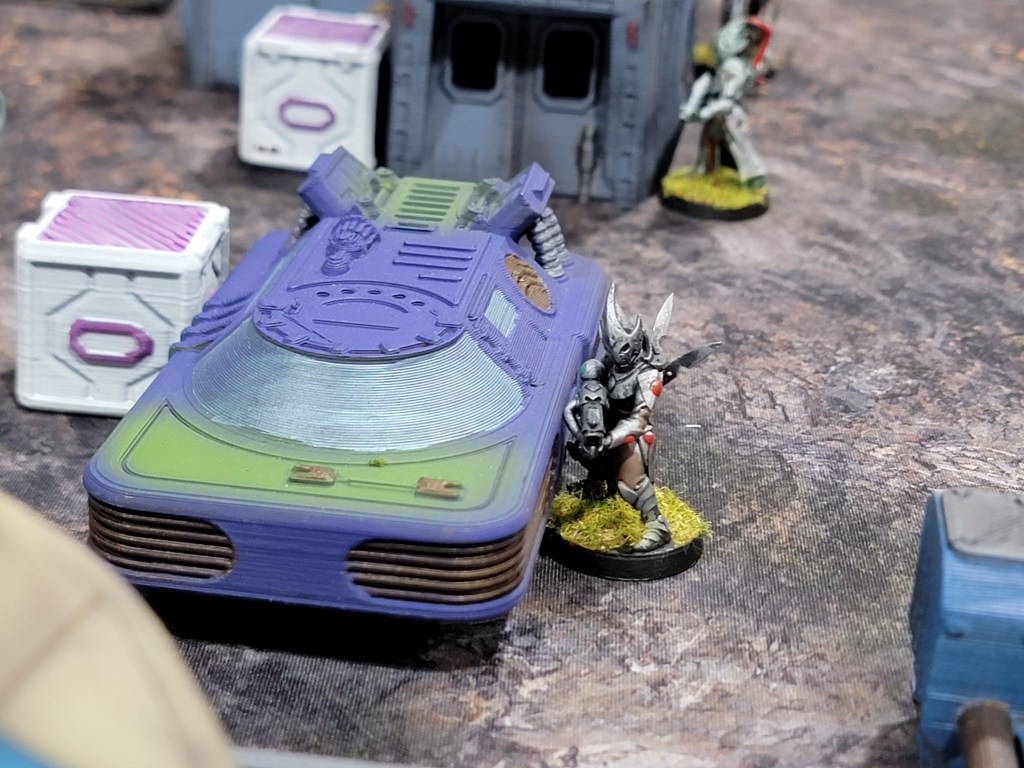
One thing I’ve wondered in the past is why systems apply “Artificial” constraints. So, for example: if I want to buy 12 special skills for a unit and just pay for them, why not let me? Why place minimum and maximum values on a squad or force’s size? Why not limit the mathematics behind the points system to control this?
Because it’s hard.
Right now, rules as written, you could build a Vector with nearly 30 models in DPS. This means you could bring around 60 models. They’d be garbage, but an opponent bringing a more reasonable list would be unable to put out the sheer number of attacks necessary to kill all 60 models, so any missions built around control would be trivially easy for the 60 model player to win.
Solutions exist, but the easiest one is to just say “Vectors are between 4 and 12 models.” This allows players some freedom in a way, too. You could invest 180 out of your 300 points into one model and then fill out with cheap models. Go ahead.
I’m considering reworking the game’s activation system in a way that might help this. I have it in my head to give you a pool of activations you use until they dry up, then reset. This creates a tempo issue but also allows me to arbitrarily say something like “You get 12 activations a turn.” Well, then there’s no reason to take more than 16 or so models.
But absent that idea, it really is just cleaner and easier to put an “artificial” limitation down. I get it now.
How Smart Is Your Player, Really?
This one is tough. I’m already aware of it but it’s a challenging issue to resolve. Take DPS again, for example. The game is highly lethal, but you’re given tools to resolve that lethality. You can throw smoke, leverage overwatch, suppress your enemy, or just build your force to use terrain better for survival.
But if you don’t do that?
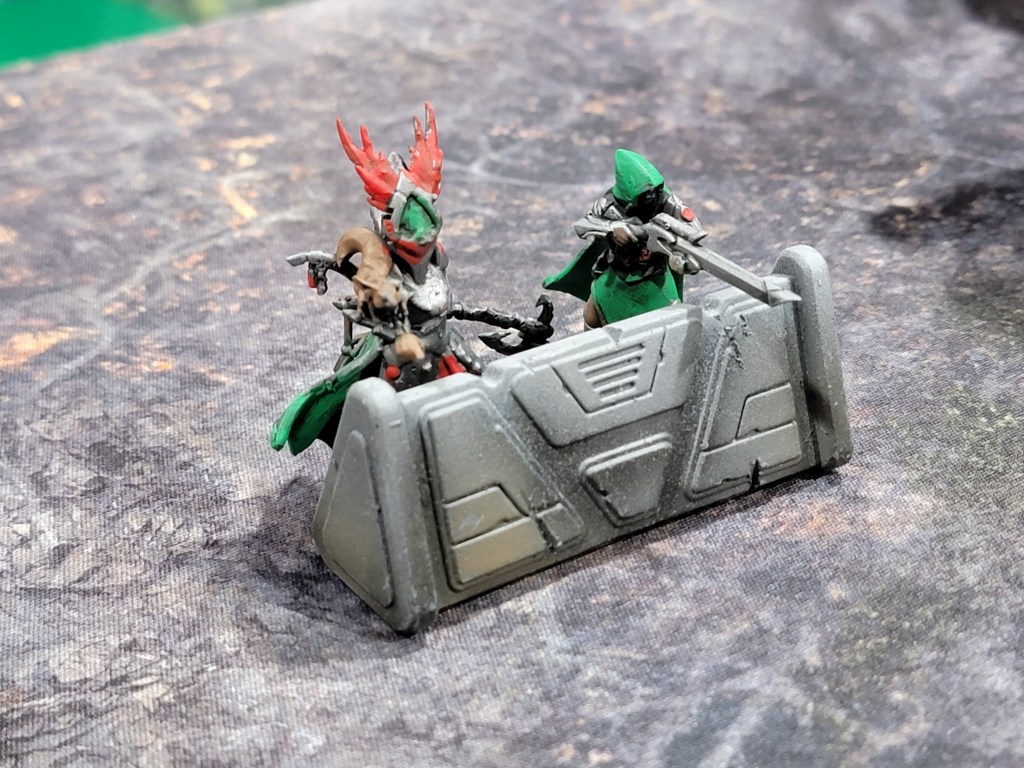
The game becomes a really simple game of standing around shooting each other. I do my best in the ruleset to encourage mobility and counter-mobility. I want players to think about positioning, but if you just don’t? The game sucks.
My effort toward a solution is “Fireflies.” They’re loitering drones you throw instead of grenades, so they act as mines or they act as smoke effects that screw with anyone who runs into or through them. This makes the mechanic thematically interesting, which I hope leads players to realizing how important it is.
I struggled for a while with deciding how many fireflies each player should get. Should it be unlimited? Grenades functionally would be, with each man carrying a few. I chose to limit them, though, because by doing so they become a resource. You even get a little checkbox on your Vector card, reminding you they exist and are limited. They’re precious, so you better use them!
Conclusion
There’s more things I could talk about it, like dice math accessibility, or how hard points are (particularly when combined with the player skill issue), but the main point is: you should probably write some rules. Play around. No need to take it too seriously. The design thought process itself just delivers a lot to consider and meditate on. Every time I sit down with a design concept, I learn something.
Unfortunately, that “Something” isn’t focus, so I’m sitting here with the Halo miniatures game in my cart. One day I’ll learn…




Leave a Reply