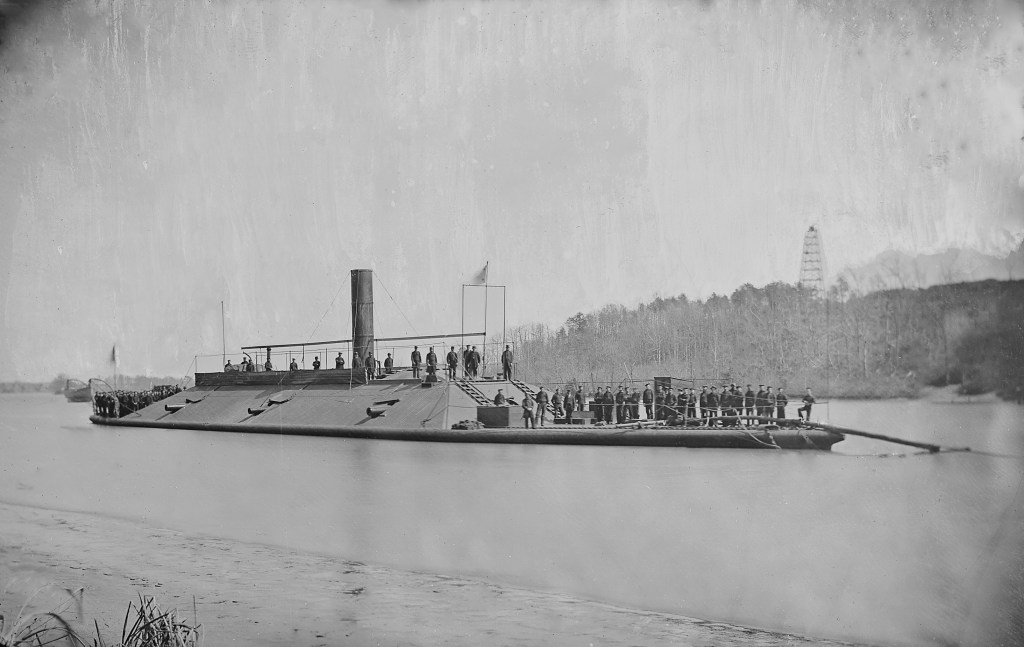
Note: Title image is taken from Wikipedia via the US National Archives and Records Administration. It is the CSS Atlanta after Union capture in 1865.
Per usual, this is not a review but an impression of a ruleset after a read through or two–three, actually, in this case. The goal here is to give the notion of the ruleset and whether or not it might work for you.
This one is a bit unique, though, as I have very little experience with naval wargaming, if any. Notably, I was shocked to discover I even have a “Naval” tag on my blog. Go figure. Anyway, let’s get into this: Sail and Steam Navies, the read through.
Overview
Sail and Steam Navies is a naval wargame for naval actions in the era of ironclads, particularly in North America during the American Civil War. There are modules for European warfare but I am not reviewing those here.
It is a 1/600th scale game that uses D6s as tokens and D10s for combat. It’s hard to rate the complexity of the game as it depends heavily on your preexisting understanding of naval movement. If you don’t already know what tacking is, then not only are you learning the rules for it but learning that it exists and thusly remembering it while you play. The rules range from lightweight to midweight depending on how much you already know.
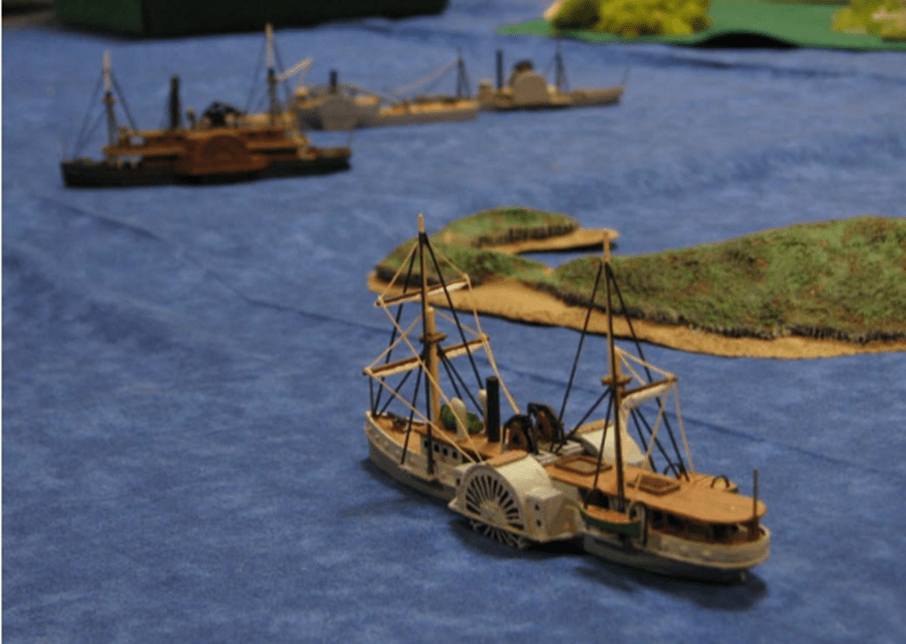
Further, the game uses both sail and ironclad ships. The ironclads are easier to manage as they don’t generally care about wind–but the sailing ships are considerably more complex if you don’t know the basics of sailing, as stated above. I’d argue everything here is done to a level that is just robust enough to cover important decision making in a battle across multiple ships, while being kept streamlined enough to be playable in reasonable time.
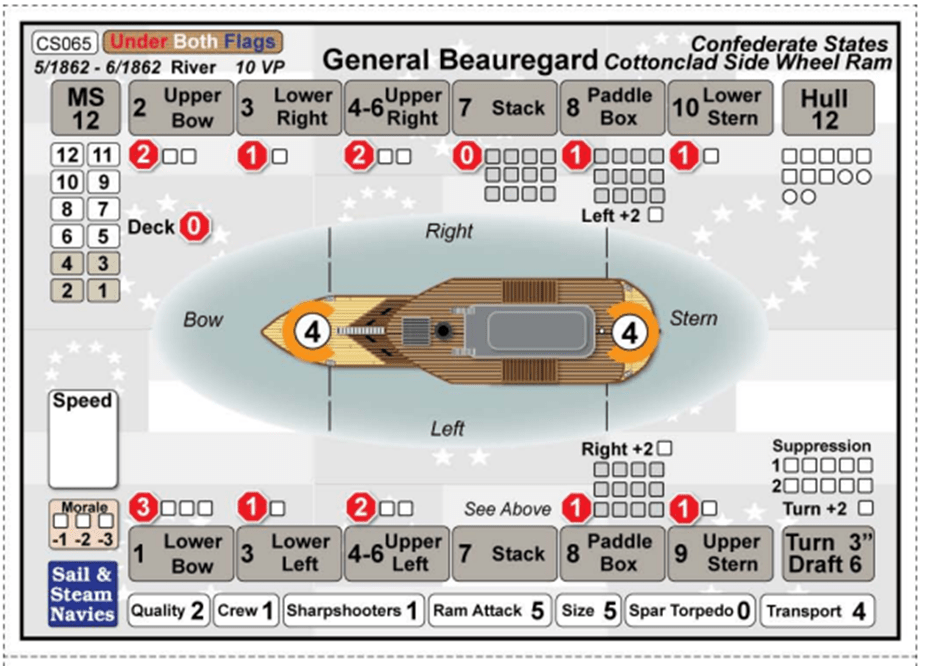
A big part of that is the ship cards, which are tough to look at on first blush, but exceptionally functional. Everything you need to play is there, once you learn the language, which is graciously not that hard.
Gameplay
Gameplay sees both players executing the turn phases in alternation, with all shooting done simultaneously.
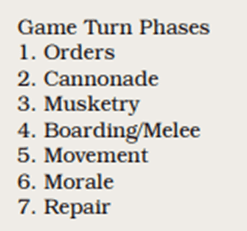
During the Orders Phase, you issue a “Speed Order” to each ship, which dictates how many inches they must move during the movement phase (phases, actually–more on that shortly).
Cannonade is shooting, which happens simultaneously. It factors range, broad weapon type (light, medium and heavy smoothbore, rifle, mortar, etc.) and hit locations, with each ship taking damage on its personal log sheet that tracks the status of the differing parts of the ship. Musketry proceeds in the same manner and accounts for the “Sharpshooters” on the boats firing at each other. On the whole this section felt like it covered exactly what it needed and did so without a ton of rules bloat.
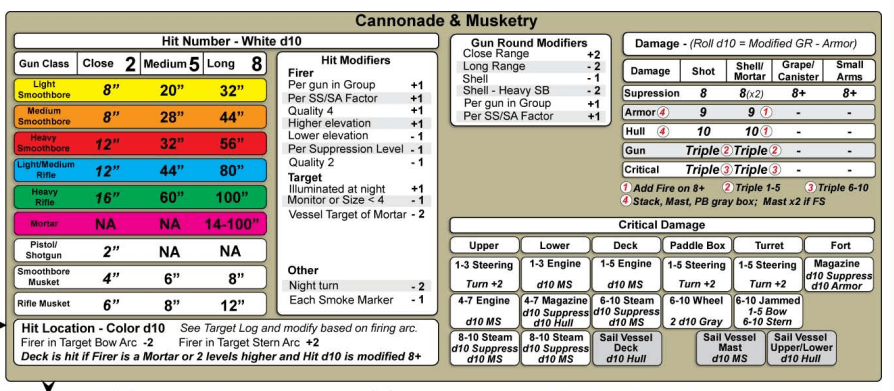
The above is a clip out of the QRS, covering just the shooting rules. I initially looked at this sheet and balked but after a read through I believe it’s really quite an excellent QRS. The above factors move quickly and in my experiments rolling it out on tabletop I firmly believe my ten year old should have little to no issues with the process, aside from dad catching some of the factors here and there.
Boarding/Melee is the next phase is is very streamlined. It appears to move quickly and is easy to understand.
Movement is where we get a little rough, but that appears to be the debt of naval movement without templates. Movement is done in two rounds, in both of which every ship must move the full value in inches recorded in the orders phase–both times. So you wrote down 6 inches for your Speed Order. During the first movement phase, you must move 6 inches. Then, your opponent goes. Then, during your second movement phase you must once again move 6 inches. So really you’re moving 12 inches overall. It’s a tad confusing on read through and I highly recommend reading the detailed play example–it does a great job of explaining all this.
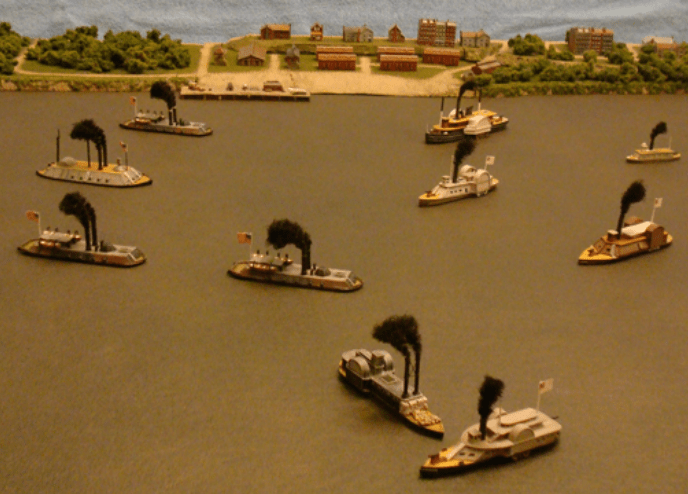
Beyond that, sailing vessels get a little complicated if you’re not already familiar with sailing. If you are, it is relatively easy to learn. I cannot fault the ruleset for this issue as, frankly, there’s no way around it other than to ignore the realities of the effect of wind on sailing. It’s important to show this so for early war battles where sailing vessels are present the player can experience the sheer difference in technology. There’s a reason we switched to steam. Several, in fact.
The final phases are Morale and Repair. Both are straightforward but I admire the inclusion of morale here as it makes sense. Rarely do we fight to the last and it’s clear vessels will retreat as things go wrong. Repair is simple and allows you to deal with issues like fires during the battle. The sum total here really makes it feel like you’re running a ship.
The Writing
Before moving on I want to take a moment to talk about the writing here. It is overall quite readable but the usage of abbreviations and the constant referencing to the log sheets can make it hard to absorb. You learn about Speed Orders (SO) and then they’re referred to as SO for the rest of the book, which when combined with several other abbreviated terms it can cause a form of reading fatigue. Add to that the log sheet you’re not looking at because it’s 15 pages back and it can be a little bit of a headache.
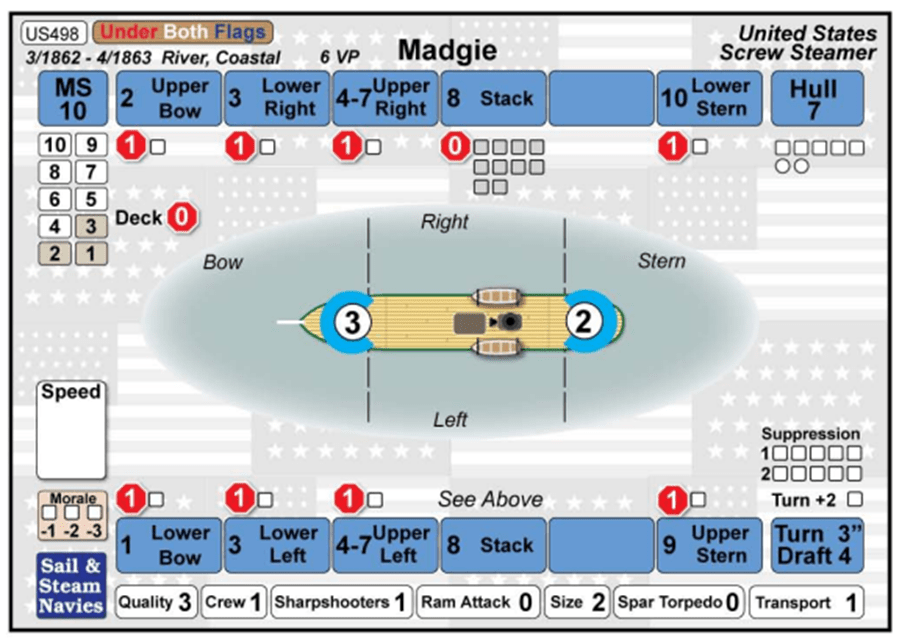
I’ll say I found it way easier to read when I opened multiple copies with one showing me a log sheet, another showing me the QRS, and a final one just being the rules. This helped massively and I highly encourage it on initial read through.
The Dad Angle
This was all spurred by my ten year old taking an interest in ironclads and in particular the Battle of Hampton Roads. As I’ve looked through the ruleset, I’ve kept in my mind whether or not he can really handle it. I still have concerns about how forward looking gameplay is–deciding moves in advance is harder than we give it credit. I think this ruleset gives just enough flexibility to get around this, as you decide how to spend your movement when you activate the ship, so you can adapt.
Beyond that, the only issue I foresee is the sailing ship movement as it’s all totally foreign to him. We can dodge it by doing pure ironclad battles but I’ll try my hand at getting him to understand. We’ll see how it goes. I think the gunnery, ramming, and remaining elements should be easy enough for him to grasp, but only just barely. He’s ten with several years wargaming experience, so that helps a lot. If you’re considering playing with your own child, I’ll caution that I would not try this if not for him being the one to take the interest, which makes it much more likely he’ll deal with the learning curve on how boats actually work.
Conclusion
The sum total here is a ruleset that I believe adequately captures the intricacies of this period and boils them down to the right decisions for players to make. Judging the right speed to travel, how to move to align your weapons, and how to take advantage of fleets with differing technology all comes together nicely here to show off the very reasons you would want to look at this era of naval combat. I’ve learned a lot just by reading the book and digesting the mechanics.
I’m not sure of many other American Civil War naval rulesets and cannot comment on the field at large, but if you want to take this somewhat seriously I don’t believe it’s a difficult ruleset to learn. I have enough confidence in that statement that I fully intend to teach my son to play it and may even host a club game or two to recreate the Battle of Hampton Roads or perhaps some of the riverine actions during the Civil War.
If you’ve recently taken an interest in Civil War naval warfare and want to dip your toe in, I’m certain you could do a lot worse and I’m not sure you could do a lot better. This ruleset feels very much complete and easy to understand.
Don your uniform, smudge your face with soot, and shout “Full steam ahead” at your friends and family while you line up the perfect ramming attack. Sail and Steam Navies will be right there beside you while you get stuck and sink to the bottom of the river.





Leave a comment