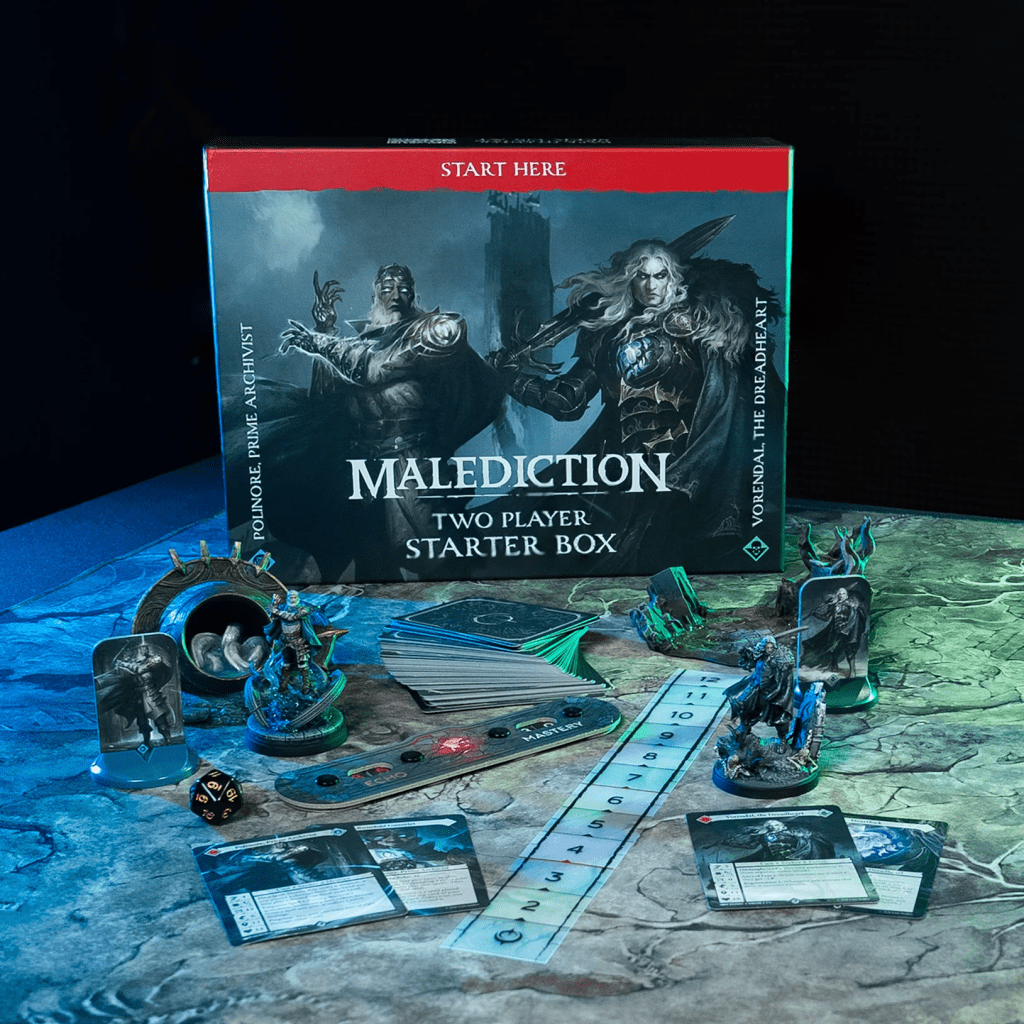
Today, I aim to give my read-through impression of Malediction. As always, I want to stress that I have not played the game and this is not a review. This is a collection of my thoughts after reading both the rules and the decks I have from the Polinore vs. Vorendal starter set. It should not be taken with anything other than a heaping helping of salt.
To calibrate before we begin, I have played and enjoyed the following relevant games:
- Magic: The Gathering
- Star Wars Unlimited
- Marvel Champions
- Marvel Crisis Protocol
Why am I listing card games? Malediction is a miniatures wargame where you play a deck-based card game to summon, augment, and assist your miniatures on a 2.5’x2.5′ battlefield. Imagine a competitive card game that includes a leader unit, a variety of potential followers, instant-cast and normal spells, and equipment that can be attached to your units. Great—but now that’s just one part of the game. Those units activate in alternation with your opponent’s units each turn. The card summons the unit, then they get to act every turn that they’re still alive. Add spells at rational times and you’ve got the general gist.
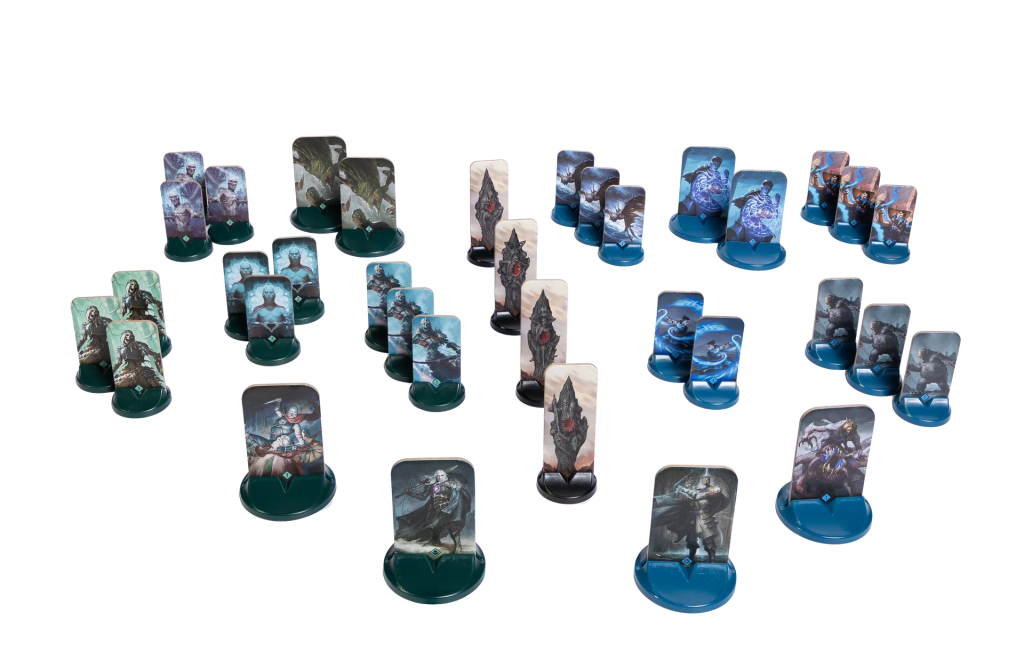
Oh, and the models are all 3D printable and come with the decks, or you can use cardboard standees. More on that later.
Let’s jump in now with the conclusion at the front.
Note: all images are taken from promotional images as I don’t wish to misrepresent the game with poorly lit photos of cardboard standees or cards sitting on my desk.
Bottom Line Up Front
The ruleset looks interesting, is easy to understand, and carries the technical texture of a card game. I love the concept of a deck of cards used to control a game, rewarding your deck building strategy with on-board action. It’s a fun concept and in execution here, I really like it.
The issues I’d foresee a player having are the same issues I’d foresee in a card game, really. With factions ever-expanding, you might get beat by the next round of releases or your faction might fall behind in balance, needing to wait for the next major release. Obviously, with expansion always comes some risk. It also carries the technical aspects of a card game: with so many rules and modifications to the rules flying around, you’ll likely have to reference a timing chart at some point in your time with this game.
Further, I’m sure we’ll end up with “Net decks” as the game grows. This is a common issue in card games and if you’re thinking about playing this game competitively, it’ll eventually come out of the woodwork here, too. It’s not unique to card games, of course—Warhammer players are very familiar with online lists. But for those who normally read my blog, this is probably something to be wary of.
The trade off is that the game does feel genuinely new. I love the concept behind it and the models and artwork are really top tier. Every card I read was easily comprehensible and I understood the strategy behind the starter decks just fine. I could see myself deck building for this and playing it casually with friends. It’s rad, and at about $70 for a self-contained starter set that comes with really high quality STL files, I’d say it’s well worth the cost of entry to at least build a box set to play at home.
The Cards
I alluded to it above, so I should probably stop and actually explain some mechanics here. We’ll start with what composes your deck.
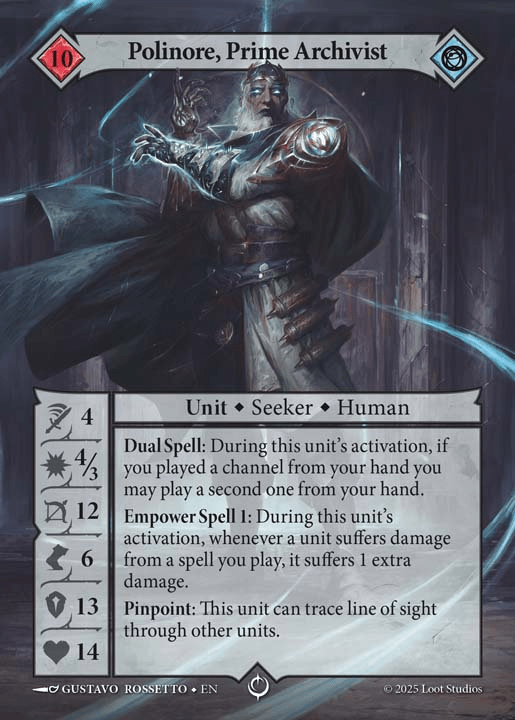
We’ll start with the Seeker. Each deck starts by selecting what is basically your champion. It’s a model that can be repeatedly summoned to the battlefield throughout the game, returning to your “Hand” every time it dies. The Seeker comes with a Legacy card, which gives you a set of abilities you always have access to. For example: Polinore comes with a Legacy card that allows you to play spells from your discard pile and then draw additional spells from your deck for doing so. Combined, these allow your Seeker to really define how you approach a battle.
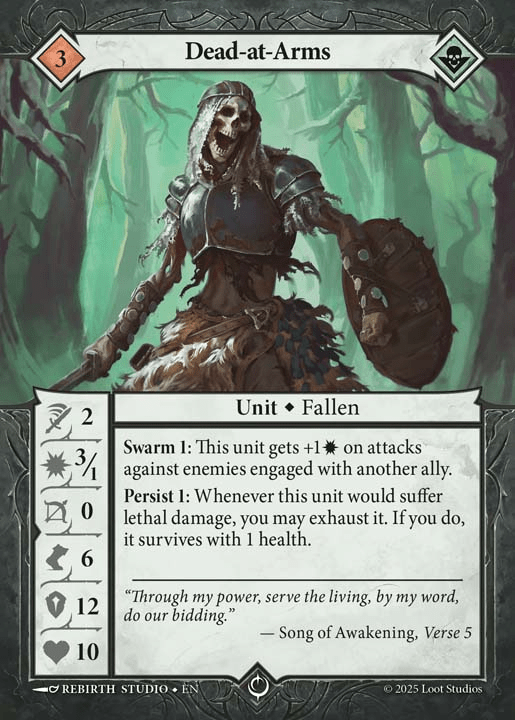
Next, the units. They’re about what you’d expect. They feature their statline on the left, beside the unit’s abilities. This is very much a “Reading the card explains the card” situation, which keeps things accessible. Thus far, every card I’ve read explains its rules and I hope it stays this way for the sake of accessibility. The stats, from top to bottom: accuracy, power, range, movement, defense, and health. We’ll touch on these a little more when we get to combat.
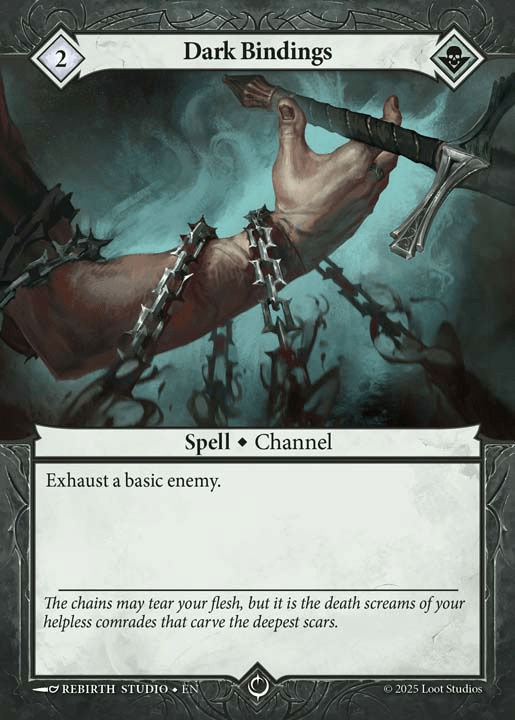
Spells come in two flavors: channeled and swift. Channeled spells can be played once per unit activation, whereas swift spells can be played at any time, including during your opponent’s activations. Notably, the game does not shy away from traditional “Control” style mechanics from card games. That is to say the Polinore starter deck features cards that cancel enemy spells as they’re cast, or in the above example you can exhaust a unit that has yet to activate this turn, denying your opponent an activation. Some people dislike these sorts of mechanics—I think they’re great.
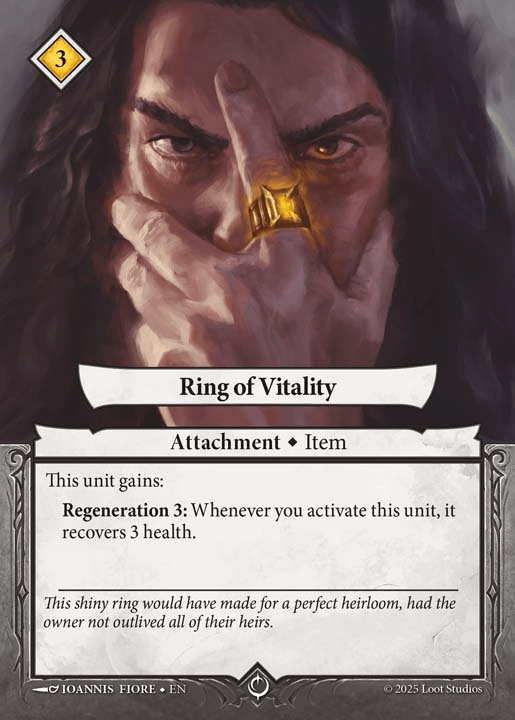
Attachments are what they seem to be: they attach to a unit and buff them. They can be exchanged between units within 1″ of each other.
Gameplay
Each turn goes through four phases. I’ll steal directly from the rulebook:
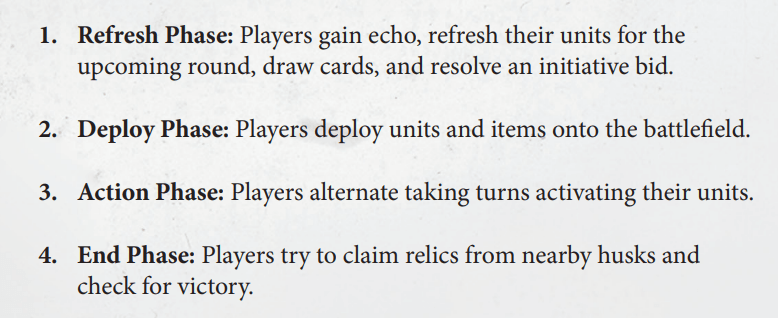
Starting with the Refresh Phase, I think the most notable thing is the game’s energy system, which is core to a card game. You start the game with a set number of echoes based on your Seeker and their Legacy card. You generate a number of echoes each round equal to double the current round number up to round 5, then just 10 per round from then on. Echoes serve to allow you to use the cards from your deck. For context, most cards in my decks appear to be priced between 1-4 echoes, with a handful of more powerful cards ranging up to 10 echoes—the upper limit being the cost of my Seeker itself. Anyone familiar with a power curve from card gaming can likely guess the distribution just fine.
During the Deploy Phase, you spend however many echoes you want to summon units to the board. This means you could flood the zone early with cheap units, or save up and summon multiple expensive units all at once. Here lies a lot of the meat of what interests me. This is a cool system for deployment to me because it forces you to consider the battle tempo. You only pay echoes for a unit once (unless there’s an ability somewhere that drains echoes or something) and then they act for the rest of the game. Summoning early obviously means you get more actions while risking being destroyed. Summoning late might allow you to hit hard in a pivotal moment, but you lose out on the actions the unit could have taken before that turn.
The Action Phase is clearly where most of the game is played. You alternate activating units. When activating a unit, you can play one channeled spell, take up to two actions, and attach augments to the model being activated. This is where combat occurs. Combat is simple enough: you roll a D20 and add the unit’s Accuracy. If you surpass the enemy’s Defense, you hit them for the left side of your Power value. If you roll lower than their Defense, you glance them and hit for the right side of the Power value. You can critically fail on a natural 1, causing only one damage, and you can critically succeed on a natural 20, dealing both parts of your Power together (both the hit and glance value). What’s intriguing is that you always do damage. There’s no “Missing” that I can see.
In the End Phase you score points and claim relics from husks. Relics are attachments that you draft from a common pool. Acquiring one gains you 10 Mastery, which are the game’s victory points. You further gain Mastery each time you kill an opposing unit. First player to 40 Mastery wins. That’s it—that’s the game. You capture relics, kill your opponent, and score points. The variety comes from your deck’s theory of victory or “Win condition” if you prefer.
The Miniatures
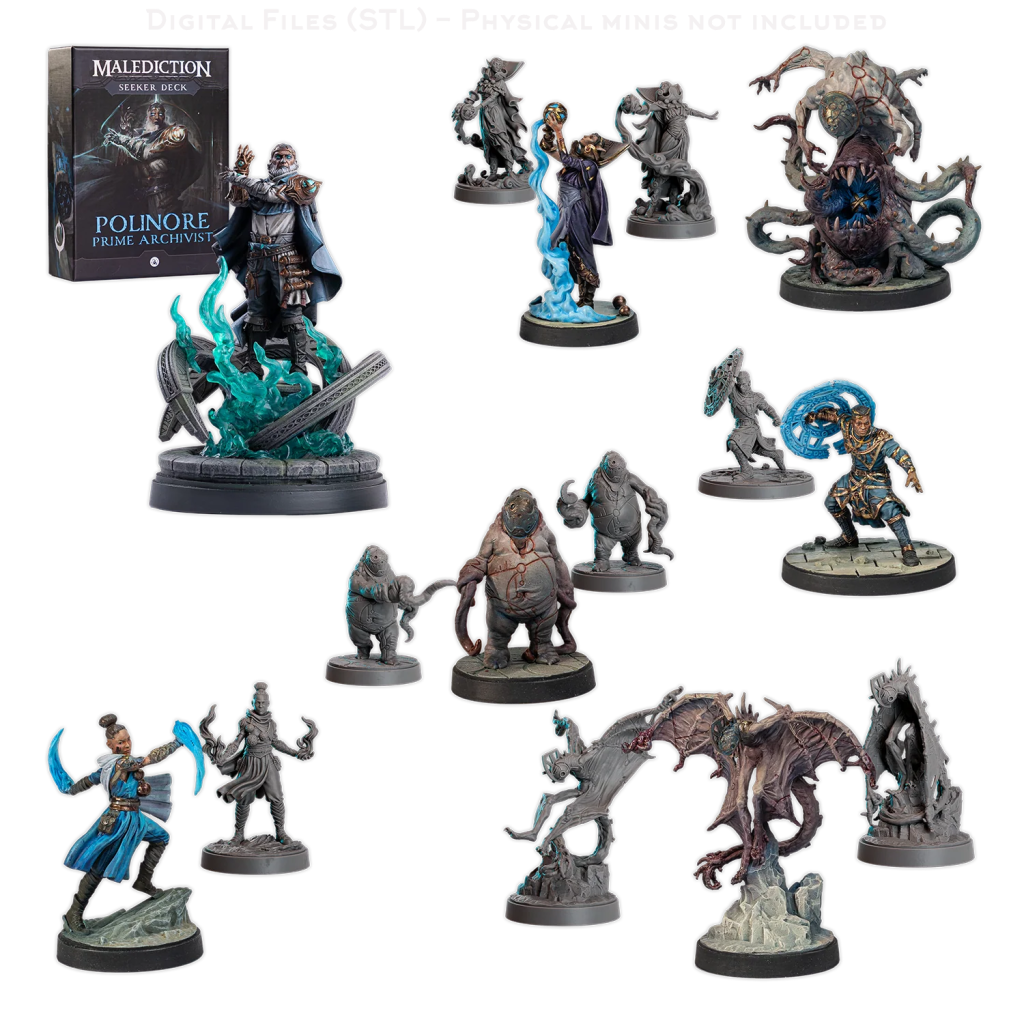
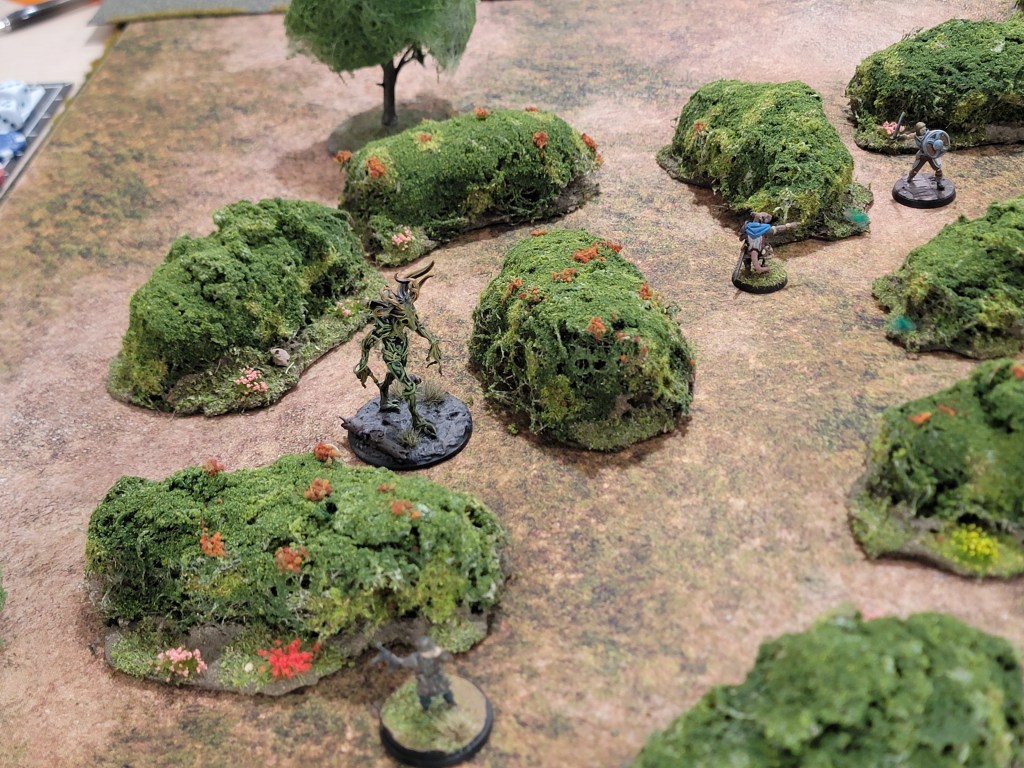
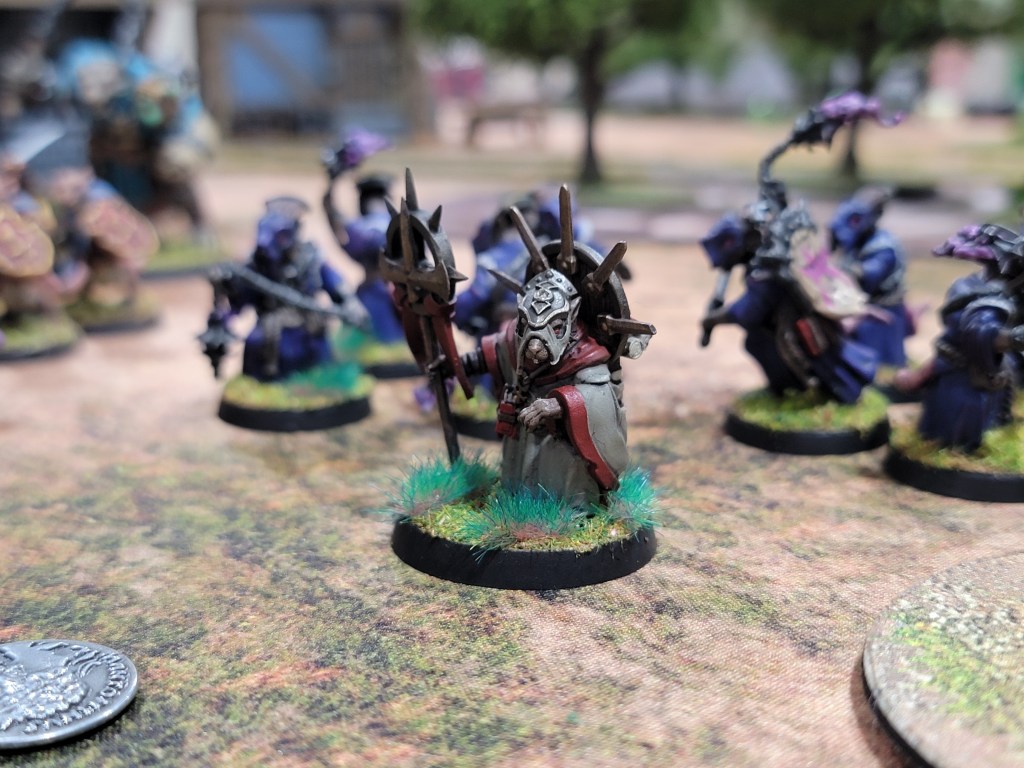
They’re gorgeous, okay?! Half the reason I bought the game is it comes with fantastic miniatures you can 3D print. They’re genuinely beautiful and correspond to excellent artwork on the cards themselves. You don’t have to use them and the base box comes with cardboard standees, but I suspect these will be a big reason many people pick up the game.
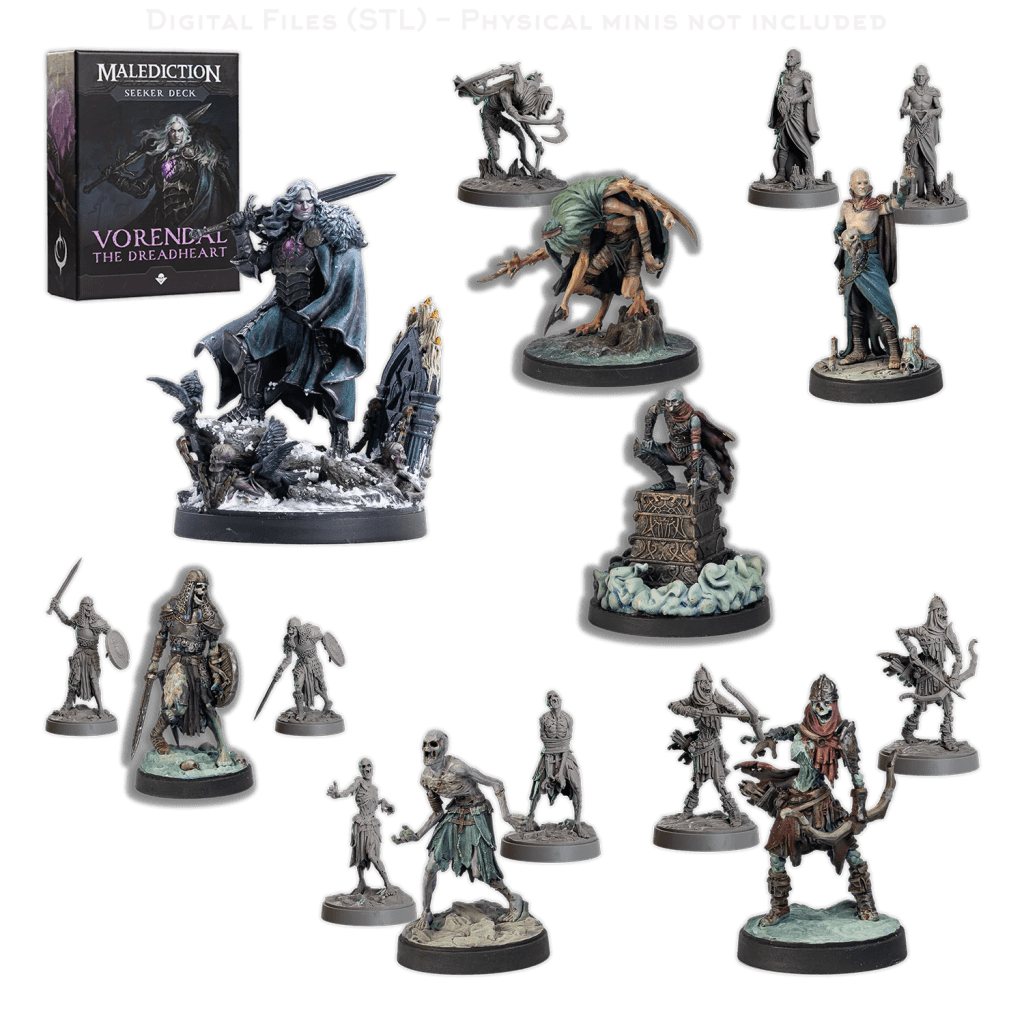
This also means the game does not come with pre-fab miniatures out of the box—buyer beware. They do sell them physically but the prices are rather steep. Given the STLs come with the cards, you’re better off seeking a friend to print some off for you for a much lower price.
Deck Building
I think any card gamer will wonder about this, so here’s the brief rundown:
- You get 30-50 cards per deck and a 7 card sideboard. It does seem a lower card count is wise for the same reasons it’s wise in every other card game: consistency.
- You can only take 3x basic, 2x elite, 1x unique of each given card.
- You’re restricted to the factions your Seeker represents.
- There’s a deck builder and it’s great.
The card pool is limited right now but if you make an account above you can freely explore it, which is great to see. Judge for yourself if it looks interesting enough to you.
Cautions
It’s a card game. I mention this in the BLUF but I’ll harp on it a little here: that comes with some baggage. Let’s start from the top with Seekers. I love Polinore conceptually, but he might eventually be out-of-date, right? As new cards release, another Seeker from his faction might become flat-out better because it has access to cards he doesn’t, or because its effects combo better with those cards. It’s a complex environment that is difficult to perfectly balance. As the game grows ever larger, a competitive player will find themself having to keep up and change up their deck over time. This is a double edged sword any prospective player should be aware of. If you want to play this in a group, you’ll find yourself having to keep up.
The combo-oriented nature of the game means you’ll never know when something will fully shakeup the meta. Again, a double edged sword. This means the game stays fresh and keeps growing and making money—great! It also means you’ll need to grow with it.
This constant updating makes it harder to really get attached to anything. They’re parts of a machine, not characters or components of your story. For that matter, the starter set came with a dearth of story information. I have no idea what the “Malediction” even is and I read what came in the box. You’ll have to go elsewhere for more and I’m skeptical most players will care. This does not feel like a game that wants you to tell stories in its world. It feels like a game that wants to be mechanically focused and fun to play.
Which is fine! It’s just something you need to know before buying in.
To give the game serious credit: it does not appear to use booster packs. This is more of the living card game model, where you buy preset packs of cards that give you all you need to keep playing. If I were to be part of a play group, I’d expect to buy a few packs a year for around $30 each time to keep on top of my possible card combos for my faction(s) of choice.
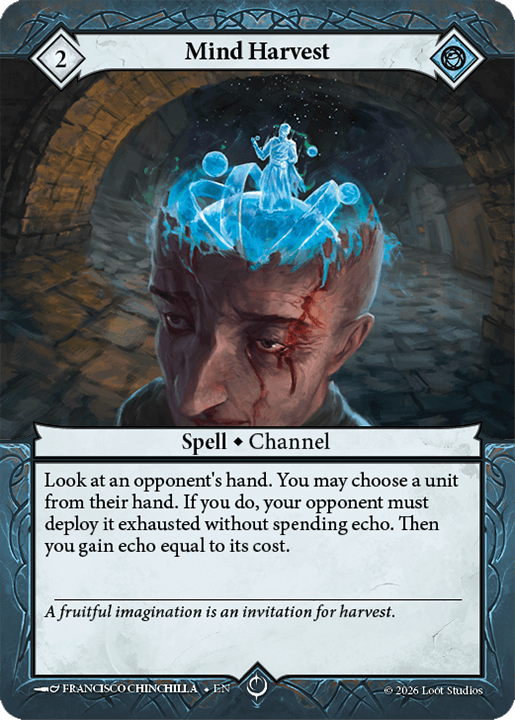
And of course, I’d inform myself of this by… well, probably looking up decks on the internet. Call it a fault of mine, but I’d do so naturally just out of interest, which will then tip me off to the combos I should be seeking. I could see this flattening playstyles within a group. You’ll likely know what a Polinore deck looks like before your opponent even flips the first card.
While I think the game will work as a game-in-a-box, I do think the nature of decks means it will feel somewhat limited. But if you like it enough to want more, that’s probably a good sign anyway.
So there you go—all of the above are really just complaints about it being a card game. I suspect if the idea of a card game informing a miniatures skirmish game intrigues you, you were already ready to accept the drawbacks for the reward. If any of the above surprises or puts you off, this probably isn’t the game for you to pursue.
Who is this for?
This game is for the player who enjoys both miniature gaming and card gaming. It’s for the player who likes combos in their games and wants those moments of surprise and clever thought where a whole game can flip on its head. It’s for someone who can enjoy a game that emphasizes mechanical interest over all else.
If you read my cautions and thought “This guy is an idiot—of course those are potential problems” then this game is definitely for you. If you read them and thought “Ah, man. I wanted a cool side game and not much else,” then this game… is probably still fine. I’d seriously consider buying what’s out there right now and just packaging it up for play as its own contained environment. Players online seem to think it’s balanced well right now, so have at it.
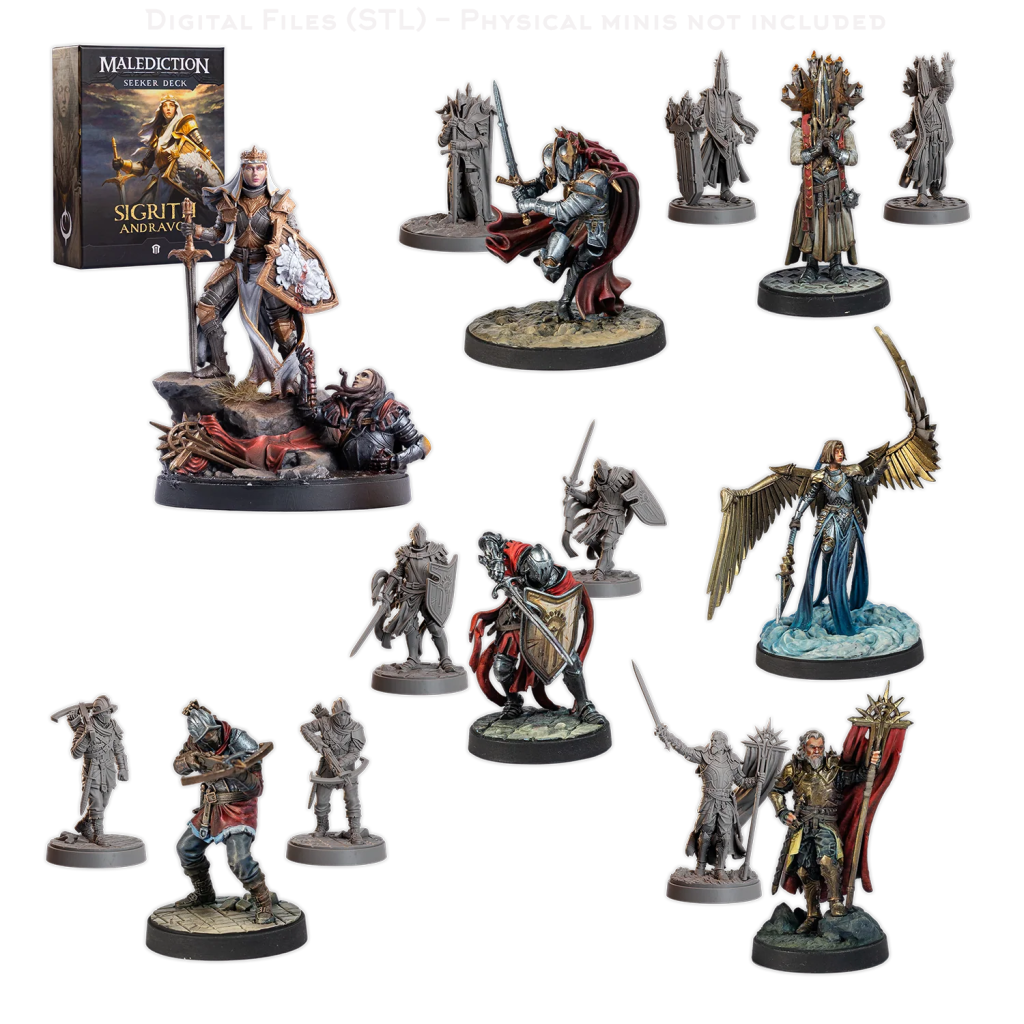
If the mechanics-first, story-second approach puts you off but you love the vibe? You might still buy it just for the STLs. There aren’t many poses to speak of, but you could readily put together a skirmish warband for a cool game and the files for a deck will run you about $30 and some shelf space for cards you might try out once or twice.
If none of the above grabs you, I appreciate you reading this far—spend the money on something you’d enjoy more.
As for me, I bought the starter and intend to play a game or two with a buddy so I can explore the game mechanically, then use the miniatures for some skirmish wargaming. I probably won’t be playing with a nearby group or anything but I do think the money was worth it for the experience and the miniatures.
In a sea of game releases, I do think this one stands out for good reason. If it has your attention and you can put $70 into a new venture, give it a shot. I think with the right perspective, you’ll at least get your money’s worth.


 Small Scale Victory
Leave a comment