
Here’s a weird one, honestly. I’ve been kicking around an idea for a fantasy age of sail and steam game, inspired by the Mantic Armada MyMiniFactory. I love the ships and I’ve had an idea kicking around in my head for a long while now that I’d like to actually apply to a game I can play with my kid. That idea, now named Frigates and Fireballs!, is now… well, a play test ready game. And I have to admit: that’s partially due to AI assistance.
Shock. Horror.

We’ll start with the aims of the game, the usage of AI, and the brief overview.
The Thesis
The goal here is to build a convention style game where players can learn the ship control and shooting with ease, while providing a simple but interesting magic system to layer on top for dramatic, somewhat silly games. This is not a serious game. It’s a game where you throw a meteor at your opponent from across the board to sink a ship in one go, then he reverses time to bring that ship back.
That’s it. It’s actually quite simple.
The AI Use
I used GPT 6 – Astra to review the rules after I wrote them in my normal notation format. I asked it to look for gaps and help me identify contradictions. It did just that. It identified some issues with my dice math to start and noted that I had yet to design any scenarios. It also suggested I should be cautious of the ramifications of the spells I started out with, pointing out a few issues that could occur. An example of that is that I have several spells that move ships. What if a player moves a ship off the board?
Good question, GPT. Really.
I also used it to build the app for the game, because of course I did. It made something accessible and easy to understand. We even added small features like an automatic fleet builder, replete with the ability to give yourself headroom to add upgrades, or even name each ship automatically.
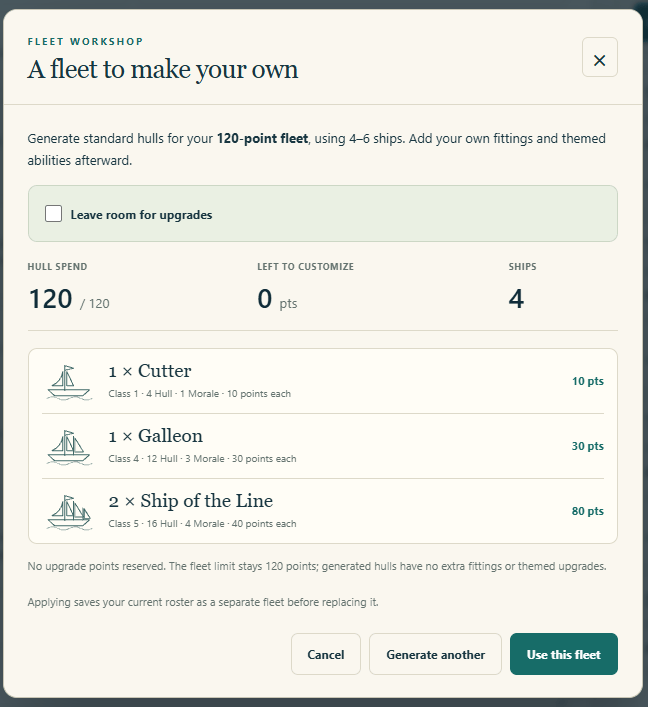
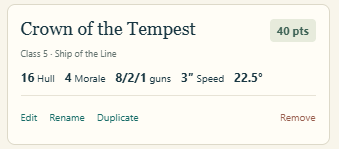
After building out 40 spells myself, I asked it to review the rules and look for things I had yet to modify, then suggest ideas. I used that to flesh out the spells massively. I also had it review the dice math for the spells and help me build an initial distribution, which you’ll see below.
And, of course, it built some basic art for the builder. I have no issues with this. It’s a tool and simple vector arts of ships is not where I was going to spend money on an artist anyway.
The Mechanics
We’ll start by explaining the simple stuff: game flow, movement, and direct combat.
| Order | Phase | Description |
| 1 | Initiative | Roll for initiative. |
| 2 | Spell | Roll and allocate magic dice. |
| 3 | First Movement | Move all ships. Turning permitted. |
| 4 | Shooting | Fire one arc per ship; simultaneous damage calculated at round end. |
| 5 | Second Movement | Full Sail ships move again without turning. |
| 6 | Boarding | Execute boarding actions setup during prior movement phases. |
| 7 | End | Cleanup phase. |
So right away: we have two movement phases. I got this idea from Sail and Steam Navies. It gets at some of the simultaneous nature of movement while allowing for a moment to shoot in the middle of movement. Your ship goes full sail to escape the enemy? Great. That’ll help you… after a round of shooting. They’ll still get a shot at you while you try to sail away. It allows for a fair amount of nuance while keeping things simple. In a convention game, I consider this ideal.
Shooting is exceptionally simple. You are allowed to shoot one arc per turn to keep things moving quickly (wait, I should make a spell for this–Speed Time: shoot from multiple arcs this turn). Look at your shoot stat for that arc, roll that many dice, hit based on distance + modifiers.
| Range between bases | Required D6 result |
| Up to 8″ | 3+ |
| Over 8″ to 16″ | 4+ |
| Over 16″ to 24″ | 5+ |
| Over 24″ to 32″ | 6+; requires Extended Range |
| Condition | Modifier to each attack die |
| Line of sight obstructed | −1 |
| Firing ship at Full Sail | −1 |
| Firing ship or target Anchored | +1, applied once even if both are Anchored |
Here’s the risky part: there are no defense rolls. This probably requires the most playtesting, but I’m trying to keep things very fast moving and reward good positioning. Count your dice, roll them, tally damage. At the end of the round, we apply the damage and ships start sinking.
Next, let’s take a look at what a ship even is. There are five classes of ships in the game, representing a general scale from tiny to huge. Each ship has nine stats (including three shooting stats based on arc) but I think they’re all self explanatory. Here’s a card.
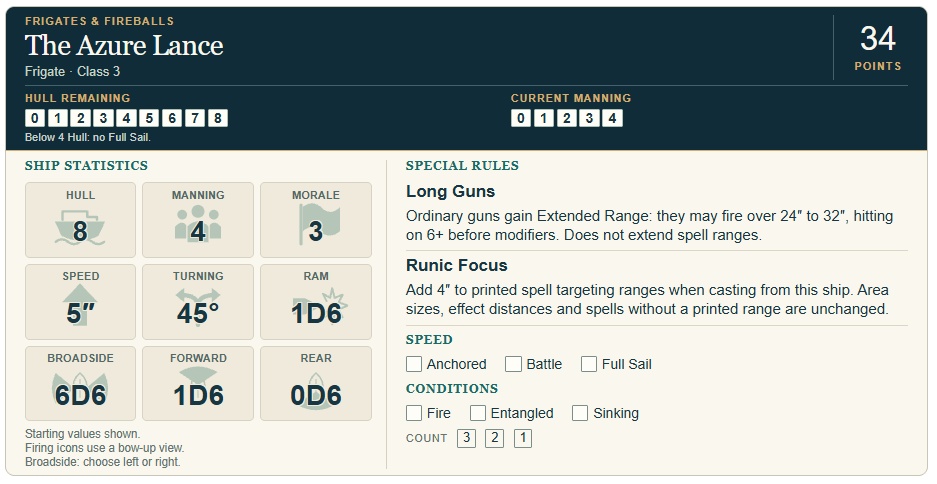
- Hull: Ship health
- Manning: Crew health–dice thrown in boarding actions
- Morale: Force morale lost if the ship is destroyed, more if captured
- Speed: Speed the ship is able to move during each movement phase it can act in
- Turning: Amount ship can turn in the first movement phase
- Ram: Dice thrown when ramming
- Broadside/Forward/Rear: Dice thrown for each firing arc
You can also see I had the card designed so you could laminate it. I really like this idea for events, where it’ll reduce clutter on the table. I’ll note there’s a misplaced “Count” row below the Conditions. That should be beside “Sinking.” I’ll go in and fix that later, but you sink across three turns with the ability to roll to buy yourself time.
Now, we have fun.
The Magic System
It’s Saga. I stole Saga. I admit to stealing Saga. Then repurposing it for a totally different thing. Alternatively, I stole Warcry, or Void Admiral (I think?), or about a dozen other games. This is not unique, but it is fun and I have a unique way by which you build your spell board. There’s around 50 spells in the game right now, spread across different levels of rarity, which control their likelihood to show up when you roll your twelve magic dice. When you select a spell, it populates your board in the phase to which it is relevant. Here’s an example:
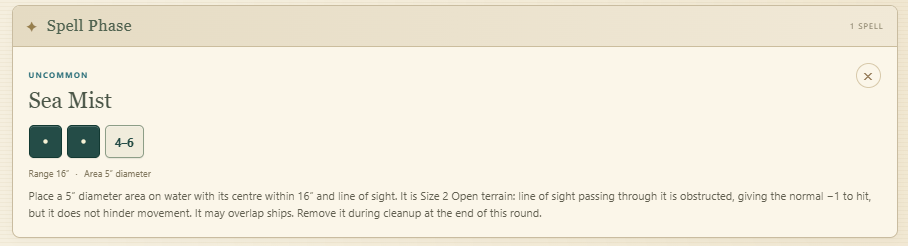
Sea Mist can only be used in the Spell Phase. It is “Uncommon,” so to trigger it you need to use two 1’s and then any number from 4-6. It creates a 5″ AOE that hinders line of sight but does not hinder movement. I might actually shift this down to common after some playtesting, but now let’s look at another, rarer spell:
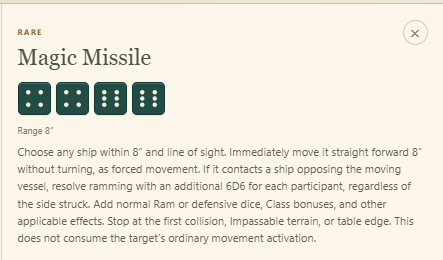
Magic Missile is rare and falls under the Shooting Phase. You need a particular set of four dice to set it off. It… basically suicide bombs a ship into another ship. The missile is the ship. Technically, you can survive. If you paired this with healing and some damage resistance, you might just manage to turn mid-sized ships into repeatable magic missiles. This has not occurred to me before and I absolutely love it. One more:
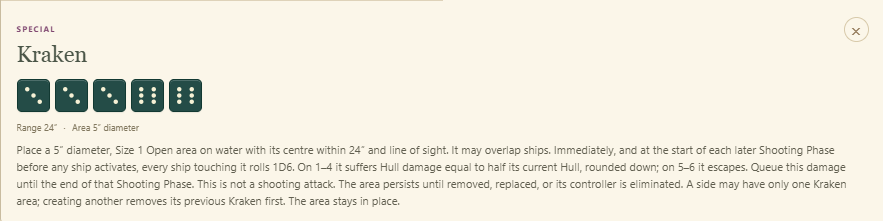
Every board gets one special spell. These are hard to pull off. Statistically, you get them around 17% of the time, so roughly once per game. The Kraken, appropriately, spawns a big monster that tries to murder things. I debate if it’s strong enough, honestly, but a well placed Kraken will be very painful. Combined with some magic that repositions opponents (which is less difficult to cast) and you can envision ways in which you can combo into feeding the Kraken.
On Tabletop?
I’m unsure how this will play, really. I’ve got the rules and the boards and the logic for the ships. I’ve got a bunch of ships printed. All I need to do is paint them and put it on the board with the kiddo. My long term goal is to use it for things like Tentcon, or a big quarterly game with four players around a board. It’s not something to be taken very seriously—just a fun way to paint cool ships and make stupid nautical puns.
And, I’ll be honest, it’s only in this state because of the AI assistance I leveraged to get it here. Is that… wrong? I don’t know. I certainly don’t feel it is. But I get that people have an issue with this and why they have an issue with this. Oddly, one of the biggest issues in our hobbyist industry is the rate at which rules are being released. AI is clearly exacerbating this. We’re getting a veritable glut of garbage thrown at us. I’m not even sure, even if this is fun, that I’d ever bother with releasing it. What’s another drop in an ocean?
Ah, well. Those thoughts aside: I think I’ve got something fun here. Fun enough to play with the kid, at least. Stay tuned for more nautical tales.
…I should go find a Kraken I can print, shouldn’t I?


Leave a comment