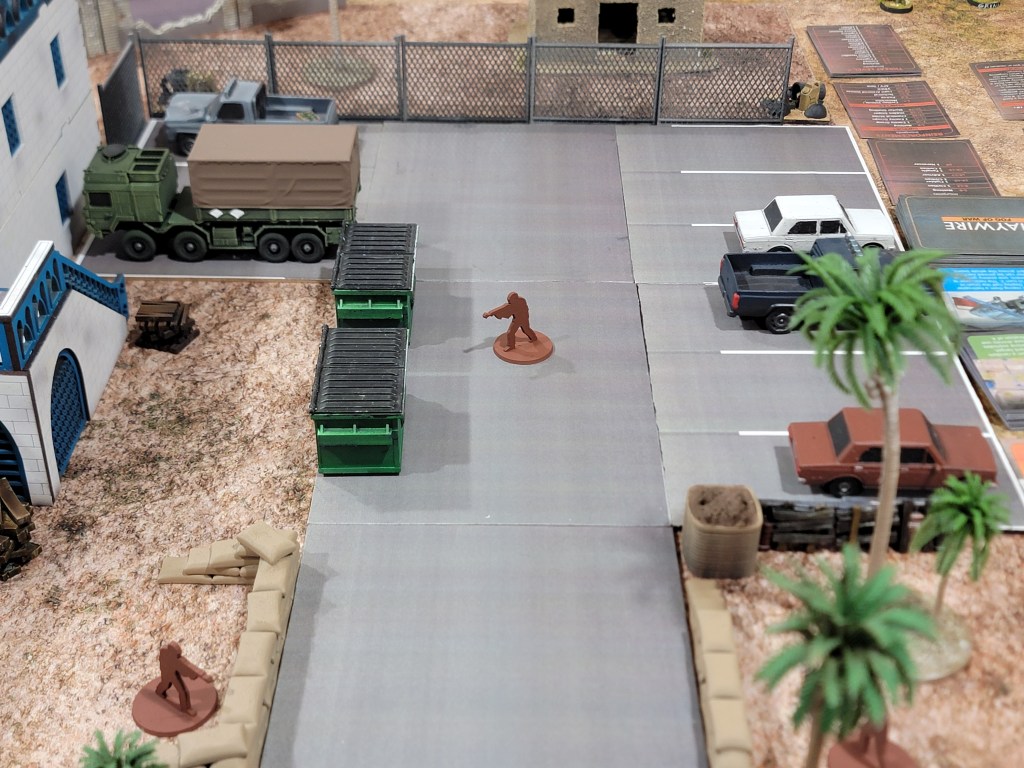
I’ve had the opportunity to read through Haywire, a modern warfare coop and solo ruleset put together by a guy whose terrain boards leave me feeling envious. All photos in this post will come from the rulebook or its associated media, just to show off the sheer quality of Martin’s work. Please note: this is not a review. It is an impression after reading the rules, not playing the game.

If the title looks familiar, Martin has previously released free versions of these rules as he developed them. Much of this is documented on his excellent YouTube channel. His work has been truly inspirational for me for years now and, despite the high cost, I knew I had to read the final copy of his personal wargaming project.
The BLUF
Martin has genuinely produced a great piece of work here with a lot of content for the solo gamer. He’s done such an admirable job of making it accessible and providing a lot of value in this one book. If you can stomach the $55 + shipping (or wait until a digital copy is released on its own down the line) I don’t think you’ll be disappointed. That’s not to say this is faultless.
It has a lot of moving parts tracked by decks. You’ll want to either buy or prepare to produce those decks yourself. Digital copies come with the rules, but print on demand physical copies are available. I’ve heard reports of these costing up to $50 for some people. I intend to cut my own cards out.
I think the core systems are really good, but I do think most solo gamers will find themselves wanting to cut out some parts to streamline gameplay or fit their collection. This does not seem like it would truly harm the experience, unless you get careless.
Regardless, the rules are well composed and designed to support thoughtful, enjoyable campaigns. I do not believe this is the ruleset for the person who wants to setup and tear down quick games. This is for the gamer who wants to think through their setups, play out full campaigns, and really enjoy their time solo or coop gaming. For that person, I think you’ve found an absolute gem.
The Core Rules
The core rules, as in the rules guiding on-the-board gameplay, compose fewer than 20 pages of rulebook. They cover a standard suite of actions that your individual models can spend their two Action Points on. Some unique bits include the ability to sneak, with additional movement modifiers to make you even sneakier. You might move into a room but stay out of LOS of the window, then stalk (1″ hidden movement) to the window so you don’t have to roll to see if an enemy spots you. You can, of course, capture an enemy in melee and then use the “Interrogate” action to get information out of them, which will help with the fog of war elements on the board.

At the start of the game, enemies are represented by hidden movement tokens. You roll for what they are when you’ve either spotted them or gained intel on them. I love this idea, as it gives reasons to use ISR drones to scout the map, or bring support options that help you identify enemies.
What each token represents will vary as the battle progresses, with the Threat Level escalating as you go. You roll on the table for your enemy faction and current threat level when you have to reveal these tokens.
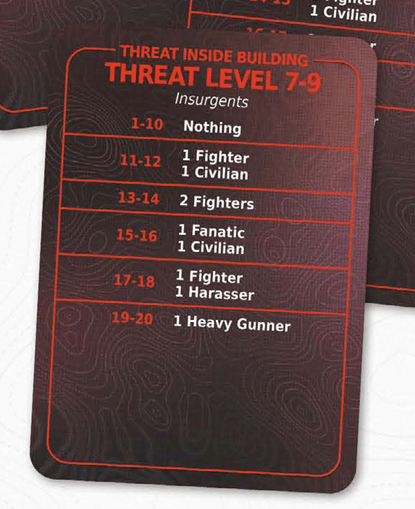
After the player phase, the enemies get to activate in the OPFOR phase. Until detected, they move around randomly. once detected, they follow their own AI patterns based on the unit and enemy type. Generally, they will move to cover and shoot you. Their AI is deterministic, so you don’t have to roll on a table every time. This seems like it would keep things snappy. I can imagine a player playing a campaign against a faction would have no issues with controlling the AI after a few turns.
After the OPFOR phase, enemies spawn. This only happens when the alert is raised, which occurs when you’ve been spotted. This sets a good tempo for the game, where you sneak around and setup before you go loud and trigger all hell.
Shooting works in a reasonable manner. It’s simple, quick, and runs on a D20. That is my main criticism for the rules, actually. A single point on a D20 is a 5% difference, which is… well, basically nothing to me. If you told me I’d succeed on a 15+ or a 14+, I’d look for any other factor to guide the decision. The 5% difference is never enough to sway me. I’m not offended or anything, just neutral. The shooting and melee mechanics are otherwise simple and stay out of your way, which I think is ideal in a ruleset that focuses more on your decision process and less on tiny crunchy bits. It resolves smoothly, leaving you free to manage the rest of the game.
And that’s a bit of an ask, I suspect. More on that later. First…
Why I Like It
The rulebook is well laid out and follows a reasonable progression, taking the reader through the flow of a turn from start to finish. It presents a lot of information, but compartmentalizes it well. It has a ton of content, but the core rules themselves only represent about 16 pages of the overall rulebook. What’s the rest of the book, then?

It’s classes, factions, campaigns, and additional optional rules that I actually do see as optional. The game provides a silly amount of content for you to customize to your needs and it’s absolutely admirable.
It features three factions: insurgents for the Middle East or adjacent areas, cartels for South America, and organized military forces for many possible locations. You could readily reskin them to your liking, as I intend to possibly do with insurgents in Eastern Europe. The different factions have different tables, classes, and stats. After reading through them, their differences are not super pronounced, but they represent their different factions reasonably given the modern focus of the ruleset. A guy with a gun is, oftentimes, a guy with a gun. You can expect the organized military to be more accurate and carry deadlier equipment, but the author rightly does not bog us down in tons of special rules to artificially differentiate the enemies.
Enemy AI is guided by individual AI patterns, which can be referenced next to their unit listing or seen on the unit cards. They behave in obvious, rational ways that should not be hard to adjudicate.
As for player factions, Haywire makes what I would judge to be a wise decision: it divorces itself from reality. Just a touch.

There are rules guiding the deployment of your force that dictate how many models you get for Tier 1, 2, or 3 operators. Tier 1 sees 6 models in their core unit, with an optional support unit added with 2 more models. Tier 3 gets a 12 man main force with a 4 man support team added on. Tier 1 would be your obvious choices: Navy SEALs or the like, whereas Tier 3 would be local guerrillas, or freedom fighters resisting a regime. You could see dropping an elite Tier 1 force into an unstable country to influence the future of its inevitable coup, or play local freedom fighters resisting an invading force to help keep your small part of the country secure.

The fireteams can be selected from presets or created by you. I think most players will follow the presets. Tier 1 features 14 different unit options, while Tiers 2 and 3 have five options each.
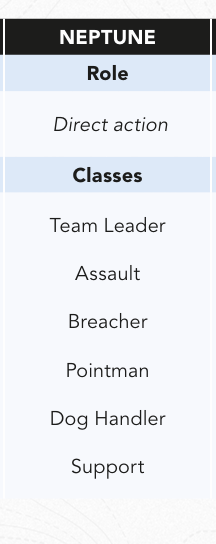
From here, coop play is simple: build your force and divide it in half. This leaves a little bit to be desired for me. I’d like the option to play full sized Tier 1 forces with my son, but as it stands I’ll probably just select Tier 2 or 3 so we each get a good number of models, or otherwise play with composing my own Tier 1 units so I can readily produce two distinct fireteams for us to control.
After you’ve selected your enemies and units, you’d likely decide how you want to approach the campaign. Haywire gives two main options: the first is to play a preset narrative campaign from the book (“Haywire Protocol”) and the second is to play the flexible campaign system (“Tour of Duty”).
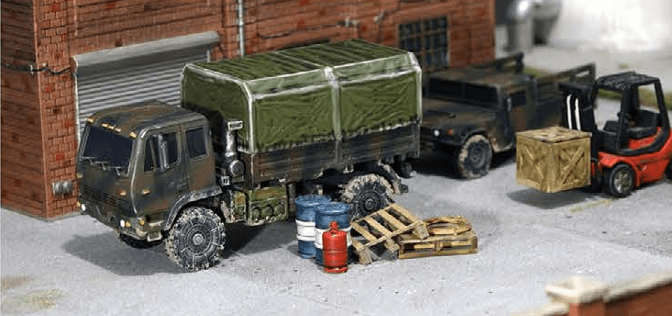
Haywire Protocol presents a full three part campaign with around 24 missions. It sees you touring the world and fighting all three of the game’s factions in a semi-fictional setting that allows you to dance around any real world awkwardness while enjoying a full, well thought out narrative campaign. The objectives and settings vary greatly and it is a fantastic tour of everything one could do with these rules. I adore it. It could readily be one of my hobby bucket list items just to play out this full campaign in all three of its settings.
Alternatively, you could select the one-third of the campaign that fits your collection the best and just play that. Again, Haywire emphasizes flexibility and a clear understanding that everyone brings different assets to their real world table.
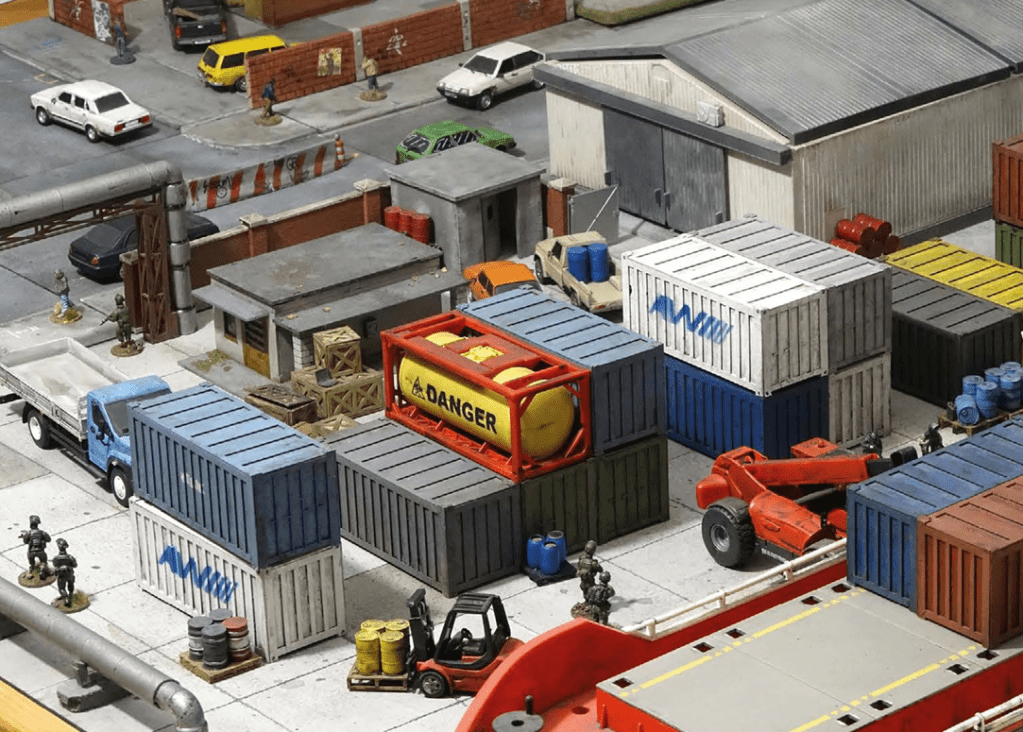
The other major option is the Tour of Duty, which is a well-constructed, customizable campaign that takes place anywhere you want with whatever forces you want. It sees you setting up and upgrading a base of operations across a ten game campaign where you roll up missions off a huge list of 30 possible missions, distributed across three phases of the campaign. I love that the ruleset opts to have you upgrade your core HQ, not your individual models. It keeps things easier to track during gameplay by only modifying campaign level considerations that affect how you start a mission, bring support, or expand your available units. For example: Level 1 Command and Control will allow you to move two of the enemy threat tokens on the board up to 12″ in the direction you want at the start of the game. Analyst Cell level 1 will allow you to reveal what one threat token is at the start of the game.
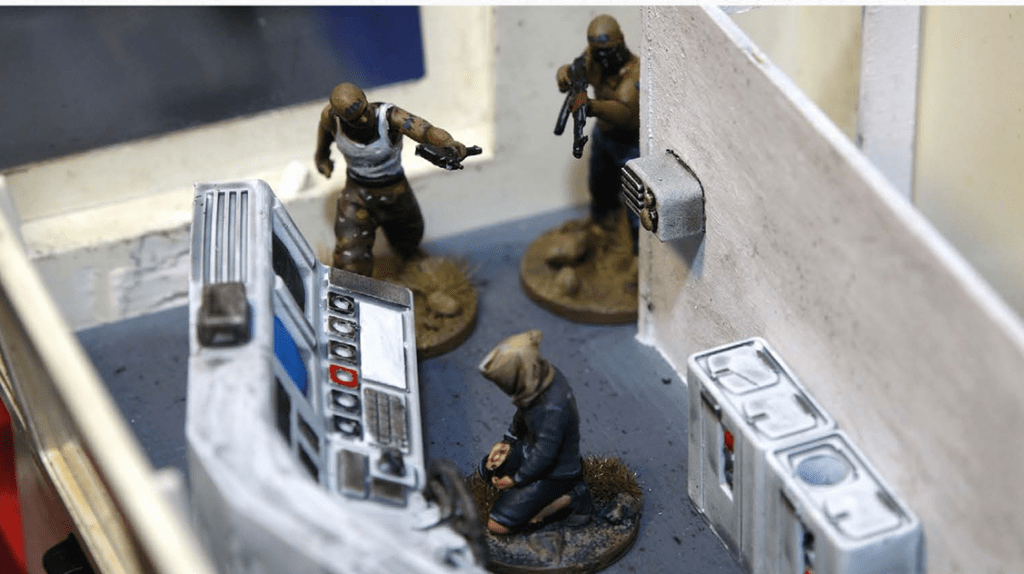
I really think they’ve struck a great balance here, with just enough campaign structure to make it feel like a progression but not so much it becomes a chore.
There’s so much here that I almost find myself at a loss for what to leave out. I haven’t written about vehicles yet. They’re fine. I don’t think I’ll bother with them for myself, but enemies use them and they seem like they’d be easy enough. Just roll on the relevant tables.
Oh right, the tables…
What Worries Me
It is a lot of game. The core rules are easy to remember and he fits more information than necessary onto the two page cheat sheet dedicated to the core gameplay, with full explanations of every action. I suspect you could make it a one pager and do just fine.
You then get into almost 40 pages of tables.
Okay, okay. I actually don’t think it’s that bad. You would not use all forty pages at one time and they are only here in case you don’t use the decks. But, as an experiment, I decided to map out how many of these pages I might use for the game I’m planning: a tier 2 force up against insurgents with all the extras in place. I’d need:
- Pages 169-170, covering all weapons in the game.
- Pages 176-177, covering the Tier 2 classes and their special rules.
- Pages 180-181, covering my support options.
- Pages 192-193, covering the optional Fog of War table (used once).
- Pages 194-195, covering the optional INFIL rules (used once).
- Pages 196-197, covering the spawn tables for Insurgents across all threat levels.
- Pages 198-203, covering the classes for all Insurgents, as well as the reinforcements tables, as well as their supports (basically filling white space with additional tables).
- Page 223, covering the optional vehicle behavior tables.
All told, that’s 19 pages of reference rules if you do not get the cards. If you do get the cards or print them yourself, it’s your unit cards, your two support cards, the enemy unit cards (featuring their AI on the back for reference), a fog of war deck you use once, an INFIL deck you use once, the threat level deck you cycle through, and the vehicle AI card. It takes up some space, but should be very easy to use and reference.
What I’m saying here is that you really need the cards.
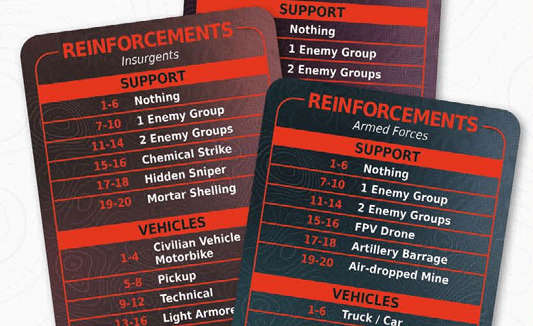
I don’t believe this is a problem overall. As I sit here mapping a turn in my head, it really does not seem that bad. I just want to note it because it’s the main concern I have for the rules. It’s not enough to stop me from wanting to play. In fact, the sheer options and variety on display make me want to play more. I really think they’ve done a great job here.
Recommendation
If you want a campaign focused modern ruleset for solo or coop play, which gives just enough meat to be interesting without wasting your time on needless detail, I can heartily recommend Haywire. If you want a simulationist toolkit that will let you play out super detailed real world engagements on your tabletop, you should look elsewhere. This is not the ruleset that will allow you to choose your exact weapon mods and decide on what background every operator has and how that affects their individual statlines. It’s not a number cruncher’s dream: it’s a playable solo/coop ruleset that really understands its mission.
What is that mission?
To deliver a highly playable, variety-packed modern campaign experience. Its core systems waste little time on unnecessary detail. Although the complete campaign framework carries considerable overhead, the actual tabletop rules appear focused and playable. I can see it flowing smoothly after your first game, no issue.
If you’re a solo wargamer, rejoice. You’ve found someone who really understands the mission. Haywire is a game worth your time.

 Small Scale Victory
Leave a comment