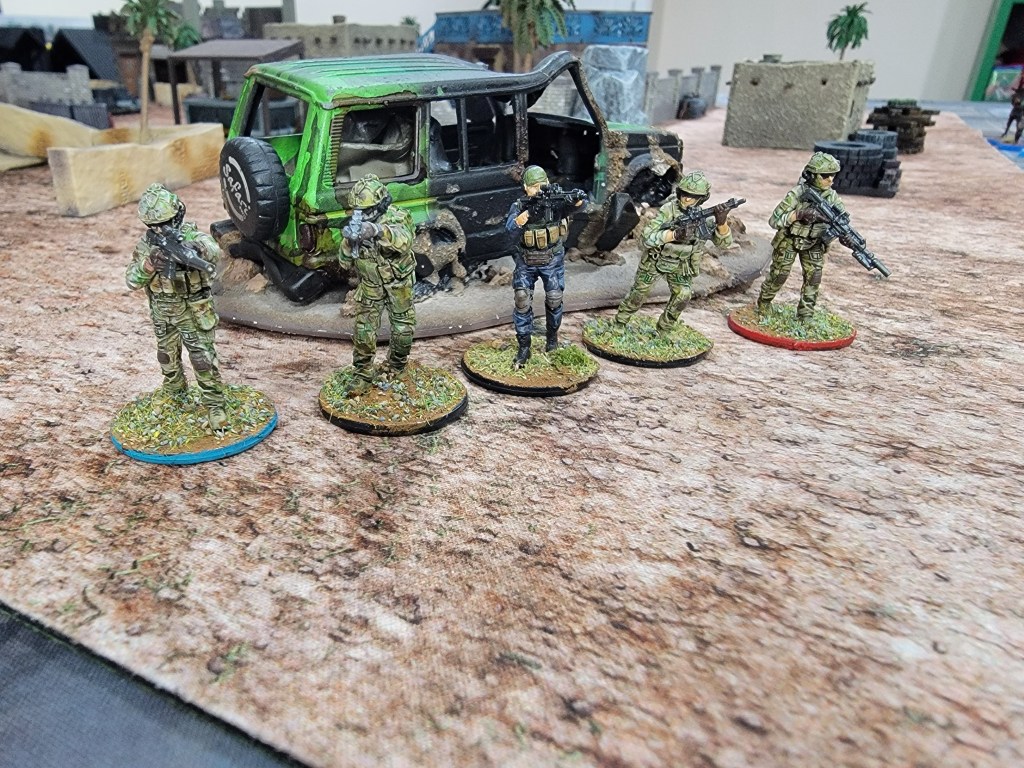
Mission design is always a challenging thing for any game. Asymmetric Warfare makes no effort at handing you a default mission set, but it does give notes on what to consider and ideas on how to begin. Recently, I posted my Mission Packet alongside a few other easy items to use while playing Asymmetric Warfare. I wanted to go through my thought process in how I generated these missions and a few things to watch out for when building missions for Asymmetric Warfare in particular.
Balance
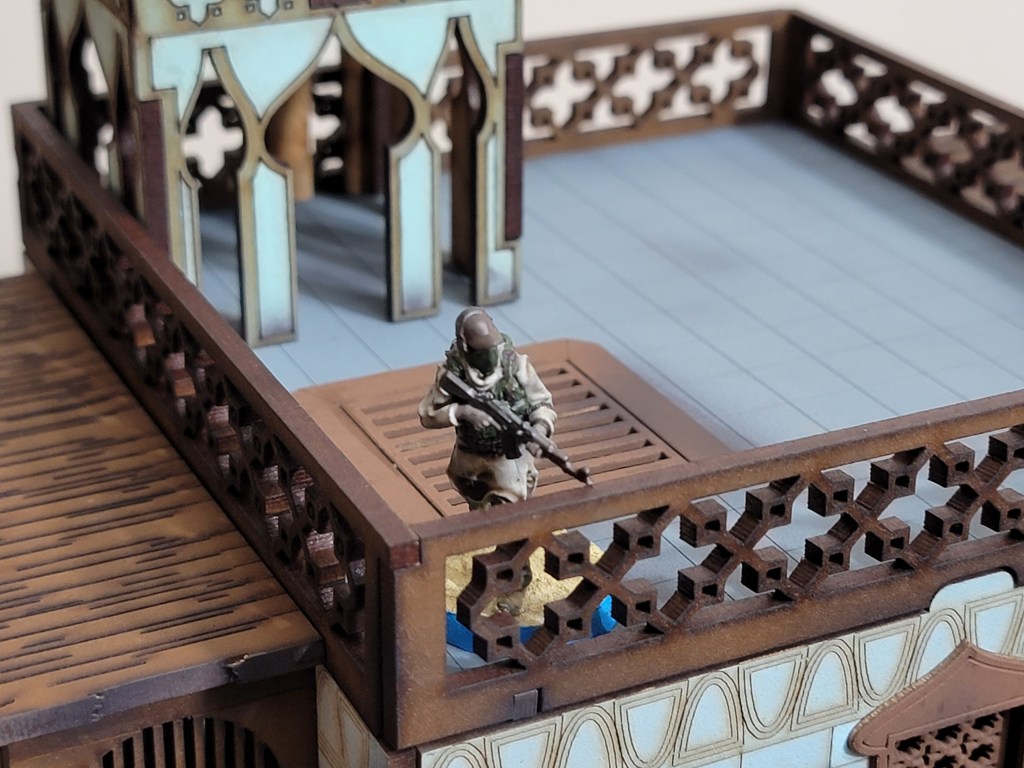
I don’t fully ignore it, but I don’t seek to perfect it. Balance is tricky, as real war is never balanced. I try to envision realistic missions and then track how they go wrong. Bad intelligence, bad luck, or just hubris can lead to battles being more balanced in real life (again, something no one ever seeks) so I try to start there with a narrative that gets me to the battle.
I also try to give players the space to make bad, but interesting decisions. Do you keep the helicopter overhead, risking your VP but giving you more firepower? It could be a great idea—it might eliminate an entire enemy team in one go. It could also be disastrous: it might crash and give your opponent more VP.
So while I consider balance, I recognize I can’t nail it down 100%. I instead try to offer interesting decisions, which make for interesting games. The helicopter above is a pain in the butt for the Local Forces, but it’s also an opportunity to score more points. Rather than feeling bad, it feels like an opportunity or challenge. This leads to players feeling like they have a good chance at victory and that’s all I really need.
Interesting Decisions
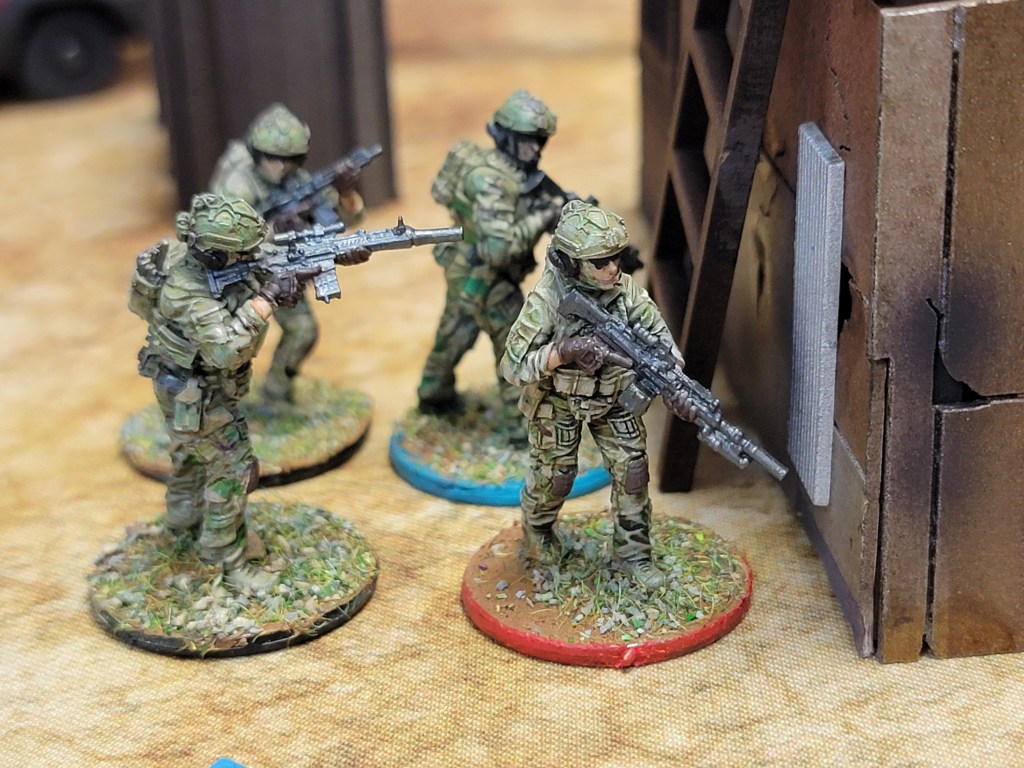
Some of this is down to the players and how they lay out the table. Make a good urban layout and the escape missions feel like a series of hard choices. Make a bland layout and it becomes obvious only one route works.
Some of it is baked in: keep the helicopter or not?
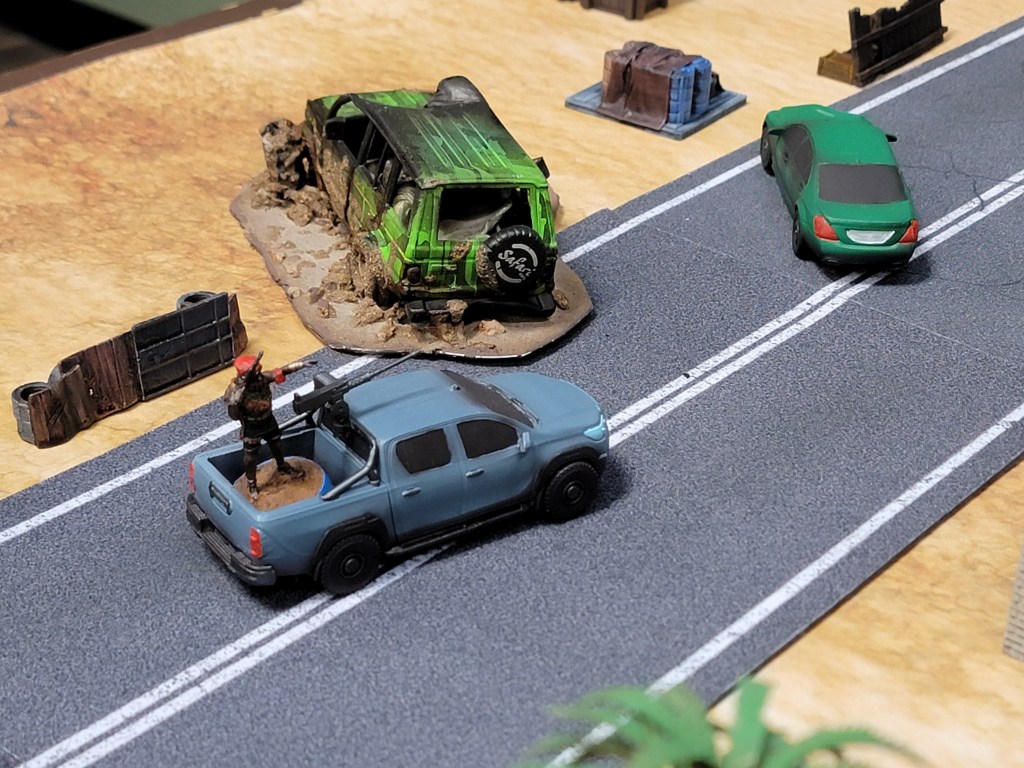
Some of it is just down to how you apply your resources to a situation. Do you run the Technical into the base, likely losing it, in order to buy time to blow a wall and get a shorter path to blowing up the building? Do you use the Technical from a position of good LOS to provide covering fire that allows you to jump a wall and run into the building?
It’s not always perfect. In the last example above, I now realize I didn’t give the defenders many interesting choices—just situations to adapt to. But I’ve ideally laid out a set of missions that you’ll remember a few weeks later just due to the situations they put you in.
Variety
Obviously, having good variety in missions is important. So really, how do I achieve it? For one, I’m not 100% sure I did. You could boil my missions down to: Destroy, Escape, or both. I’m being cheeky and simplifying quite a bit, but it’s fairly accurate.
I tried researching real missions, but I also tried thinking about how missions go awry. I traced a story in my mind of the conflict between two forces and tried to hone in on the smaller actions that occur: a vehicle destroyed en route with information, a target that needs surprise exfiltration, or a stolen vehicle needing recovery.
Force Structures
I give some suggestions for force structures, but don’t strictly put them in the missions. The reason is simple, again: everyone has a different collection. To get to the forces I do use, I considered a few things: my audience (players), my collection, my desired game length, and my desired complication.
Audience is simple: I have specific friends I’m playing with who will never treat this as a main game (nor will I). I can’t expect them to keep a million rules in mind or consistently deal with a large amount of weapon choice.
My collection is obvious. I own certain things and have certain preferences. That’s why the Mission Packet is framed around a PMC versus Local Forces. I own a lot of Local Forces and any old model can be part of a PMC.
My desired game length is 1.5-2 hours so we have room to chit-chat in a 3 hour timeline. I like my games to be a chance to socialize, so the game itself needs to be relatively fast to play.
My desired complication. To be clear, I don’t mean complexity. I mean the number of rules and small decisions I need to make that don’t really matter. Equipping my squad, I don’t want to be deciding what small arms I bring every time. Let me pick major choices—LMGs, support, LAWs, etc. I don’t want to pick between compact weapons or normal ones. I also don’t want units with a million items on them. For the most part, I run only with primary weapons—no secondaries aside from special weapons like LMGs and LAWs. This keeps things simple and fast moving.
Asymmetric Warfare – the Quirks
Night is big. Asymmetric Warfare does night correctly by making it pervasive. It touches cohesion, vision, movement, and probably a few other things. This makes Night Vision Goggles incredibly effective. In missions that take place a night, I try to make note of light sources that make things visible from a distance and I try not to keep the mission at night. Either the forces are moving into a lit area, or the sun is rising soon. This keeps the period of imbalance, but also the period of slow movement, short.
The quality of your units is important to consider. One Elite = Two Professional = Four Trained, etc. This means an 8 man elite squad versus militia will face 64 militia. You may have that many models, but do you have that much patience? That poor elite player has to wait through 64 activations each phase. That’s far from fun for most people. Not to mention the amount of rolling and missing the militia player will be doing—ouch.
Finally, I’d consider the Alert system. Unalert units are garbage that will die pretty quick if caught up correctly. You probably want to supply the Unalert player conditional reinforcements or just more models off the cuff. Easy enough, but you then need to consider something really important: is it fun to be Unalert? It’s not. It’s procedural. You need to make sure these periods of being Unalert are brief. Creating complex sneaking missions is cool, but not when one side has to spend thirty minutes just moving their units back and forth across patrol routes, effectively being a glorified AI. Use the Unalert status to allow one player to setup their approach, but don’t make it easy for them to accomplish the whole mission without alerting their opponent.
Concluding Thoughts
I had a lot of fun making the mission packet and I learned a lot along the way. It was a good exercise for me. It’s not perfect, as I’ve stated many times, but it’s a good start. I hope folks can leverage it to get themselves started in the game and tweak as they go to have a good time.
I still have more to learn I’m sure. I’ll continue to add missions as I think of them. Feedback is welcome, as I doubt this is the last time I’ll produce a mission packet and I’m certain it isn’t the last time I’ll write missions.
Now if only I actually played enough to keep up with this output…

 Small Scale Victory
Leave a comment