I’m not even going to try to rewrite this title: we’re calling it EKPS from here on. This is a read through impression of Ivan Sorensen’s EPKS, a low fantasy skirmish game where you play with anywhere from a dozen to a few dozen models per side. It is scaled similarly to Middle Earth Strategy Battle Game and you can expect me to draw some comparisons throughout.
First up: this is not a review. I have not played the game and cannot tell you if it is any good. I can only give you my impression after having bought and read the ruleset. This is hopefully useful to help bring a new ruleset to your attention or perhaps remove it from your wallet’s consideration depending on how this comes out. I won’t bury the lead or my bias, either. I like the author and his work, which inclines me to like this. Overall, I walk away from my read through genuinely wanting to try out the ruleset.
Ivan is responsible for both Five Parsecs from Home and Five Leagues from the Borderlands, making him the author of my favorite solo wargames. He has a variety of other rulesets I have not tried. He’s downright prolific in his writing and I tend to find what he puts out quite intriguing. This is my first real look at a non-solo ruleset written by him.
Production Value
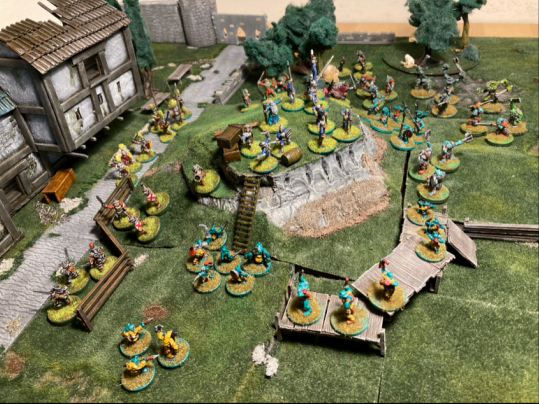
This is sold as a no-frills PDF with the basic chapter links in place. It’s functional, light, and lacking in flair or photos. All images in this impression will be from the book to convey the idea. This is an indie effort on his part and clearly done on a low budget. I’d like to have seen more photos of miniatures or a few diagrams where it made sense to use them, but I found the rules easy to read, cleanly written, and easy to internalize based on how they were presented. It’s an odd one: good job on the technical side, very poor job on the flashy side.
I’m not huge on presentation: I admire great presentation but I’m mostly worried about readability, comprehensibility, and searchability. Don’t say that three times fast. I feel that in those categories it is a solid ruleset.
There are some issues: I think the tables could be better displayed for clarity. The usage of “Independent Model” instead of “Hero” is at times confusing. You have two major unit types: groups and independent models. It’s not hard to envision where this goes wrong.
It’s also so barebones that I fear for some folks it might hinder their reading. It looks boring. Again, this doesn’t bother me much but I think it’s worth noting.
The Elephant
The elephant in the room here is, again, Middle Earth Strategy Battle Game. It’s tempting to boil this ruleset down to “Lord of the Whatever-You-Want” and and call it a day, but that would be silly and rude. I believe it’s safe to say Sorensen is inspired by MESBG as evidenced in the basics of the combat system. Two models meet, roll competing fight values (D6 + Fight Value) and compare to see who wins the fight and gets to do harm. I don’t consider this a bad thing: as a professional wargamer I value the “theft” of good mechanics. It’s obviously not actual theft, it’s just recognizing a great system when you see it.

Here, it continues to be a great system, but the comparisons don’t quite stop there. Heroes (“individual models”) get Sources of Power, which give them a limited resource to spend on capabilities granted by the power source. For example, a hero with the Expertise power source can add a D6 to any non-combat check in the game or cross/scale any piece of impassable terrain in exchange for a point of his power source. This echoes the notion of a limited heroic resource used to do limited heroic things. I’ll revisit it down below under “Stuff I liked.”
The Basics
This is a ruleset where you alternate activating either heroes (“individual models”) or groups of 3 or 6 models. They get one action, then play passes to your opponent. Models do the expected actions. When models contact, they fight man-to-man, rolling competitive fight rolls to see who wins.
It has no true setting. You could play it historically, using the basic human factions provided, or play it in a low fantasy setting. I think the latter shines, as it gives access to a reasonably diverse magic system, but if you play historically you could still use the Sources of Power system to give your historical heroes extra capabilities that don’t necessarily break immersion. I contend that a ruleset always dictates a reality and I’d say the reality here is, again, a low-fantasy setting thematically grounded in real world medieval combat.
Monsters are present, but deemphasized. This is a ruleset for the models that go on 25mm or 32mm bases. Monsters don’t even receive points values.
Narrative play is at the forefront, with skirmish generation tables that put narrative reasoning first. The author strongly recommends campaign play.
Stuff I Liked
A lot, actually. I liked a lot.
I like how the heroes in the system work! Power sources are streamlined and easy to follow but can be powerful in a game, especially with some narrative flair. Imagine a heroic adventurer type with a grappling hook and perhaps some tools to break into a locked area (okay, imagine a thief). He has the Expertise power source and walks up to a castle wall, spending one point to scale the wall, then running over to the door and spending another point to add a D6 to his check to unlock said door and break into the gatehouse to open the gate! In fact, he doesn’t just add a D6. The D6 can be added in any way you want: add it to the first D6 rolled, use it as a second success where appropriate, or take the higher of the two rolls. You get to use that dice however you see fit in that non-combat action.

Take the Divinity power source and bless your warriors, giving them tokens used to do rerolls–or give them a buff that allows their next dice roll to be rolled three total times, picking the best of the three results.

Take Leadership and activate models out of sequence for a free activation. You’re getting the idea.
Heroes also get classes which come with various small benefits, like fighters rolling 2D6 in combat and picking the highest dice. In exchange, they will never outnumber an opponent–it’s dishonorable/hurts their pride (good/evil reasoning).
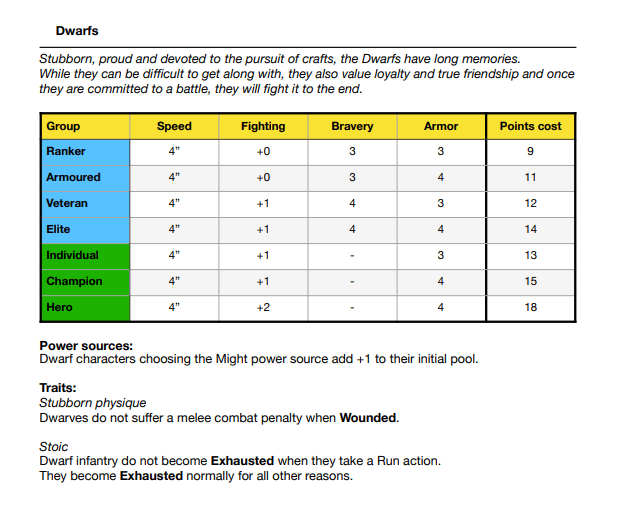
I also like the sheer number of fantasy races on offer: 15 to start with. They don’t vary dramatically, as all models in this game are generally man-sized, but it’s nice to see the variety of options. Ratmen come in groups of 4 and 8, representing the horde. Dwarves lean into the Might power source and take wounds on the chin.
The ruleset also doesn’t limit your army to one race. Mix and match at will: it’s your setting, after all. I’ll have my dwarf champion leading a ragtag band of elven rankers trying to rebel against an evil goblin king and his bewitched orc hordes, thank you.
The core combat is simple, clean, and rewards positioning. I like it. It distinguishes weapons just enough for interest, with emphasis on melee. Missile weapons have limited ammunition, which does feel a little clunky to me, but it helps to limit them in a reasonable manner. I am a little more neutral on that.
The narrative emphasis is strong and I intend to step through the skirmish generator in a section below. He spends a lot of time explaining potential campaign methods and mindset and I appreciate that. This is definitely a ruleset that wants to reward investment–which is another way of saying…
Things I’m Wary Of
I’m a little worried that this is a ruleset that really demands a lot of its players upfront, similar to an RPG. This might appeal to you: it does to me in principle. The issue is that it’s hard to get someone else willing to go through the world building, army creation, and storytelling. This is not a pick up game in my mind–it’s a game that wants you to invest time upfront to get the most out of it. Now, it doesn’t ask a lot relatively, but it’s more than most people are used to.
I actually dislike limited ammunition which I mentioned above. I can appreciate the intended effect but I don’t like having to track stuff like that and it does limit the styles of armies you can bring. You’re unlikely to bring a wood elf army full of archers now, if that’s what you had your heart set on.
Alternating activation is something I’m basically famous for disliking. I feel it’s slow by its nature and does a poor job of recreating combat. I can stomach it in small skirmish rulesets, so I’m somewhat forgiving of it here. It’s not something you could write out, either–several abilities break turn order, like with the Leader power source. Scouts are useful because they’re not expensive and allow you to effectively “Pass.” Speaking of, there is no built in pass mechanism. Alternating activation, no real reaction system (except the simultaneity of combat), and you can’t pass. Many people will walk away right there.
The lack of robust monsters is somewhat disappointing. I’d like to have them more “built in.” Personally, I’d likely play out a system of “We play XXX points and get a monster each.” Even then this isn’t a ruleset where you have a hero charge in mounted on a dragon. That’s not terrible but it did keep me from playing the ruleset with my son, who really wants his lizardman on tyrannosaurus to be a regular part of our gaming.
Alternating activation does play to a strength, though: you really need to keep your troops together and care about positioning. It’s not hard to envision a group of six models surrounding one or two of your models caught out slightly too far from the rest of their group and then pounding them flat while their buddies… er… await their turn. This also happens in systems with full army movement, so I can’t fully blame it. I like that it forces you to worry about positioning and take up realistic formations. I’d have liked to have more ability to break sequence in these cases to respond, like by having a leader nearby enable some form of “React to charge.”
Skirmish Generator
Before closing out, I’d like to roll dice! The game features a Skirmish Creator which allow you to setup a battle. I rolled a few dice and here’s what I got:




We meet near a river crossing, which marks the borders between our lands and is used as a common trade route. I’ve sent some of my best men to take control of it so we can charge taxes from you in the future. Boom, scenario. I love it!
Conclusion
I’d consider long and hard if you have someone who wants to sit down and make a small world with you. I’d also consider your feelings about alternating activation and whether that small world will really line up with such small skirmishing. If enough aligns for you, I think this is a ruleset worth buying and reading. I said above I won’t be playing it with my son, but I might anyway! I just have to convince him to leave the big boy at home and only use it for special battles.
Sorensen is, to me, an interesting developer. I like his work and am inclined to give him credit. I really stress that and I further stress that this is just a read through, not a review. Take my personal bias into account before you drop $20–but if you do and you find the ruleset middling, at least you supported someone who is out there really trying to put out new content. You get a simple set of skirmish generation tables and some great thoughts on campaign play, if nothing else.
Elf Knyghte Pyke Sworde can be found on WargameVault. If you don’t give this one a try, I do encourage you to look at his other work and see if anything grabs you. I think Sorensen deserves more credit. Nordic Weasel Games is out there really trying to build worlds that are fun to play in and encourage you to be creative. That’s worth something to me–and it might be worth something to you.
 Small Scale Victory
Leave a comment