
Disclaimer: this is not a review of Black Iron Sigil. It is a read through impression only and should not be taken as a review. It’s somewhat off-the-cuff and really just represents an initial impression. My goal here is to give an idea of the ruleset, my own thoughts on it at a glance, and an impression of whether or not I’d personally like to try it.
Black Iron Sigil is a recent release that immediately caught my eye. See, I actually like the general grimdark fantasy historical vibe—it’s neat. It’s a fun opportunity to paint some creative, dark, moody pieces and try out some cool rules. The problem for me is I have not found any systems that I really like. They either feel bloated, have a different focus than I’d like, are half-baked, or come across as a little too weird.
Black Iron Sigil seems to strike a good balance. Let’s go through why, piece by piece.
The Generalities
This is a miniature agnostic larger sized wargame. You run around 70+ miniatures per side in units ranging from 6 to 18 models in an alternating activation system with enough twists to keep me intrigued. The game is clearly aimed at being high lethality, with miniatures dying off quickly to represent the brutality of its world. Its mission set is built around both killing and owning terrain. It feels very focused and in general vibe it comes in a similar world vibe as Sludge, Trench Crusade, or Turnip28.
The Theme
The theme here is dark, moody, and late medieval. You play an off-board sorcerer of sorts who dedicates themselves to a path. These paths are themed around the human body and generally gory: bile, marrow, blood, and so forth. This is a dark, oppressive fantasy world where humans killed all your standard fantasy races and now fight each other in an unforgiving, bloody world that sounds rather dreary and hellish. Again, grimdark.
The rules do a great job of reinforcing this theme, from the terrain being very focused on swamps and dead trees to the spell casting being themed around the human body. I cannot fault the game for really pushing its theme. It even seems to successfully bleed through into the mechanics. Color me pleased. At first blush, I can tell what world the author seeks to build on your table and I do actually get the impression that the rules will build it.
Finally, I think that while the theme is clearly dark, it’s not overkill. Sometimes with these rulesets things become a little too out there or specifically strange (looking at you, Turnip28). Here, I think you’re left with enough creative freedom to tune to your liking.
The Activation System
It’s alternating activation but I like it. Go figure. Here, you alternate activating units to perform two actions, after which they gain a fatigue token, preventing further activation. You can choose to activate a second unit if you want (known as “Retaining the Initiative”) but that second unit will only get a single action and then gain a fatigue token.
Instead of activating a unit, you can choose to issue new orders, which refreshes your fatigue across your force but does not allow you to activate. Here, we have the ability to repeatedly activate a small subset of our force so long as we’re fine with sacrificing action economy for it. I find that interesting. I could see a situation in which I repeatedly activate my artillery as an attacker, surrendering momentum of my attack to soften my opponent.
The next thing you can do is Arcane Channeling, which refreshes your ability to cast magic. More on that later, as the game has a clever magic system I rather like. Finally, some spells take up your whole activation.
All told, there’s just enough here to make it interesting, with a lot of your concern being focused on battlefield momentum and choosing when to surrender some amount of initiative to refresh your capability. In theming, this feels like an intense battlefield that will fatigue you and slow you down as you go. I like it.
The Units
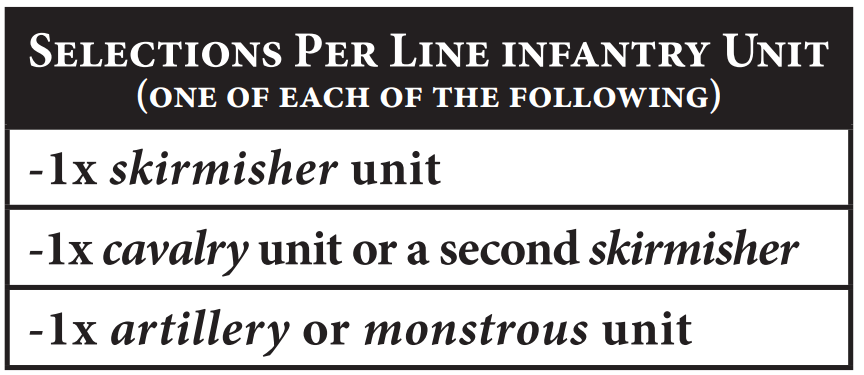
I won’t say much here. They’re acceptably diverse without being overcomplicated. As this is just a read through, I can’t attest to whether they’re well pointed or all useful or what have you. The system does want you to have a lot of line infantry, which are the larger (12-18 man) units. Units come as a default quantity with an option to bolster, so for instance Men at Arms come with 12 models, but you can buy 6 more for 6 points. To bring anything that is not line, you must have a line unit. So it’s a 1:1 ratio of line:other units. It is a ratio of 1:3 per the following table:
An example 100 point (standard size) army I’d consider:
| Unit | Type | Model Count | Unit Quantity |
| Musketeers | Line | 12 | 2 (24 models) |
| Men at Arms | Line | 18 (with bolster) | 2 (36 models) |
| Stalkers | Skirmisher | 12 (with bolster) | 1 (12 models) |
| Knights | Cavalry | 6 | 1 (6 models) |
| Abominations | Monster | 3 | 1 (3 models) |
The above is probably not an optimized list. I just looked at a few miniatures on my shelf and put something together. Conceptually, I have some shooting to pressure the enemy but mostly I’d be aiming to setup a charge and dive right on in. Men At Arms anvil, Knights and Abomination hammer—that sorta thing. Overall, it is 81 models. This is no small task and is important to note, as I think most people may be put off by this quantity of miniatures to paint. I’ve messed around with a few more lists, built in different ways and I generally land around 60 models. I believe you could do 50 models in a list on the more elite end and the book does have ways of sizing down to 50 point matches, which would cut this painting burden in half, but know that the ‘full’ sized game can be quite a few minis.
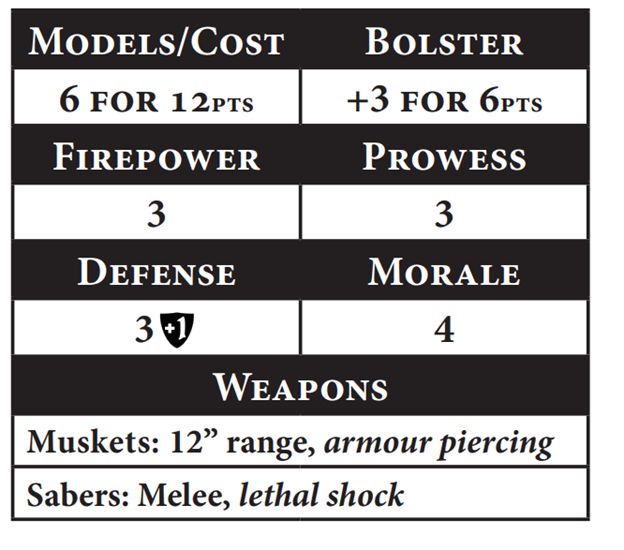
The stat lines are at least simple enough to understand. Armor (listed as the ‘+1’ under defense) plays an important role, with certain units being armor piercing, as shown here with the musket on this unit. Firepower is your shooting strength, Prowess is your melee strength, and the rest is straightforward.
One final note on the units: I love how monsters take a magick dice to control. So having monsters in your force requires you, as a spellcaster, to continuously focus some of your magical energy to make them do anything. Fantastic theming and tradeoff.
Combat
Combat, again, appears quite lethal. Units roll to hit based on a charge that compares their Firepower or Prowess to the enemy defense. Based on the difference, you roll on the following chart:

That may look intimidating but it really isn’t. It’s a simple sliding scale. Taking the stat line from above, assuming that unit attacks an identical unit, you compare the Firepower (3) to the Defense (3+1, but the gun is armor piercing, so just 3). That’s equal, so it’s a 4+ to hit. Done. Now, if they engage that unit in melee, it’s 3 v 4, which is down by one, so 5+ to hit.
If you hit, you kill. If you kill, you roll against their morale, which factors shock inflicted within the combat as well as men killed. Beat their morale, hit them with a negative status effect.
Oh, and when rolling to hit, if you roll a 1, you take attrition, which is your own models dying. So your dice kill you, too. Looking through the rules it seems you’ll often hit on a 5+, which means you’ll often kill someone 50% of the time on every dice rolled, whether it’s yourself or your opponent. Again, highly lethal. This is probably the biggest sticking point I can offer, after the quantity of miniatures needed to form an army here.
The Magick
The whole reason I bought these rules: the magic system. You start the game by rolling 6 dice and placing them on your board of magic spells. Your board is based on the ‘lore’ you chose. You assign those dice to the board and that’s the spells you have access to in the game. Each time you cast, you take the dice for that spell off. If there’s no dice on a spell, you cannot cast it.
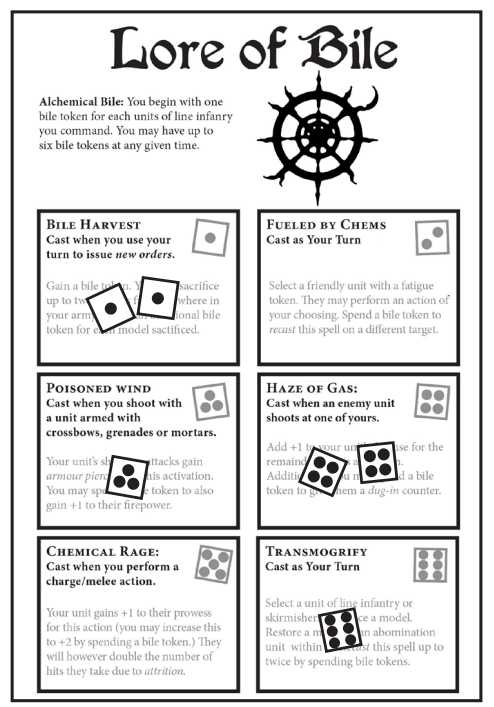
You get more dice through Arcane Channeling, which eats your full turn. There you go. Simple, but effective. Spells appear to be really important for getting the upper hand and I get the vibe that you’ll really feel important as your army’s spell caster. I am, overall, a fan. Each lore also has a way of building up special tokens that get consumed by spells to do extra stuff. In the photo above, Alchemical Bile gives you a token for every line unit you control start of game. Some of the others do things like giving you a token each time you do not activate a second unit. It’s a neat idea, adds flavor, and brings some interesting adaptation and decision making to the game. This right here really grabs me.
The Scenarios and Campaign
I appreciate that the author saw fit to include both competitive and narrative scenarios. The competitive scenarios appear well constructed, with a focus on controlling special areas on the board, known as circles of power. To claim the points for them, you have to spend an action (Domination) to earn the VP. I love this idea, as it sacrifices action economy to earn points. From a competitive standpoint, this is actually a really cool idea and I think it will make for some really fun situations. It’s not unique, I’ll grant, but it gives you a good idea of the author’s focus in the competitive design.
The narrative scenarios on offer are varied and mostly amount to vignettes with fun special rules. I rather like them and I think they are enough to get any player thinking about their own narrative scenarios they could build. The main thing holding back “Narrative” for me here is the lethality of the game—but I think you could think of your narrative as being focused on your spellcaster, which is your offboard avatar.
The campaign itself emphasizes short campaigns but lacks any real mechanisms for advancing units. I actually really like that the author acknowledges that units die quickly, so such advancement is not especially possible. There is one light rule for advancing units that survive but it’s clear that you really should not expect it to happen very often. I’d like to see a system that perhaps focuses on your spell casting, helping to tell the tale of you as a spellcaster in this world, leading armies to their demise for the sake of whatever higher purpose is worthy of such sacrifice.
So in essence, the campaign system is very light, more of a guideline, and could probably just not have existed in the first place. I’d love to see some expansion of it in the future, focused on your spellcaster. I don’t like campaigns where your units level up and change over time—that becomes a ton to track. Having your spellcaster perhaps gain new spells or more control over their spell dice would be a cool way to advance and up the dramatics across a 6-8 game campaign.
Conclusion
So the big question: would I play this game, assuming I could get a suitable opponent lined up?
Yes.
Upon first impression, this ruleset reads cleanly and appears very well focused in its purpose. I think it has a clear design goal and chases it throughout. I admire it, honestly. The main issue for me, aside from the logistics of getting an opponent and armies prepped, is the lethality. I believe it fits the world, so I’m not entirely turned off, but I often find that high lethality can work against a system’s sense of place and devolve it into pure offense. That’s just an impression, though, and I know I can’t actually suss out the end effect without playing the rules. Everything else about it has me convinced.
Should you buy and read these rules?
Yes. It’s $3 for goodness sake. This is absolutely worth the purchase and flip through. Read the magic system alone and be content. I think Black Iron Sigil is a game worth looking at and giving a try, especially if you have some armies around that may already work well enough for it. I believe I can compose a few myself using some of my armies of Frostgrave cast offs or my medieval armies and a few monsters. It’s getting the opponent lined up that I’d struggle with, otherwise I’d at least give it a shot.
I appreciate the focused design, sense of place, and theming throughout this ruleset. If the theme and game size appeal to you, give it a shot. I’d love to see more games like this get more attention. They really deserve it.
EDIT: I have updated my interpretation of army building as I made a vital mistake in my read through. After a comment made by a user below, I went back and added in the table that shows how an army is built. The 81 model list was made in error, though I do feel it is a list I might run. It is not representative of the correct army sizing for the game and I believe a real army would normally be between 50-70 models, based on a few builds I’ve thought up.


 Small Scale Victory
Leave a comment