Purpose and Taste
I take reviews seriously: they influence people toward or against a ruleset and can cost companies money in a hurry. Wargamers are often very discerning in their tastes and look for opportunities to reject a ruleset so they can take one off their plate. The statement “Ah, what a shame–I was hoping it’d be good” paired with an internal sigh of relief is a common experience for most wargamers, I’d think.
The purpose of this review is to explore this ruleset based on my core theory: a good design has a clear underlying objective. I want to calibrate your expectations and give a qualified recommendation. I don’t want you wasting your money but I also don’t want you missing an experience you would genuinely love.
First step in calibration is my own taste. I tend to like games that build a world model (thank you, Paul Bussard) with a clear vision of the world they wish to recreate. I can stomach some oddities along the way so long as the end result is a system that really models a sensible world and allows you to pose interesting challenges. I enjoy the following games that I think are relevant to why I enjoy this game:
- Chain of Command (V1 and V2)
- Midgard
- Middle Earth Strategy Battle Game
- Warhammer 40,000 4th Edition
- Marvel Crisis Protocol (several years back–no idea on modern updates)
- Star Wars: Legion
Add to this that I spent thousands of hours in Morrowind, Oblivion, and Skyrim combined (far less in Skyrim specifically) and actively play The Elder Scrolls Online. I fondly remember rolling up characters in Morrowind and actually role playing a story for them. I lived in these worlds. It cannot be overstated: I am a fan of The Elder Scrolls. Put a whole box of salt in front of my opinion here, not just a grain.
Finally, for context: I’ve played this game primarily as a competitive game over the last two to three years. I’ve played north of 40 matches, by my estimate, and own three factions I’ve played repeatedly over time with a fourth in the works. I’ve thought about this game a lot.
I aim to waste as little of your time as possible, so without further ado:
Bottom Line Up Front (BLUF)
So what’s the clear design focus here?
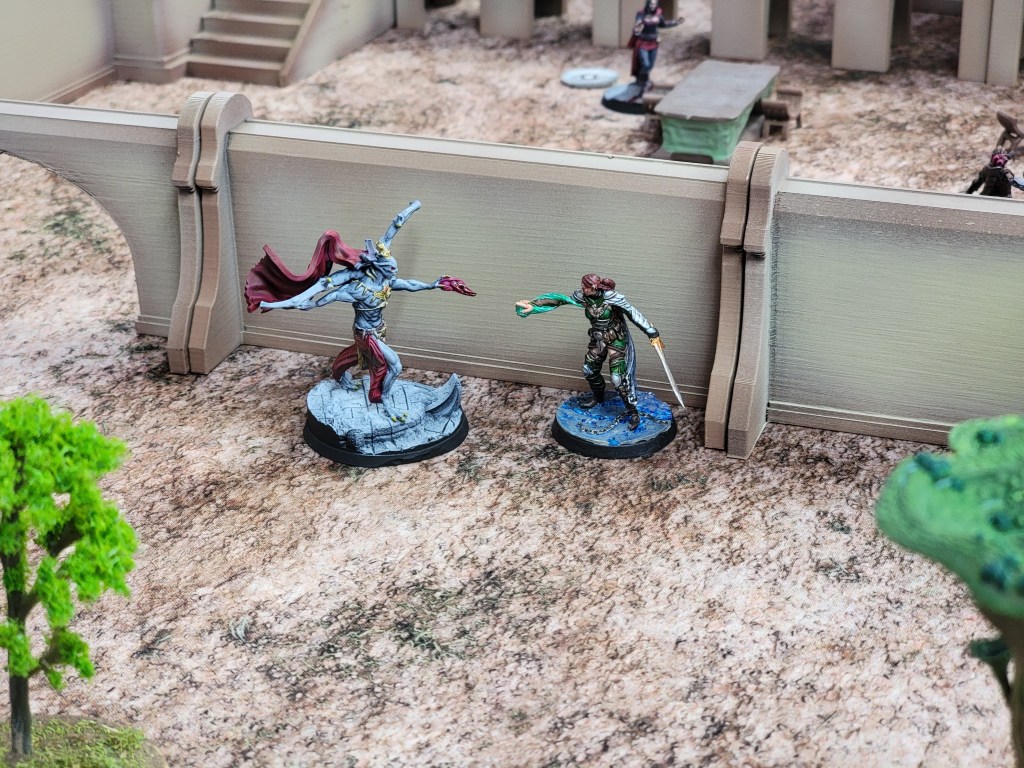
Elder Scrolls: Call To Arms is a solo, co-op, and competitive game that wants to recreate detailed small skirmish (8 or less models per side) within the realm of the Elder Scrolls focused on the characters we build and interact with in the games, specifically Skyrim at this moment. It clearly desires light RPG level depth of customization and purpose. It seeks to vary win conditions dramatically from one battle to the next, both in terms of objectives and in terms of how your party succeeds and what it pursues. It seeks to be varied, dramatic, and hard to predict.
Or, in a sentence: it wants to be a detailed small skirmish game with as much variety in build, purpose, and events as actually playing The Elder Scrolls as a video game.
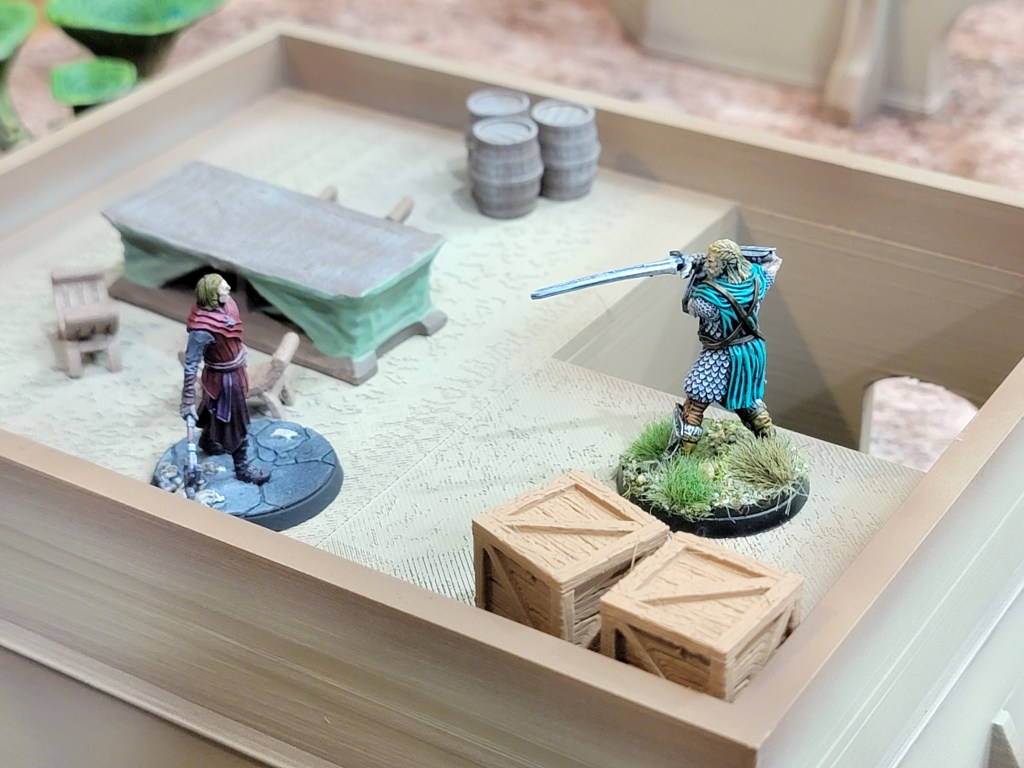
It succeeds quite well, with caveats. Games are dramatic and unpredictable with varying win conditions. They really are. A thoughtful player wins more often than not but the game’s systems can be swingy and it’s entirely possible for a stealth archer to effectively head shot your leader in a single roll or for a new quest to pop up that fits your opponent’s plan perfectly. In fact, I hate to tell you: if you want to just machine gun the game and win you can in fact just bring a bunch of stealth archers. I would not play this game with total strangers or without some business rules in place to stop people from “breaking” the system. It’ll at least bend when not played in good faith, I assure you.
The other side of this is that you can build parties with totally different goals from your opponent. This may favor some battle types over others but it means every battle can really be different. My Dark Brotherhood gets to place contracts on three enemy models on the board and earn 2 VP per each of those models I kill. I can select enemy player or AI models. In PvP games with additional AI opponents, I might shape a strategy around killing my opponent player or killing the AI itself. I genuinely choose based on the other objectives: if I want to open chests, it makes sense to select the enemies near chests, for instance.
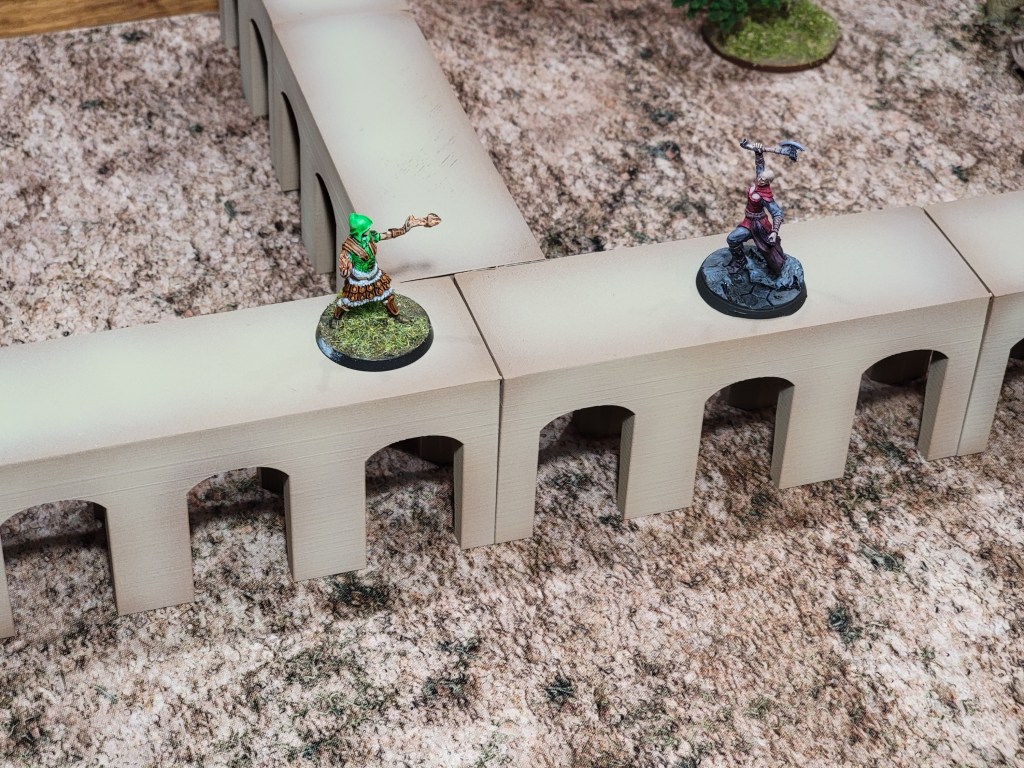
The game is very detailed and you really can make your models feel unique thanks to how Elder Scrolls as a setting handles magic. It’s a very high magic setting, so you can readily produce a character with sword, shield, and fireball. You might sketch out an archer with illusion magic that makes it easier to achieve his sneaky goals, or maybe just a big ol’ brutish orc with a two handed axe and a pile of potions. The game models the world and you get to build in it through your heroes.
That detail means you’re using cards to customize your characters, so in comes character cards with attached smaller cards–up to five on each. In a 300 Septim match, you can expect to have 3 heroes with these smaller cards, followed by up to 5 followers with poker sized cards and no attachments of their own. The cards are absolutely necessary, because every character has a litany of stats and you’ll reference them fairly often. When constructing a party, Call to Arms feels like a light RPG.
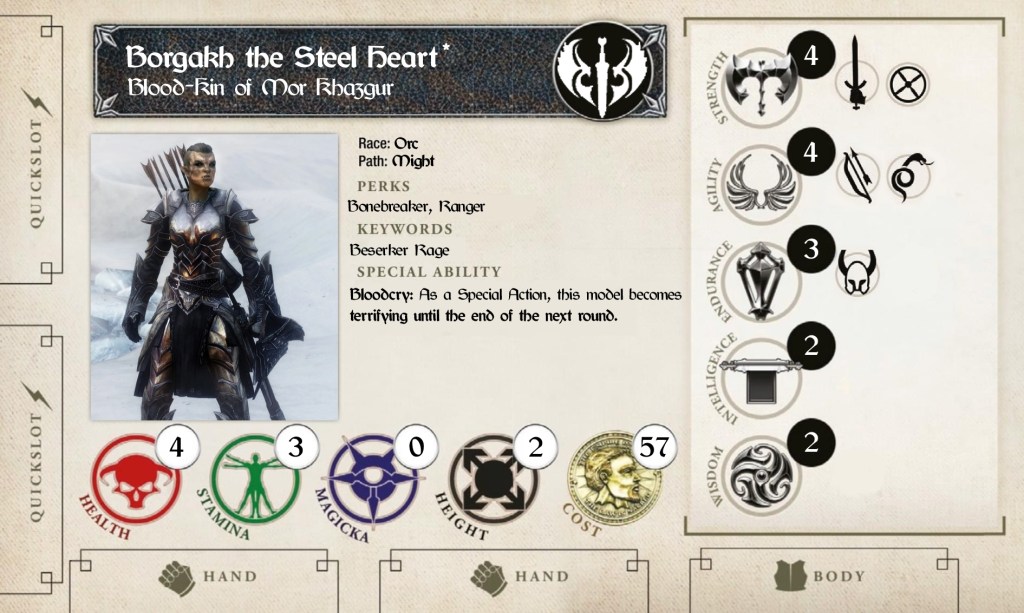
There’s tokens–a fair number of them–to track statuses. There’s decks of cards that make tracking what treasure or trap or event you just found/triggered really easy but also means more setup prior to any games. It can feel fiddly at first until you adjust, then it just becomes something you put out during setup and only ever modify as much as you really want to. The same decks of events and quests can readily be used across matches for months on end until you tire of it and produce a new one. Or, if you’re like me, you just throw everything into one big deck and ignore it when you draw something that doesn’t fit your map. Easier, simpler, and more varied. Also, again, necessary. I can’t see this design functioning without them.
A final, important caveat: you don’t make your own characters but instead play characters from The Elder Scrolls: Skyrim with few exceptions. Sorta. The most recent update as of this writing allows for unique character creation for campaigns, which you could readily take and apply to the normal game, though not officially. This was a huge turn off for me at first and had I not powered through I would have never explored this game. This latest update is a positive thing to me and I believe you could use it to reasonably hack together your own forces from other parts of the world–though this requires some creativity on your part and isn’t the obvious use. I intend to build a Morrowind themed set of ordinators while calling my opponent an “N’wah” repeatedly. Just know this will take some doing.
I caveat all of the above to say: if you like the idea of an Elder Scrolls skirmish wargame set in Skyrim and don’t mind the swingy dice (or, like me, actually enjoy them), you should probably get this game and get the tokens and cards setup and organized immediately while you’re in the honeymoon phase. Do that and you’ll find a game that delivers a varied experience match to match, in which one party really can feel utterly different from another with a different approach and tactic to victory.
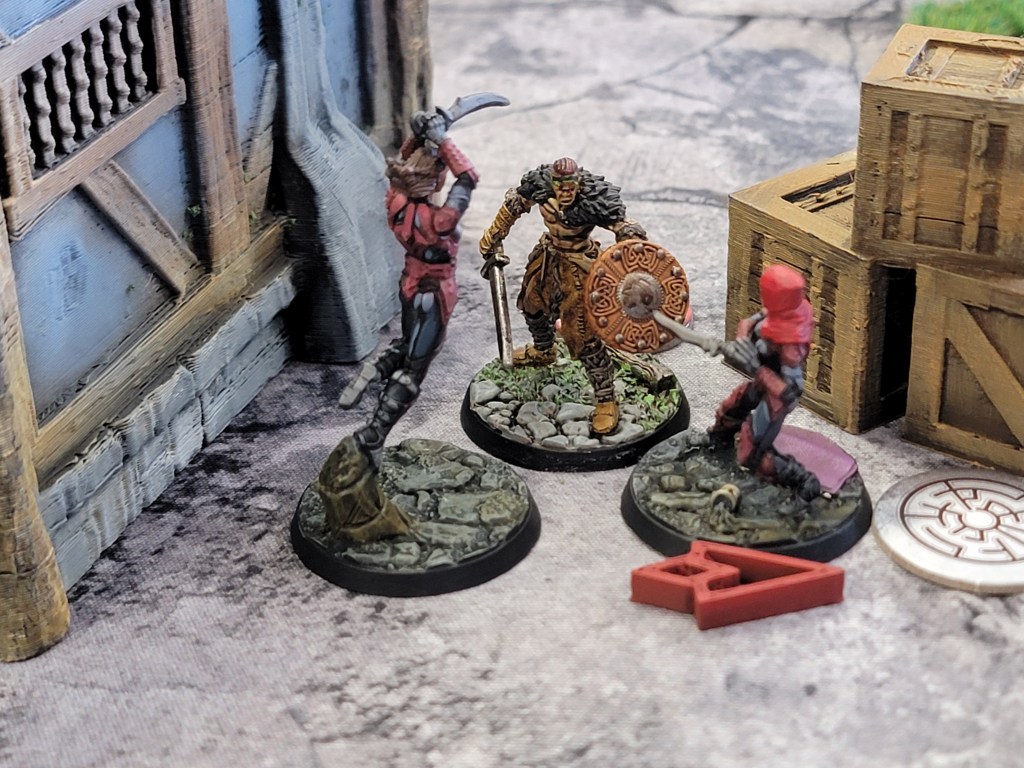
It’s not perfect but if you really enjoy your Elder Scrolls lore, the game does a great job of putting it on tabletop–genuinely. The fact that you can play solo or coop also means you could play without an opponent (for indeed, finding another true-blue Elder Scrolls fan can be difficult) or play a campaign that blends all three modes of play. There’s real variety here, but you need to be ready to put in the work up front.
I consider this one of my favorite rulesets and I’m thankful I put that work in to make it work.
Okay, now for some detail.
The Game Itself
Feels weird to be this far in and now explaining the mechanics, but here we are! Elder Scrolls: Call to Arms is an alternating activation small skirmish game. You pick a model, perform two actions, and turn control back to your opponent. Models can do all the standard stuff, plus pickpocketing, looting, sneaking, and generally anything you can think of doing in the Elder Scrolls games.
And you will do them. It’s one of my favorite things about this game.
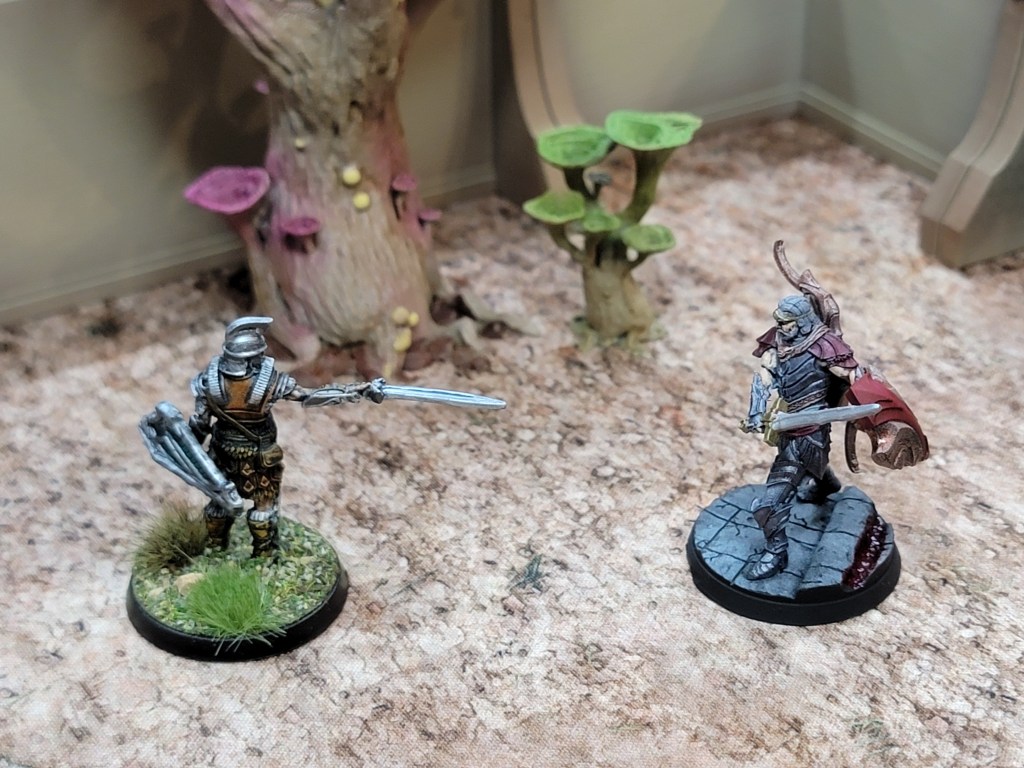
In one match, your objective will be to discover and “solve” puzzles around the map via an intelligence based dice roll. In the next match, you might be focused on opening chests–go thieves! In the next match, it may be a race to kill the most monsters. In the next match, it might be just straight up murdering each other. Your party will need to have a plan to address all of the above. No one party is amazing at everything and you will find yourself really needing to think about how to solve problems.
Take the straight up kill-the-enemy for example. My Dark Brotherhood are actually terrible in direct combat. They want to sneak up on opponents and kill them. In a straight up fight, I’d rely on my two archers to pick away at the enemy while avoiding any balanced fights. I’d use my faction ability to place contracts on my opponent’s two weakest models and one strongest model. This is to make him hesitate around using the strongest model, while giving my archers easy targets to get extra points from.
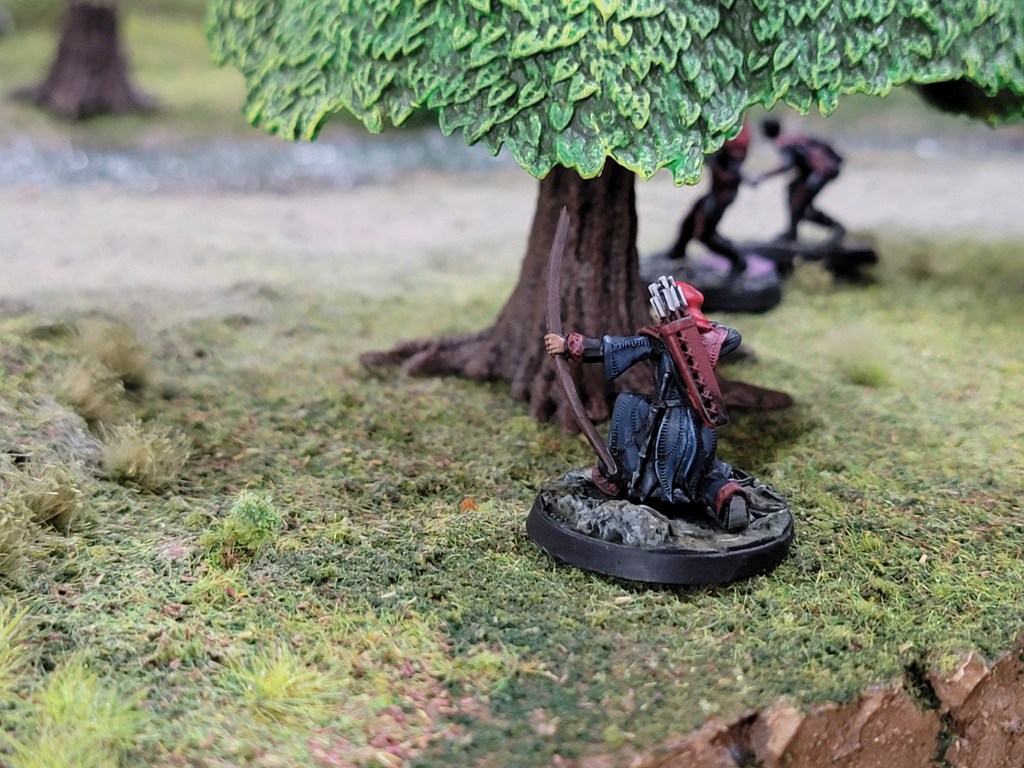
My Vampires, though? They’d just kill the enemy–no problem. Go, my gargoyles!
I’ve mentioned previously how important stats are in the game and even mentioned an intelligence roll above. Every card has a set of statistics that get used throughout the game. After a single playthrough it’s not hard to remember what statistic governs what roll. Agility obviously does your sneaking. Strength clearly does your hitting. So on and so forth.
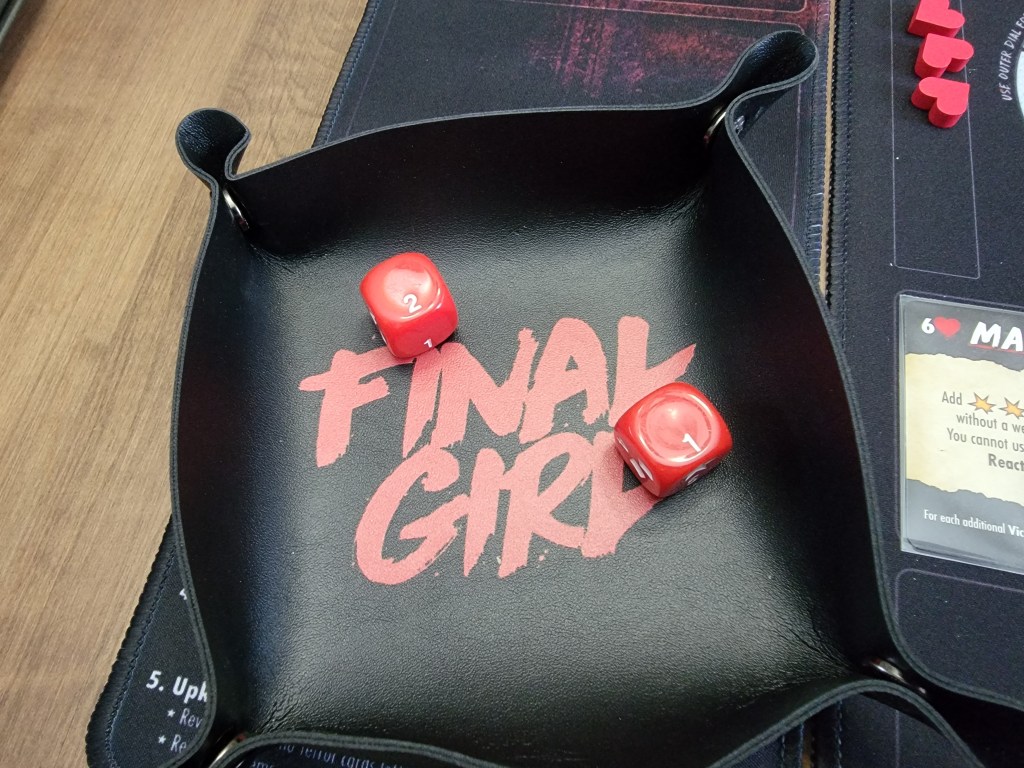
The dice in this game are interesting–which is to say they’re proprietary and work in a way you cannot mimic otherwise. I think the juice here is worth the squeeze. You get a modified D20 with more successes than failures, normally, and four different critical results. So 20% of the time, you’re getting a critical miss or success. Dice have special symbols on them and your gear will trigger off those symbols. I roll my red and yellow dice and see a crossed sword symbol: great! My elven sword gives me a follow up attack on crossed swords. I strike again! You can see how this is both fun (the above example is a great experience) and swingy (a great experience for me).
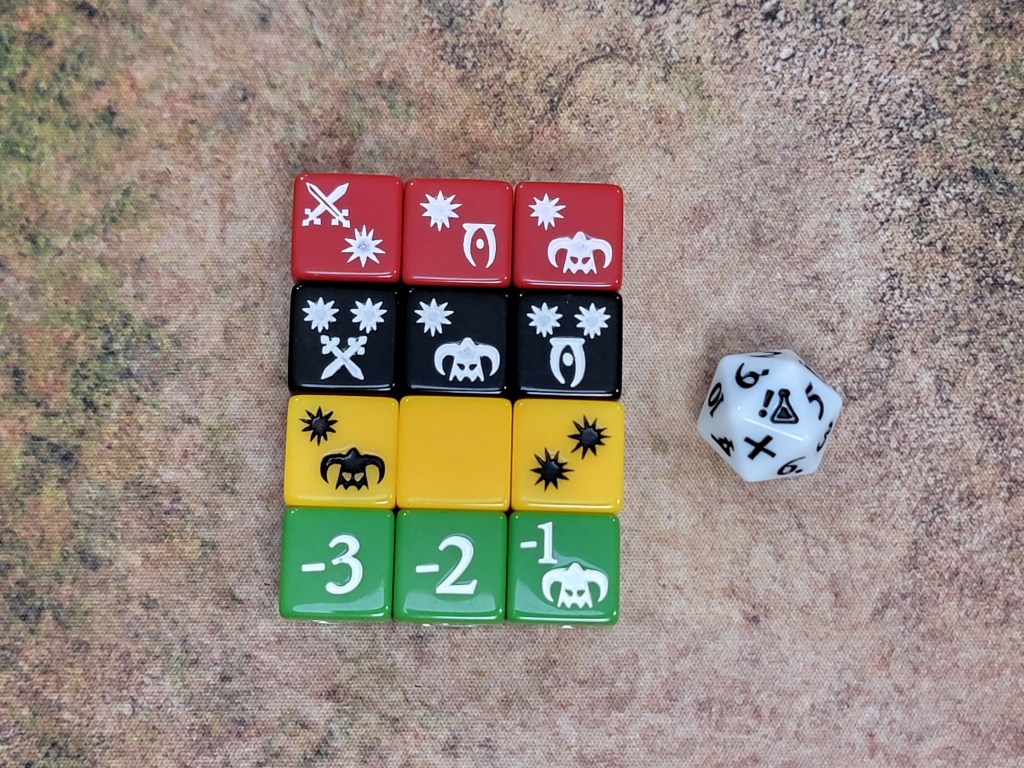
The dice, while swingy, are also strangely consistent–just enough for planning. You know that stealth archer in the corner is dangerous. That archer might roll a critical miss at the most important moment of the game but that does not mean you should treat it lightly. I found the dice off-putting at first but as I built an understanding of them across games they have, shockingly, become one of my favorite parts of the game. It’s just satisfying to roll a crit and trigger an ability in a way that utterly destroys the master level enemy and earns you three points toward victory.
I’ve mentioned monsters or AI enemies–they’re a frequent element of the game. Just about every match will feature some amount of enemies trundling around. Here’s a pain point for me: the AI system works well but you do have to roll for every monster activated to see what they do. I almost find myself wishing they’d included a set of monster dice that handle this for you. Instead, you roll one of the attack dice and compare to a chart that varies from monster to monster.
Once again, I think the juice is worth the squeeze here, but just barely. Once you get used to it, I think it lends some unpredictability to monsters that I appreciate. A thief will likely focus on objectives and hiding to get the drop on you, whereas a wolf will often just run up and bite you. The sum total of this system is that monsters are not an afterthought: they’re a main part of the game. They’re as influential on the outcome of matches as just about anything else and you’ll have to consider them in how you approach each battle. At times, it is entirely valid to avoid fighting your opponent altogether and just fight the monsters. I’ve had many matches where I did not touch my opponent because the monsters were a better path to victory or I ended up struggling with a dragon.

Now for the cards. There’s a lot of them. They do a lot of heavy lifting, though. I’ve mentioned them and will mention them a lot in this review, so suffice it to say that once they’re setup they make managing the varied gameplay easier and I can’t fully imagine the game without them.
When you put all of this together, again, you get a game that feels like it’s taking place in The Elder Scrolls. You start a fight out in the wilderness with some Dark Brotherhood assassins and part way through, a dragon shows up and the whole battle is suddenly about three competing things at once. That’s a very Elder Scrolls moment. I don’t want it to sound totally chaotic–it’s more that there’s always multiple ways a party may succeed in a match, if you’re paying attention and think it through. Better yet: how your party solves the situation in front of you may very well be utterly different from how your opponent approaches it. I genuinely love this about the game and really enjoy the game overall because of it.
The Problems
I’ve actually found it hard not to discuss the problems with the system throughout. They deserve their own section–I think they can all be overcome with a bit of play and none are deal breaking per se, but I believe they will be a hurdle to a new player.
The cards: there’s a lot of them. If you don’t organize these cards early in your Elder Scrolls: Call to Arms career, you’re in for a bad time. You could do binders–I 3D printed simple card holders and pull all weapons together, then all armors, then all shields, etc. I also have a baggy or container I keep my current party in for easy setup. This has worked well for me. My common opponent has everything in bags, kept in the starter box. That also works. I’d still hate to manage multiple factions at once, though, and often stick to one faction for a long period of time before swapping back to another.
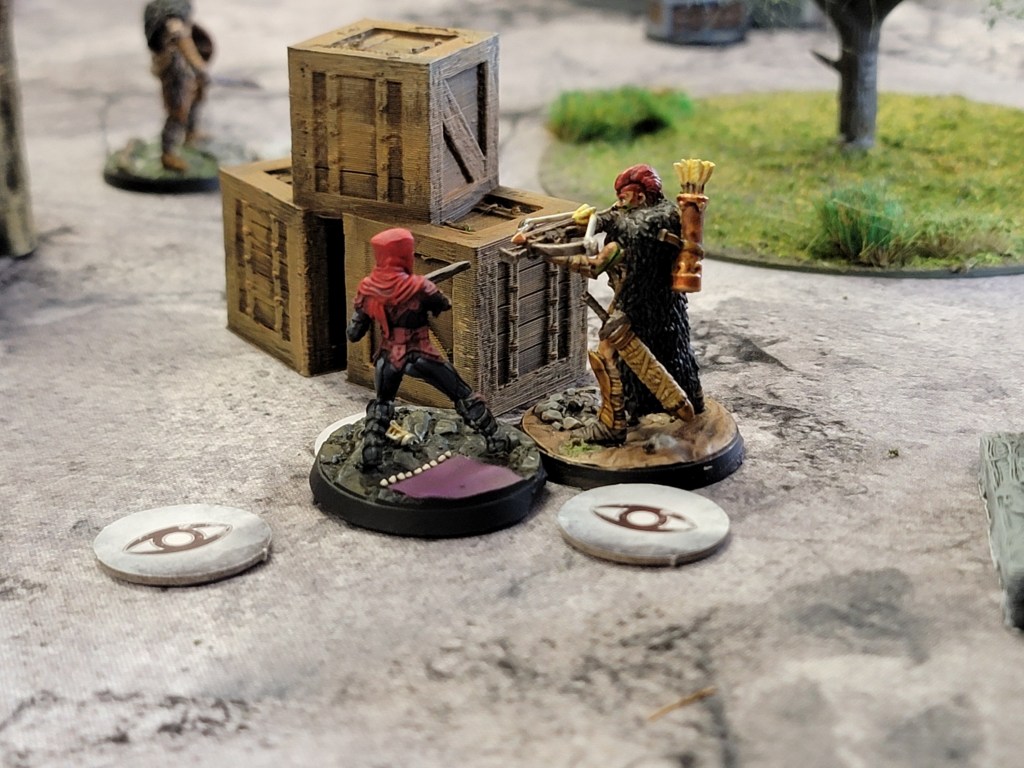
This leads into the problem with setup. You’ll want to solve it early on by having everything in each reach. Setup will require you to set out your cards, set out the enemy cards, and setout the game management cards (events, quests, treasures, and traps). It’s not that bad if you have it organized but for some people this is a bit too much.
Finding an opponent may be difficult–it’s a heck of a game with a very specific focus and I have not found many Elder Scrolls fans in the wild who actually view it as a place they want to wargame. Most people view it as a wonky, bug ridden open world game they enjoyed ten fifteen years ago. I would not want to play with total strangers for fear of someone just spamming stealth archers like a jerk or finding some other way to bend the systems or play in bad faith. I’d say this is a game where you want to have a reliable opponent lined up before you buy, if you intend to play competitively.
The game has a lot of special rules. I find it helpful to just note down all of the special rules for your faction into a table and print it off for reference during the game. I don’t use a QRS for this game at all as the rules themselves are quite intuitive, but I do use a reference sheet that has all of the rules for each of my characters. For my Dark Brotherhood, that’s 19 rules. I could not play the game reasonably without this.
The swinginess of the game can be annoying and you need to be ready for the inevitable match where you fail every damn spell or your opponent pegs a wild kill with a grunt follower against your main hero (forgive me, Paul). It just happens sometimes, even if it’s far from being the majority of my matches.
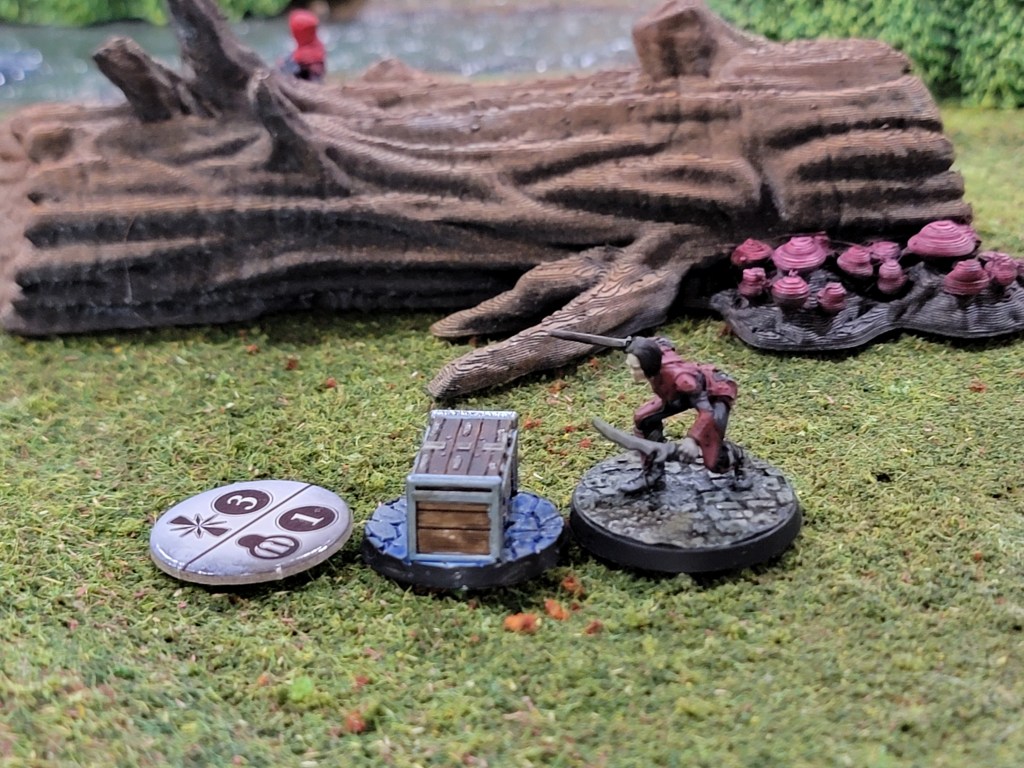
Price is my next issue. I appreciate that you can buy all of the chapter 1 factions online for 3D printing–this somewhat helps. A box of five minis can range from $30 to $50. The card packs for each chapter can be $40-55 and they’re sold separate from the minis. That last part is not a problem except for price. Selling the cards without the minis is actually surprisingly friendly toward people who wish to proxy or easily collect all of the options in the game. I appreciate this but it does mean owning every card in the game costs around $150 by itself right now. Buying a new faction is normally a $100 investment just for the models. The card packs cover 3-4 factions each for another $40-55 on top. I’ll grant that the factions feel very distinct and I don’t feel cheated in terms of gameplay time–but it’s a steep price.
Finally, my real core problem with the game: it’s Skyrim. It’s not Morrowind, or Daggerfall, or the realm of Hermaeus Mora, or the Summerset Isles. It’s just Skyrim. I want so much more from this setting and game it’s painful. It just took over a year to release chapter 4, and even with chapter 5 on the near horizon (end of this year… maybe) the distance between us and the rest of this beautiful and fascinating world is vast. I don’t know that this game will ever grow past what it is. There you go. There’s my biggest caveat. There’s the truest criticism I can deliver of this game: it only scratches the surface and is too obsessed with the most popular video game in this series.
Conclusion
I feel almost weird recommending this game. I’ve outlined some serious caveats. Yet, I think if it appeals to you and you invest some time up front and you have an opponent and you can stomach the price and you’re okay with Skyrim and you love Elder Scrolls and you’re a mythical unicorn you’ll really enjoy this game. It will deliver varied, interesting battles across its setting, while reliably and genuinely feeling like its setting.
This hits the mark as an on table Elder Scrolls experience despite its limitations and flaws. It achieves what it set out to do and it’s the best us Elder Scrolls fans will likely ever get and it’s truly great once you get into it. By now you should have a good idea if you’re the right person for this game–not if this is the right game for you.
That’s it.
If you’re this mythical Elder Scrolls fan I’ve been describing: this serious fan who knows the lore and can stomach some setup and can somehow bear with it only being Skyrim, I can assure you this is the game you fit and will love.
Sometimes the game doesn’t fit us.
Sometimes, we fit the game.

 Small Scale Victory
Leave a comment