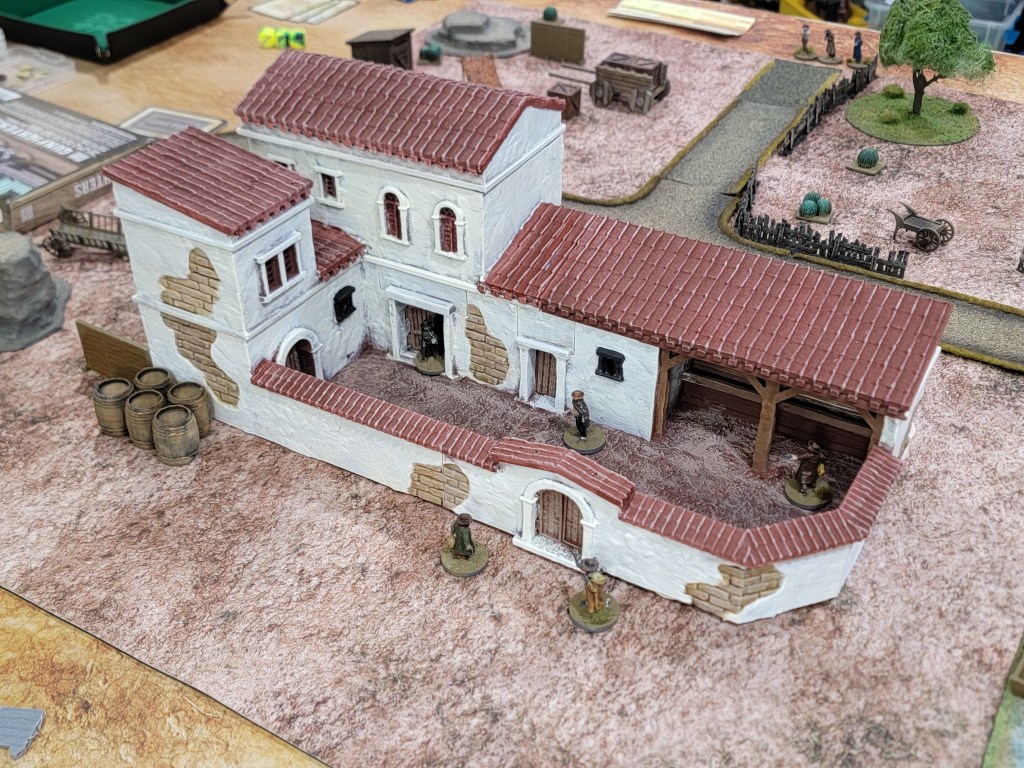
One of the greatest ironies of my wargaming career is that I appreciate cleanly written, concise, and clear rules–a rulebook that follows a logical flow, explains everything, and leaves you able to play when you’re done. Great! Unfortunately, I also love TooFatLardies. Not so great.
I think people fail to appreciate how well put together some rulesets are, especially when they’re very simple. I get that simple is easy to explain, but it still needs to be explained in a good manner that flows. An example of a well written ruleset is Gaslands. Even the granularity of how moving works is cleanly and clearly explained. The ruleset itself may be simple and perhaps have some issues in balance, but that rulebook is top notch.
What a Cowboy is an unfortunate example of the opposite. It’s a simple ruleset in many ways, really. It just doesn’t explain itself very well. The flow of the game is genuinely pretty straightforward: you assign a playing card to each cowboy on the field, shuffle them together, then draw a card to see who activates. When activating, the cowboy rolls 6 Activation Dice which then map to actions that cowboy can take. He or she uses up those actions, then we draw the next card. Everything else is a wrinkle on top of this system. Bonanza coins let you interrupt, you can do some fancy-ish stuff, etc.
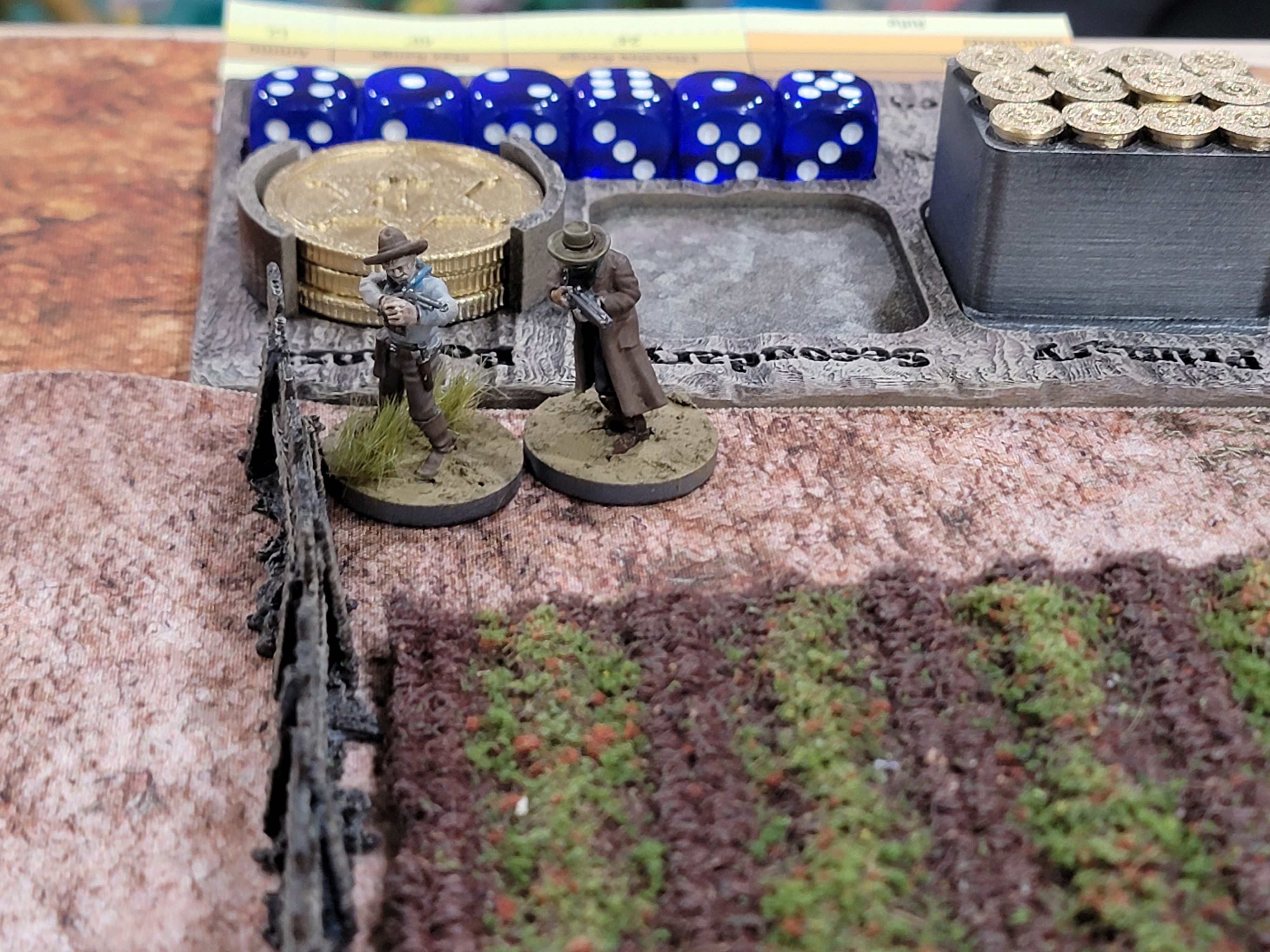
But one-third of the above statement is not clear in the rules. It never explains the deck mechanic. You gather it by implication and vague reference throughout the rules. It’s a core system, it’s simple, and it’s basically unexplained. Ironically, movement, which is far more complicated, is excellently explained. Shooting is also very well explained, but dodging has several key points buried in paragraphs of text such that I’d honestly recommend you reread the section on dodging after your first playthrough.
The deck issue aside, the rest of this is classic Lardy verbosity getting in the way of clarity. They’ve gotten better over the years, I’ll grant. After reading the rules once I could definitely handle activating and had only a few small rules errors in movement and dodging. The remainder I got pretty cleanly.
Okay, so the deck was egregious, but that isn’t enough for me to pick on a ruleset so much. The next piece is pretty big: pickup games. The game does tell you how to setup pickup games and how much each cowboy costs. What it does not make clear is if cowboys come with anything by default. In the section on pickup games it tells you that you should play at $150 (points) “…and then use what money remains to enhance their equipment” (Pg 50). Great! Simple! Wait–“enhance?” So they must have default equipment. What is it?
Well, that’s never directly answered, but if you get down to the section on campaigns it tells you cowboys always start with a Colt .45 and a regular horse. This is reinforced by regular horses not being an upgrade option anywhere as you can only buy the two levels of further upgraded horses. If you pay for Colt .45s it becomes really hard to generate a reasonable gang at $150. Grab a Colt .45 for $20 on a $20 Shootist (normal skill cowboy) and you’ve used almost 1/3rd of your price point. Throw a shotgun on a Gunslinger for a total of $80 and you can’t even fit another cowboy in your pickup game. That clearly isn’t the author’s intent as he intends each side to control 2-6 cowboys–I can’t imagine he wanted you to have… not even 4 Shootists with pistols (160 points).
I’m beleaguering this to drive a point: I had to do all of the above to reason out the solution. It’s not a complicated solution and a single sentence would have prevented it. The shame of all this is that the underlying ruleset is great. I’m having a blast with it! It’s just very awkward to try and sell the ruleset to others when I have to also say “But let me explain these two mechanics myself because… uh… the rules don’t.” I have a hard enough time selling historicals to a wider audience when I have to contend with explaining that it’s totally a great ruleset despite not explaining its core activation mechanic because the author took it as a given.
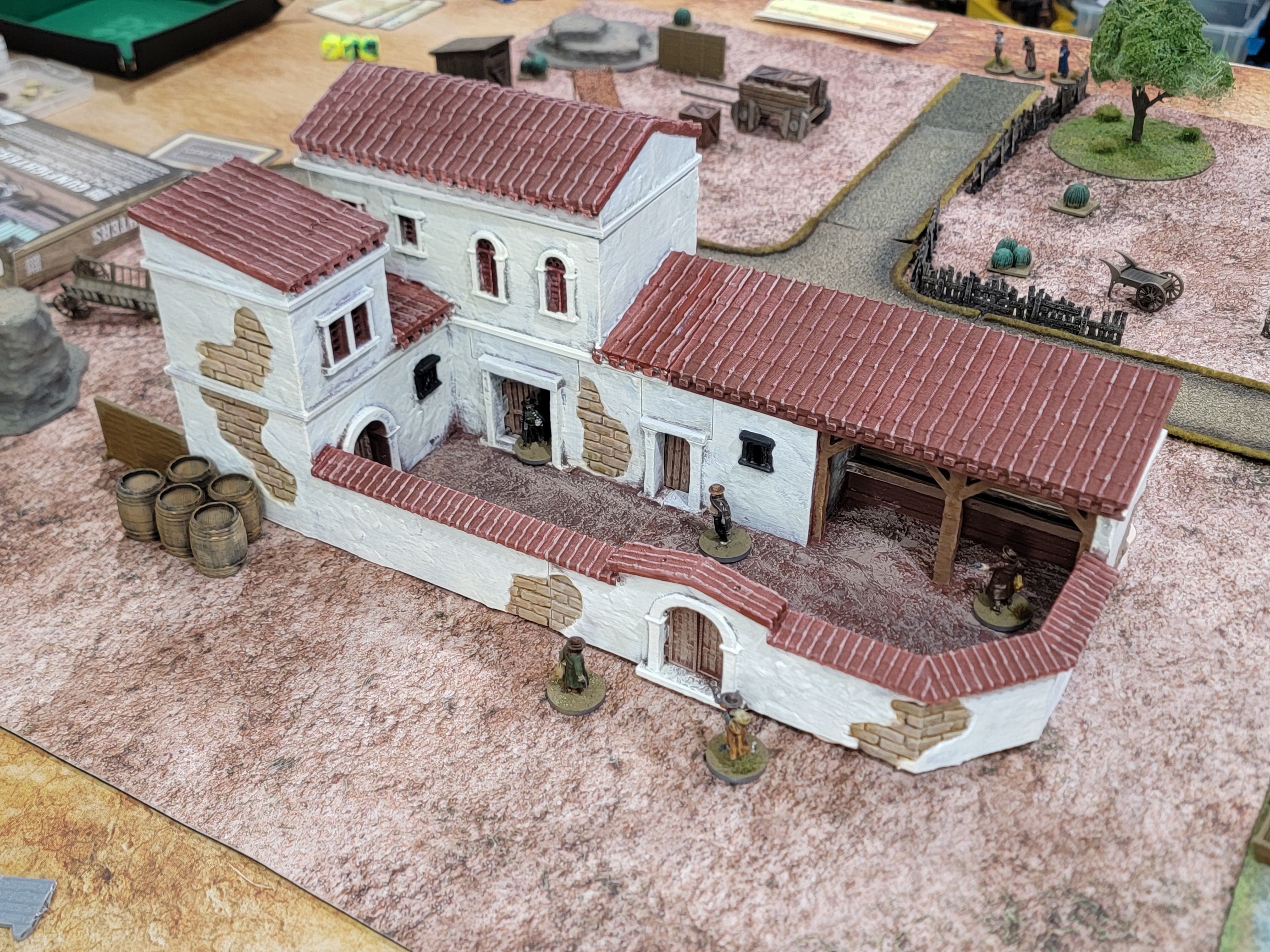
That leads to reinforcing this idea that as a person who plays a bunch of historicals and thinks a ton about rulesets I obviously think these things should just be simple for people to understand! You must be dumb for not being able to get over or reason this. Clearly!
This is my fear. Here we sit on an excellent game for introducing people to historicals and that same game fails to put its best foot forward in the most basic way. When I hand people these rules, I’ll tell them just to read certain sections “for your convenience. I can explain the rest.” I’m literally going to intentionally dodge the issue and explain it after the demo.
It’s silly, it’s embarrassing for me as a person hawking the game, and it’s bizarre. My final review of the game will be positive. I’ll undeniably recommend it. I’ll also have to explain the rules in the review in order to make up for a weak rulebook and to enable the ability to recommend it.
So should you play What a Cowboy after this? Well, yeah, but remember:
- The activation deck is composed of a single card per cowboy. You draw and activate the cowboy drawn. When all cards are drawn, you end the turn and reshuffle. If someone dies, just pull out their card when it’s drawn (which is totally NOT stated in the rules as best as I can tell).
- For pickup games, cowboys come with a Colt .45 and a horse by default. You can of course ignore the horse. If you upgrade to a long arm, you lose the Colt and will need to pay for an additional one if you want to have both a long arm and a pistol.
I’ll try to compile a full list of unexplained things as I find them, but the above are the only ones I’m aware of after five games.
Chain of Command Second Edition is right around the corner. Rumor has it it may release at Salute in April. The whole point of it, aside from upgrading some aspects of the rules, is to produce a clear set of rules I can hand someone and have them play. I know this is hard–I don’t want to undersell how hard it really is to write clear rules–but it’s necessary. If I have to turn around and tell my playgroup “Great news! New rules for you to learn… and then for me to explain after” I may very well be shooting the game dead in terms of future growth.
While the Lardies can get by on reputation and excellent mechanics, even I have to admit I probably shouldn’t be rewarding sloppy rules writing with a recommendation. I’ll do it, with caveat, but I don’t like doing so. I continue to learn from TooFatLardies. Sometimes, it’s what to do; sometimes, it’s what not to do.
Granted, “Don’t forget to explain key mechanics” is… uh… probably not the note you have to write down in class.

![[Tentcon Preview] Blades of Woe: An Elder Scrolls Adventure](https://smallscalevictory.com/wp-content/uploads/2026/03/20250810_135109.jpg?w=1024)
 Small Scale Victory
Leave a comment