
AT THE FRONT: So I wrote this last week as I was thinking through a ruleset. Over the weekend I continued to think about it–a lot. As a result many of the ideas below have been thrown out! In particular, the activation system proposed breaks pretty hard in practice. As does the idea of ad-hoc groups. I think I’ve solved a better method of handling Group creation as well, using the two levers of Level of Supply and Experience to create units with further restrictions based on broad faction choice (Western Europe, Eastern Europe, North Africans, Middle East, Bandits). I’m keeping the article below in place because I hope to follow up with an update that shows progression. There’s certain things here I liked and certain things that I only liked on paper but not in practice.
Or in other words: if I sound crazy, it’s because I am. Tear it apart! Have fun!
——–
I’m dreaming a bit here but I’ve been drafting, deleting, and redrafting a dark age and medieval ruleset lately. The objective is to create a warband size (30-50 models) ruleset of medium depth—something that’s just enough to chew on but not so much you forget how to play.
As of right now, my favorite game in this space is Lion Rampant—a game intended to be beer and pretzels (successfully so) but that accidentally stands as one of the better representations of warband size combat I’ve seen in a miniature wargame. Other games I’ve tried either accept the conceit of being gamey to create interest (SAGA) or produce a complicated set of rules to try and make things more tactically interesting than they really are (Baron’s War).
I suppose my issue boils down to really trying to solve the major pivot points of medieval combat:
- Leadership/Command and Control – a nearby ‘leader’ of some sort helps to rally troops into combat, assuming he’s motivated and good at his job
- Equipment categories by reach – basically, a sword and axe are roughly the same, but a spear or pike or bow are dramatically different
- Morale – as with all battles, you don’t win by killing everyone but by breaking their will to fight
I don’t buy that at the warband level we’re worried about formations or rank and flank maneuver. In fact, as I think about it, even grouping units together feels somewhat wrong. The best model of this level of warfare I’ve seen actually remains The Lord of the Rings from Games Workshop. That feels almost odd to say—but it’s a brilliant ruleset. It’s just a little superheroic by merit of the world it’s trying to reproduce.
So as I think about this issue I slowly come to solve how I want to resolve each of the above three pivots.
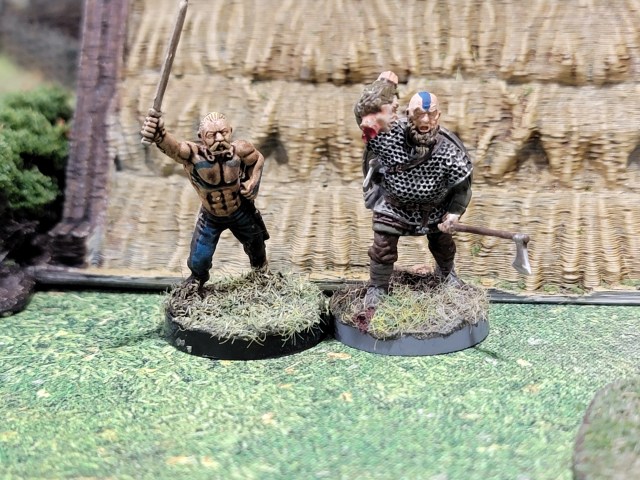
Leadership/Command and Control
I’m envisioning an activation system in which you go back and forth activating leaders specifically, who then activate all models within range of them. So we alternate leaders and their “groups” but groups are flexible based on who positions where.
Once all leaders have activated, we alternate activating single models who were not activated by the leaders. Single models have fewer options and are less combat effective due to their lack of cohesion with the group.
The activation of leader led groups happens as a blob—you run your blob into an enemy blob. Every model engaged in base-to-base melee this way rolls jointly, with success being based on either their veterancy level or their veterancy + a buff from a nearby leader. Both sides fight simultaneously but the combat system prefers the attacker (see below).
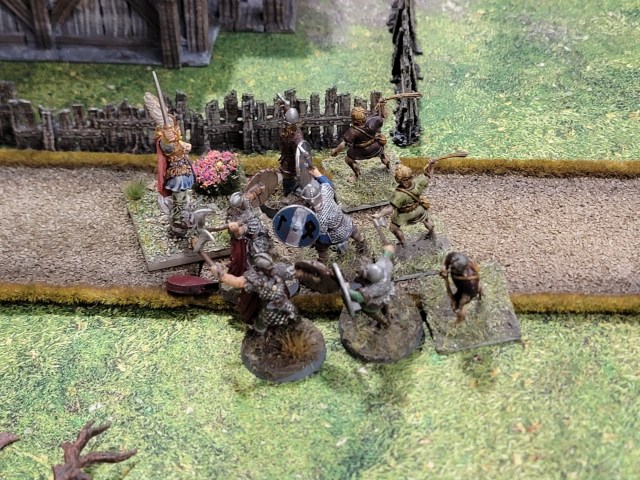
Combat and Equipment Categories by Reach
My nascent concept for combat is similar to the systems seen in Lord of the Rings and Five Leagues from the Borderlands. In short:
- If a leader is in range, that side may consolidate nearby soldiers into the combat with a 3” move.
- Tally up all dice for units in range on both sides. Attackers use Attack and defenders use Defense to… well, fight each other.
- Roll dice, comparing to successes which will be determined by veterancy. Green units on a 6, normal on a 5+, veterans on a 4+ on a D6. Whoever succeeds more ‘wins’ the round and decides what happens next.
- The result depends on who wins the initial struggle:
- If the attacker wins, they get to roll to kill enemy models with all successes or they can push back the defenders. If they roll to kill, another round of combat must subsequently be fought.
- If the defender wins, they can choose between rolling to kill or pushing back the attackers. If they roll to kill, another round of combat must subsequently be fought.
- This process repeats until one side gets pushed back, at which point morale is rolled.
- Morale is modified by losses in the combat—being pushed back adds a further penalty to these rolls.
Okay, that was a bunch. This idea is, again, nascent. I’m a little worried it ends in all-out-death the moment two groups meet but I’m not necessarily convinced that’s wrong. From what limited reading I’ve done two groups push into each other, fight with minimal losses, and then one side ends up running away.
The roll-to-kill will be tuned to produce few casualties. Combat should be a grinding affair and the losing side of conflict shouldn’t lose more than 30% of their actual models.

So how do weapon types and reach factor?
Hand weapons only attack the man in front of you. Spears allow you to attack one rank deep. Pikes allow you to attack two ranks deep. Shields give additional defensive rolls that cannot be used for kills. So on and so forth. This part is very directly stolen from Lord of the Rings.
Why steal this mechanic? Because in Lord of the Rings it encouraged realistic tactics without strictly forcing players to execute those tactics. In Lord of the Rings you’d use shield walls, spear walls, and flanking two-handers realistically because the atomic rules of the game made your decision process rationally land on real world solutions. That’s the goal here.
Morale
Showing my final inspiration, TooFatLardies, each side will have a morale clock affected by failed morale tests. Each failed morale test has a chance to make its respective unit break and back off or even flee the battle but also affects your overall morale track. Hit zero, lose.
Objectives will be based around morale, too. Hold the point and it will hurt enemy morale over time. Burn the building and, again, hit the enemy morale hard. Each mission will play with this differently so players can win through the brawl or win through capture and control
It’s really that simple, I guess. This alone makes leaders worthwhile because they’ll boost morale and help keep your soldiers in the fight.
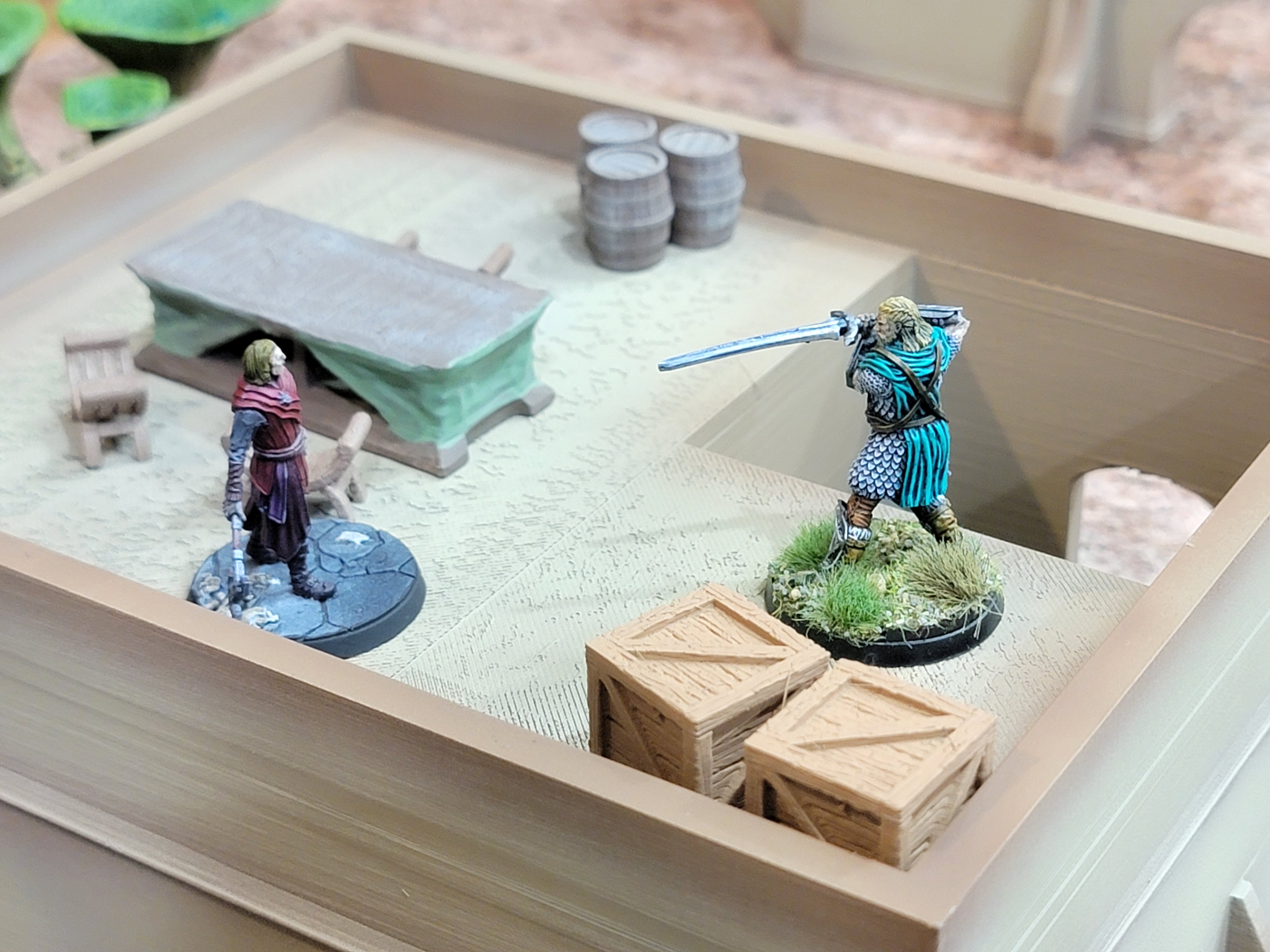
Putting it Together
Altogether, leaders now give you more control, make you fight harder, and make your morale more resilient. Losing leaders is disastrous and they’ll be less likely to be in the front line itself so much as right behind.
Units develop distinct and important roles. Light cavalry is used for cleanup because chasing down an enemy unit and finishing it off it will hurt enemy morale severely. Archers soften up troops but won’t necessarily affect morale outside of dramatic success. You’ll want some but at this scale they can’t dominate the battlefield.
Equipment matters but only for practical effect so as to keep players focused on their real decisions: how do I leverage my leaders to leverage my troops to break the enemy morale?
Morale, as an underlying system, helps link everything together and should be one of your biggest concerns. Here is a game where you’ll want the banner because of how it keeps your men in the fight—not because it gives an arbitrary buff.
I’m unsure if I’ll ever write the above. Honestly, until I playtest, I’m not even sure it’ll work well. I’ve got it down in notational format. I may even arguably be able to playtest in its alpha state. We’ll see.
Shield of His Men (SHM for short) may just be a dream for now but I’d like to think I might just be able to make this one work.
Or it’ll join my Mogadishu and cowboy rulesets in purgatory. Writing rules is fun until you have to actually lay them out!


 Small Scale Victory
Leave a comment