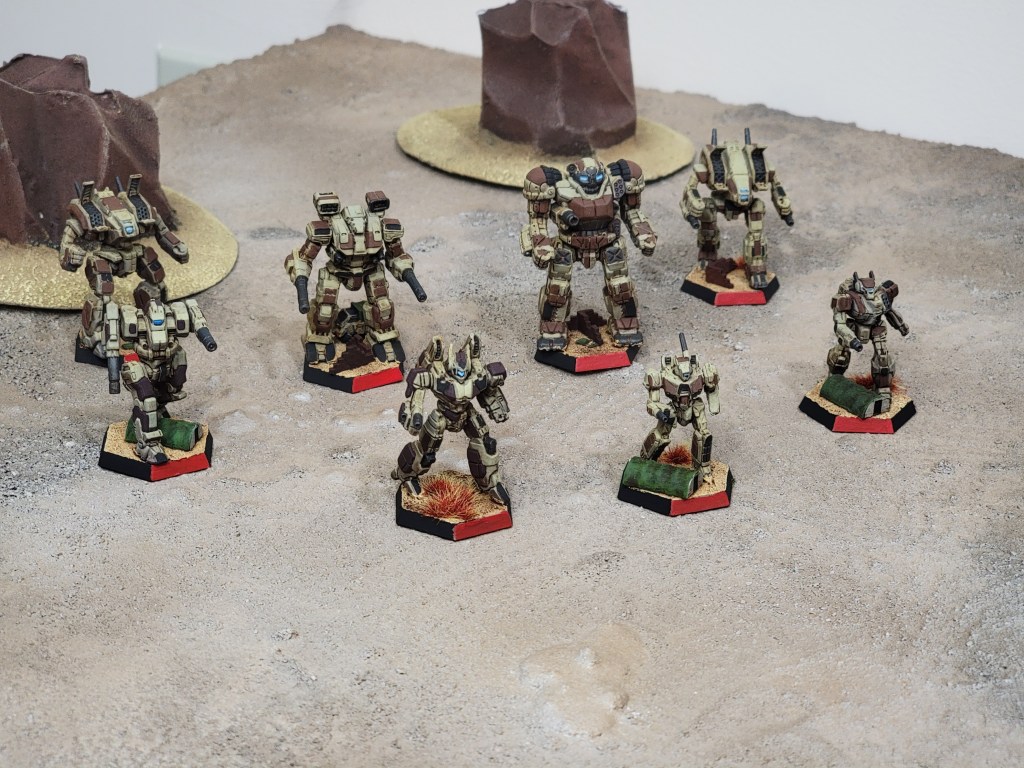
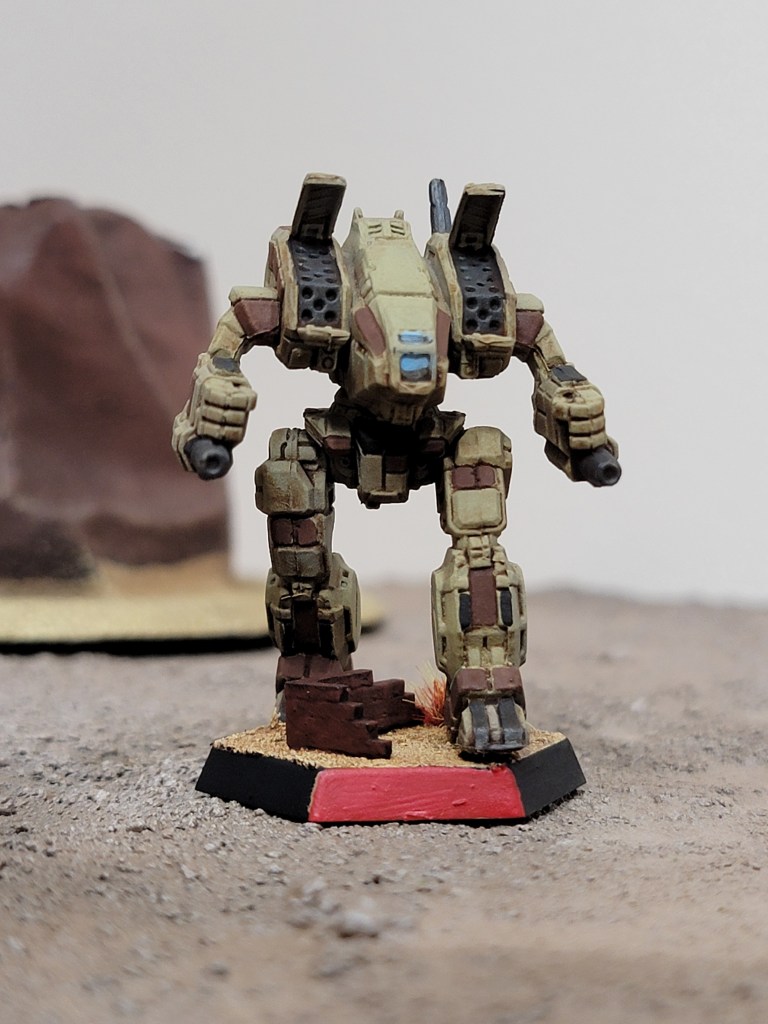
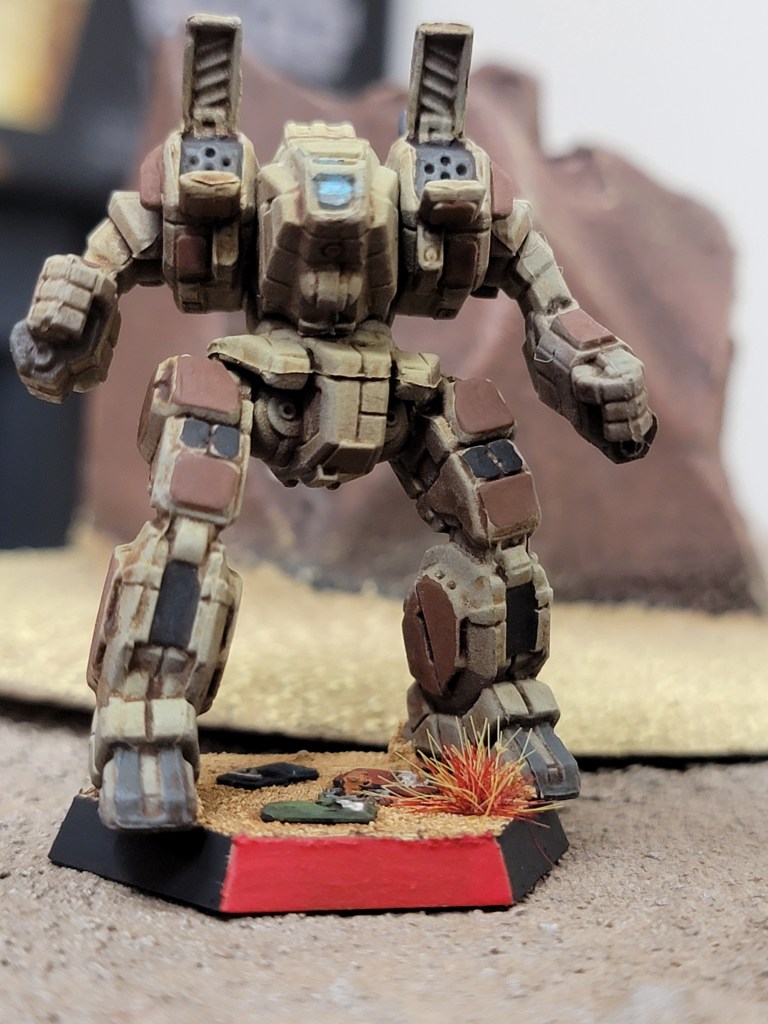
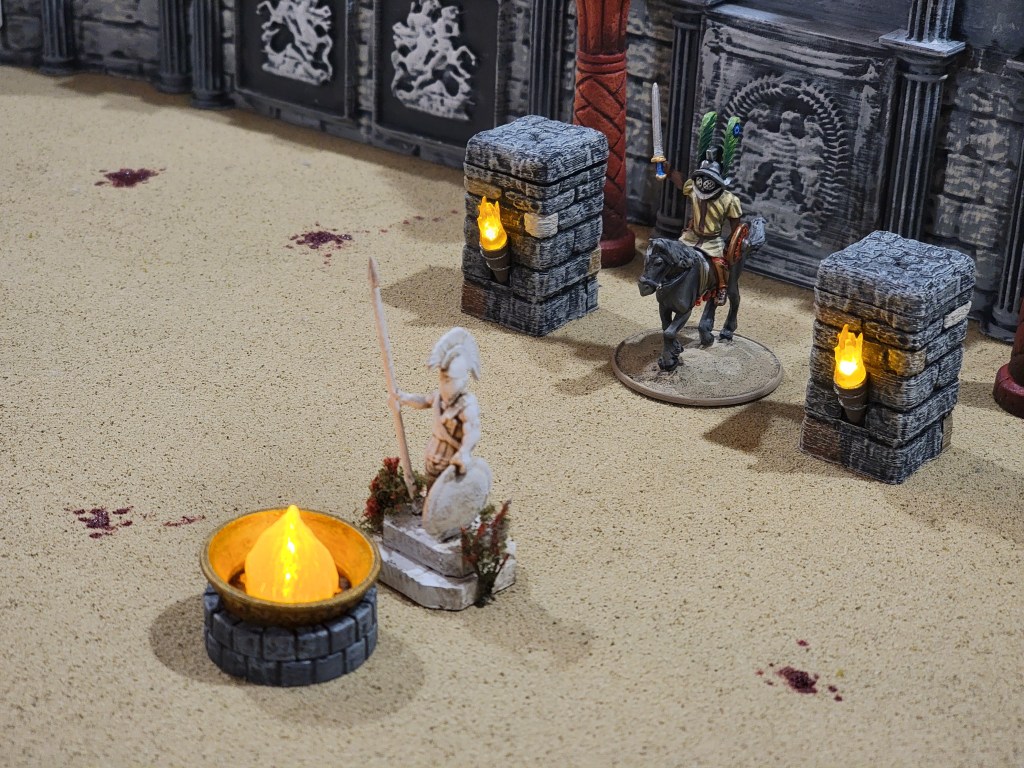
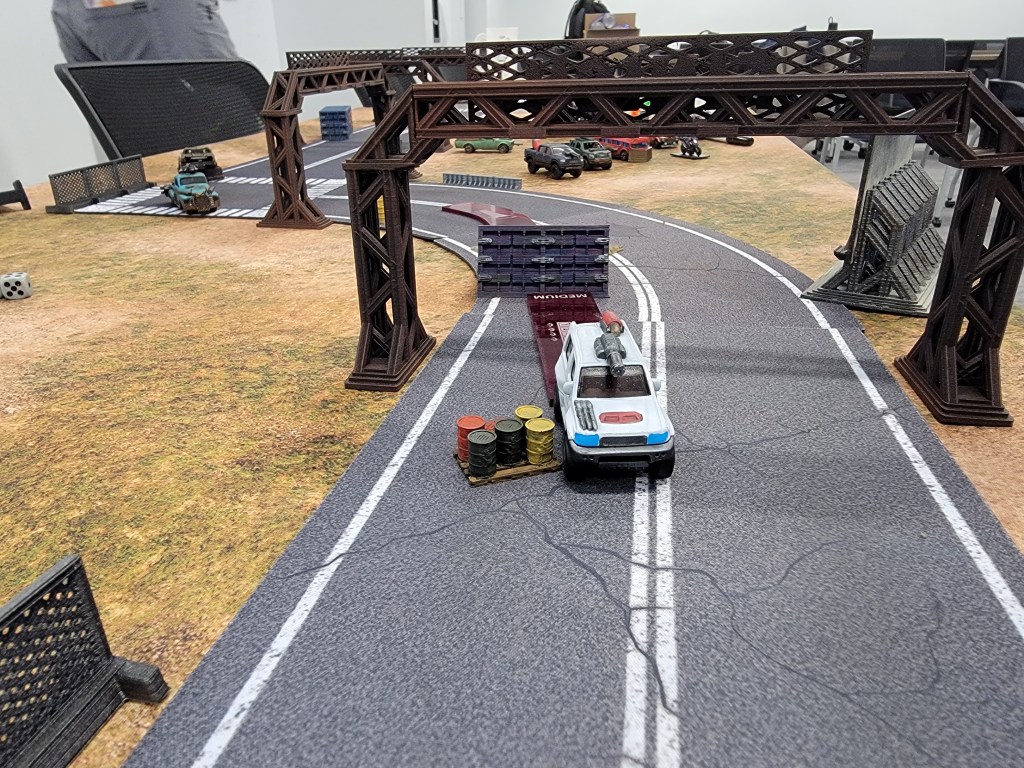
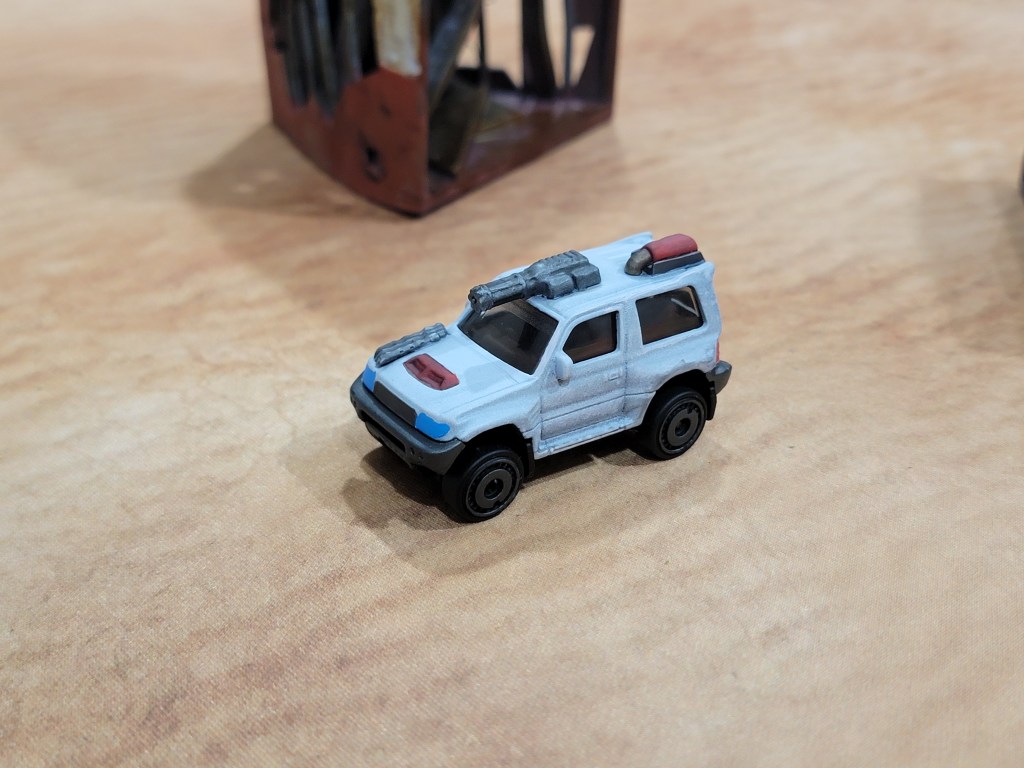
(The photos in this post are from a force I’m painting and haven’t published yet. It’s a stealth Off the Bench, I suppose.)
With Tentcon fast approaching (Mid-June), I’ve gotten most of the way through planning for my first event of the day: Battletech. I have a bad habit of wanting event games to be unique, with their own elements that give players a new experience. I say “bad” because this means I’m effectively doing a WHOLE NEW THING every time, which is perhaps ill-advised.
Ah well. Here’s the WHOLE NEW THING for Battletech, bad or not.

The idea here is to create an atmosphere is constant uncertainty about your allies. Often in the Battletech universe, allies betray each other, even in the heat of battle. Doubly so for House Liao and the Capellan Confederation it leads. In fact, the opening story of my House Liao RPG book is literally a betrayal. This event game features a temporary alliance of mercs, hired under the banner WOLF to attack a Liao city where biological super weapons are supposedly being developed. At its core, it’s simple: WOLF attacks, seeking the facility, and Liao is left to try and hold them off and break their spirit.
To add wrinkles, though, I’ve decided to give each player C-Bills (credits) based on performance and achievement of specific objectives. These C-Bills determine the order in which players take prizes for the event, meaning your side might lose, but you may still be first in line to grab a prize. Objectives either score C-Bills for you or your team. So, for example, the defenders have a bounty where they earn money for every enemy killed outside the city walls, but that money is for each player individually. On the other hand, the attackers have a contract to destroy at least 50% of the city walls—that earns C-Bills split evenly across the team.
So far, that’s cooperative competition. You’re on the same side but competing for points. Now, to add the spice: you can bribe anyone on the field with C-Bills for any purpose, you can shoot allies, and… everyone has their own secret objectives, including up to two traitors in the batch.
So now you might bribe an enemy with 200,000 C-Bills to get them to setup conditions for another contract you’re trying to score or bribe an ally to back off an objective so you can take it for a mission they don’t know about. Or, more directly, you may take a 1,000,000 C-Bill payment to execute a round of fire at your own allies. No hard feelings, guys—just credits. Sorry.
Now, of course, players don’t normally want to betray each other. It’s scary, hard to position, and a bit mean. That’s where the traitor card comes in. You never know who is and isn’t a traitor, which should hopefully help push the players to take bigger risks in the first place.
The tricky balance from a design perspective is what missions to give the players and how to avoid overloading them. My fear is that if there’s a smorgasbord of options, players will glaze over and be unable to focus.
This is the challenge in running a new event every time. Every event is a bit of an experiment. The advantage, however, is that I learn a little each time. This one feels more ambitious than I intended it to be, but I’m confident it’ll be fun, even if it goes a little off-the-rails. It’s also just a great prototype for the kinds of asymmetric and challenging objectives I want to subject players to. More than just a big battle with winners and losers, I want battles that make players feel like they’re in the universe and in the shoes of the commander of the miniatures they painted.
Wargaming has more to give than just being a game—it’s an experience that should immerse you in a set of problems and ask you to solve them. The more interesting the problem, the better the game.
I think here, I’ve succeeded in making an interesting problem. We’ll see if my players agree.
 Small Scale Victory
Leave a comment