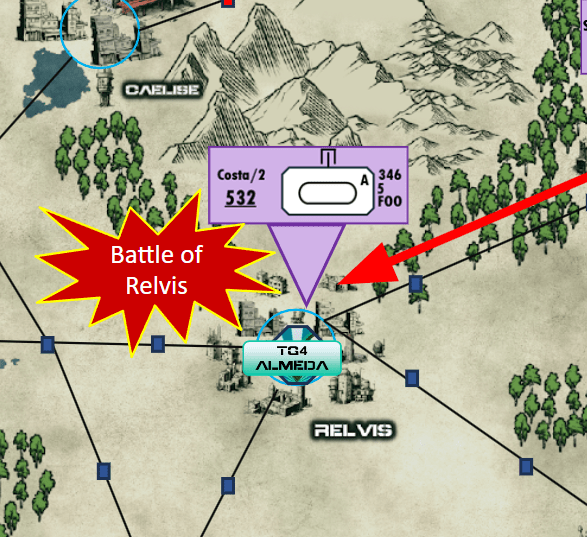
I got the opportunity to play out first map generated battle for the Battletech campaign I’m testing. It was an interesting experience, having to consider the campaign level elements mid-battle, and I want to outline why that is and what makes campaign play so compelling.
The scene: I took the town of Relvis last turn and my opponent is immediately assaulting it. After a discussion in which I established my rapid defense plan, we decided to play a breakthrough mission. All I had to do was sit and wait.
The issue? I chose terrain poorly.
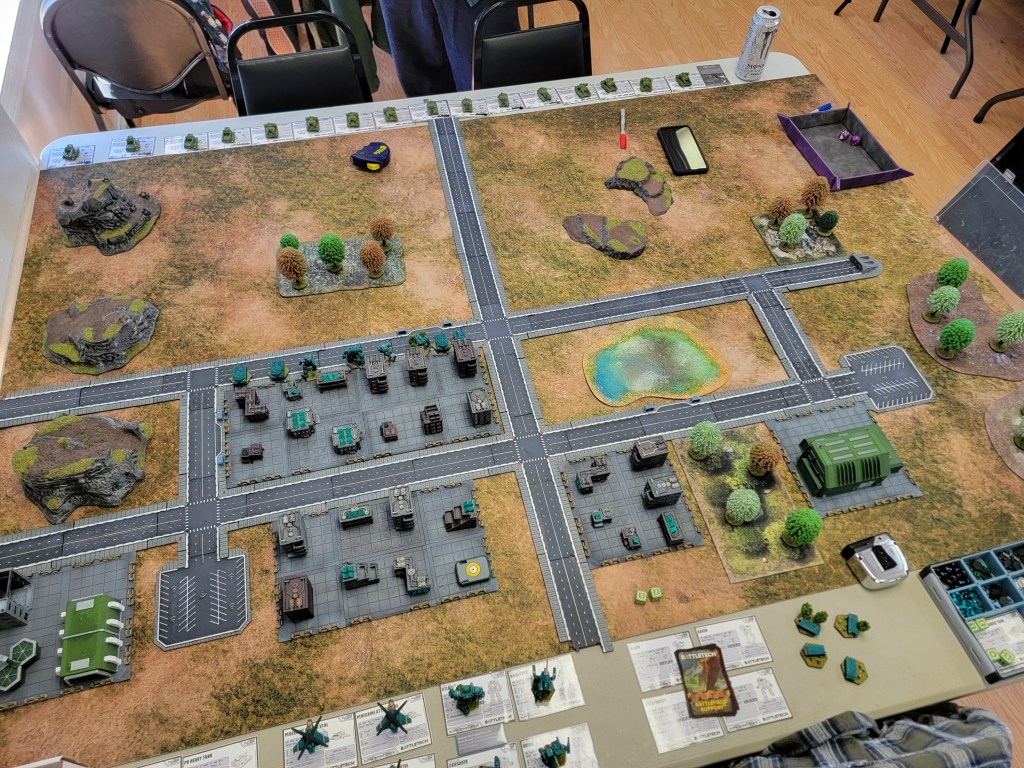
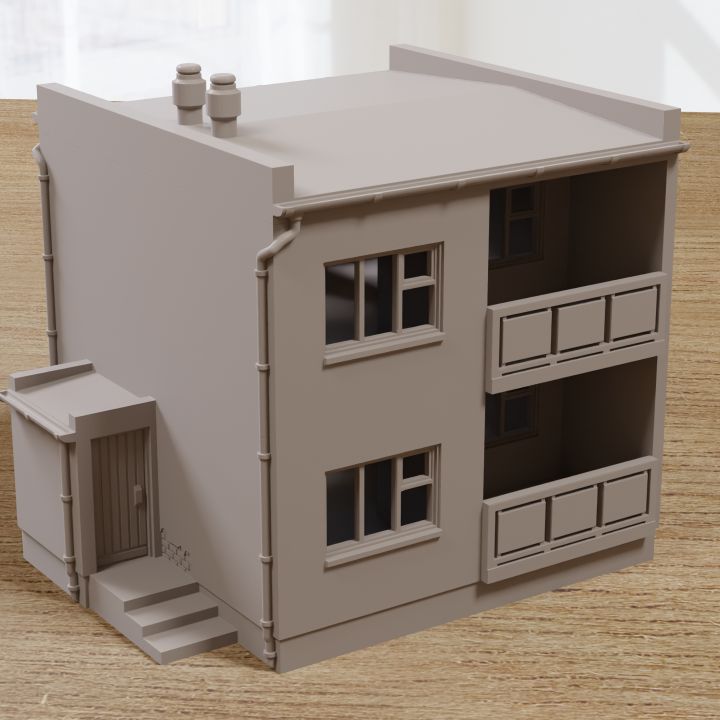
I quickly realized that there was nothing breaking up line of sight effectively on my side. The buildings were on an implicit grid, which allowed long lanes of fire horizontally across the board. You’d think this is an advantage for a defender in theory, but in practice in meant my opponent could use his greater medium-to-long-range firepower more effectively. His Ontos tanks were a bear to deal with and he had a fair amount of long-range firepower which forced me to try to push into mid and close range.
Really, I assessed my force wrong. I should have pulled deeper into the town and fought over the town square in a truly urban environment, but I was hoping I could do a lot of damage early and force my opponent to flinch. See, in this campaign, you have to reconstitute your losses using Supply Points. You earn them by converting Warchest Points (effectively Action Points at the campaign level) or by holding the field after a battle to be able to claim salvage. My initial thought was I could do enough damage to cause my opponent to back off so as to minimize losses.
Unfortunately, those first few turns proved painful. There were trades, but he was clearly out-damaging me. I found myself down around 30% of my force when I first considered backing off. I did the risk calculus in my head: if I back off, I preserve more of my force and use less supply points, but I’ve already banked supply points for repairs. If I back off, he shoots me as I leave and I do less damage to him.
I decided to fight.
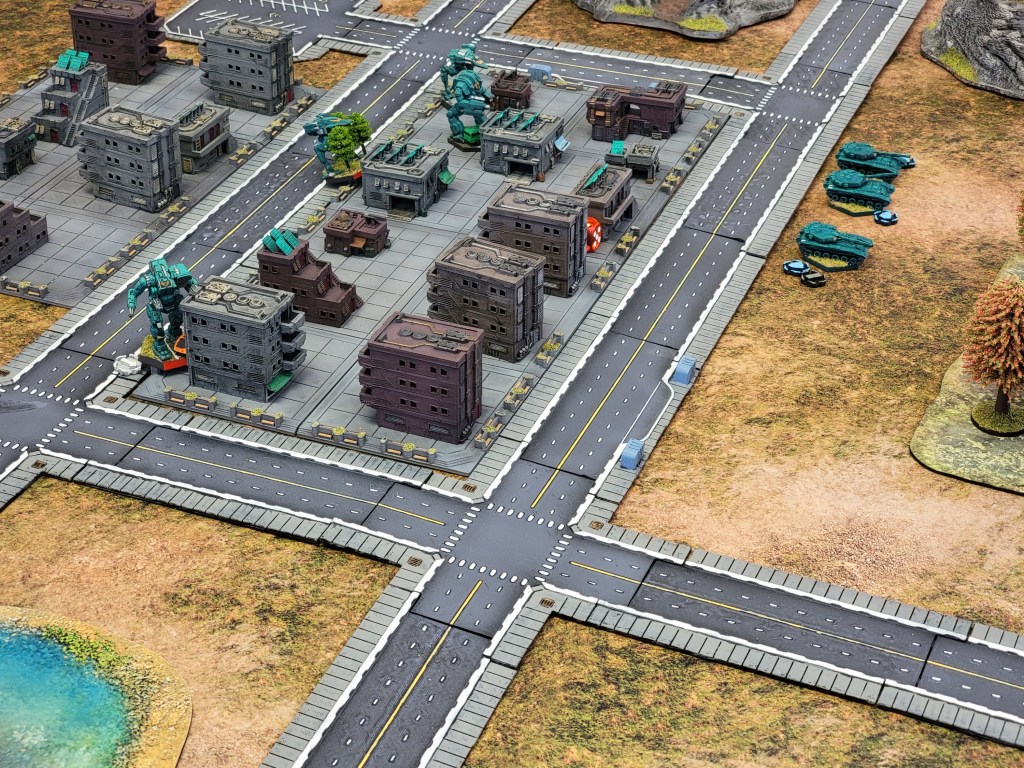
See, my thought here was that I could end the battle in a pyrrhic victory for either side. I didn’t even care which side won: I just wanted the battle to hurt enough to discourage immediate follow up from him. I did manage to inflict slightly more damage than he earned the points to repair, but I took more damage than I can easily repair. Put another way: it was the right choice, I think, but only because I strategically screwed up from the outset.
Had I chosen an interior battle with a lot more line of sight blocking terrain, I’d have found myself able to actually fight and maybe even play the angles to isolate him. I assessed my opponent, my environment, and my own force wrong. Sun Tzu (both Liao and real world) forgive me.
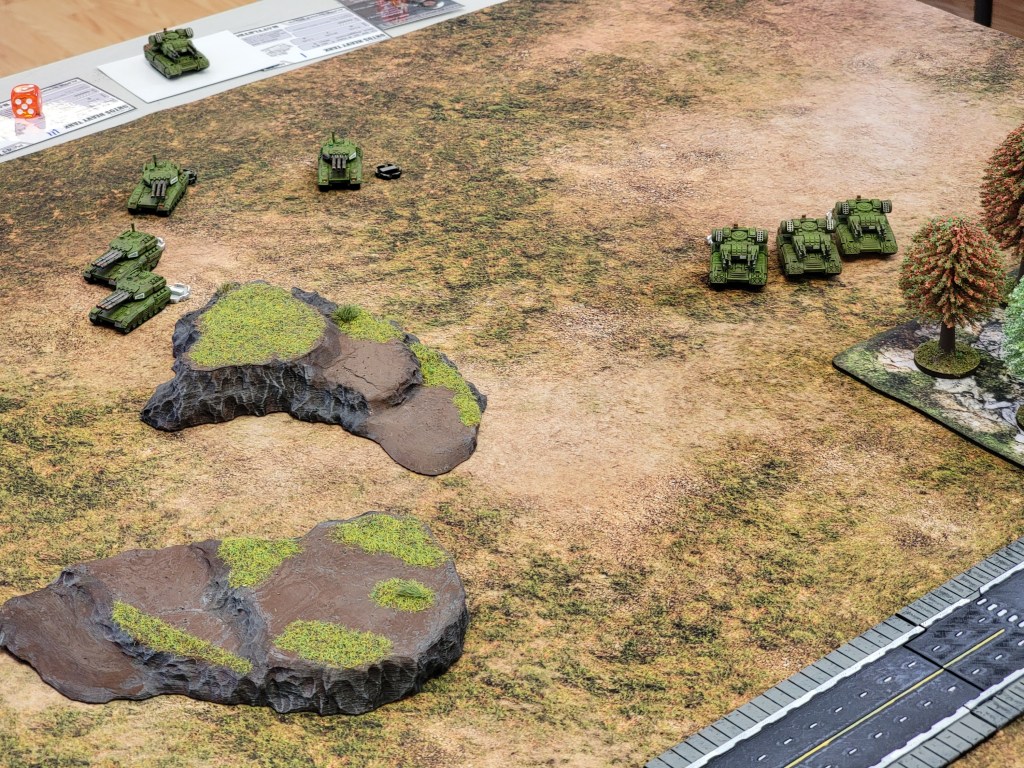
But I did hurt him, and I may very well be able to counter-punch before he can reconstitute. In fact, that’s likely my very next turn. The interesting thing about the lasting damage from battles: forces will struggle to hold ground if not backed up quickly. As a result, I may have lost a tactical battle, but I haven’t necessarily lost the conflict over the town of Relvis.
I’m nervous about this, really. The smarter thing to do in a map game is to try to overwhelm your opponent in battle. That’s the true spirit of operational and strategic warfare: fight unfair fights. I’m curious to see how it plays out and if it’s really a desirable outcome for a campaign. It may very well be that we end up with either games that play out like a steamroller over asphalt or games that are too big to easily play in an afternoon. Neither of these things are my “Goal” in campaign design. I’ll play out this campaign, then mull it over. I could be wrong in my assumption here—I hope I am.
If not, though, it poses some interesting thoughts. I built the campaign to force players to think operationally, thinking that was what I wanted. It would be funny if in the end, operationally sound battles aren’t the battles you really want to fight with miniatures. I also need to be cautious of our own preferences: there’s the possibility we fight mostly even battles by our own design because it’s more entertaining, but not necessarily tactically sound. If I released a campaign that requires players to, in essence, not be jerks all I’ve done is released an unplayable campaign.
We’ll see as this campaign progresses. My underlying hope is I have a system that can be translated and used elsewhere. I enjoy the interplay of force positioning and sustainment that this campaign encourages. There’s something compelling about knowing a loss isn’t necessarily a loss, or knowing the crushing defeat of an enemy really has a lasting effect.
But I realize now my objective is for this campaign system, so I’ll be cheesy and end with a quote that succinctly explains it:
“Who wishes to fight must first count the cost.”
-Sun Tzu
 Small Scale Victory
Leave a comment