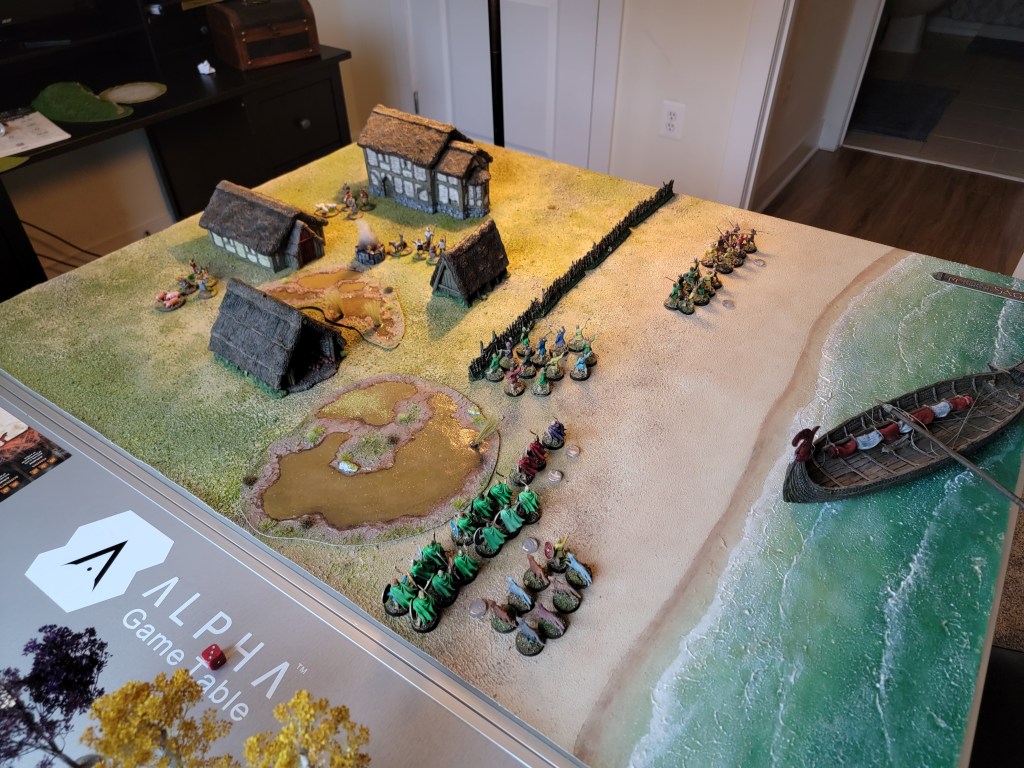
I played SAGA yesterday and the game was great, as always! I absolutely recommend SAGA for a good time. That’s not the point of this post.
I played SAGA yesterday and the game gave me thoughts and feelings about what I’ve referred to as “Process Based” and “Results Based” adjudication*. Going forward, I’m going to rename these as I continue to refine my thoughts on them:
Narrative Generating Adjudication: Rules that generate a narrative through their resolution
Narrative Imposed Adjudication: Rules that do not generate a narrative, but must have one imposed upon them post-resolution
These concepts will evolve with me as I play games, so consider their definitions somewhat fluid, but I believe in the above I get at the heart of what I’m trying to say.
SAGA falls firmly into the latter category. Let’s discuss.
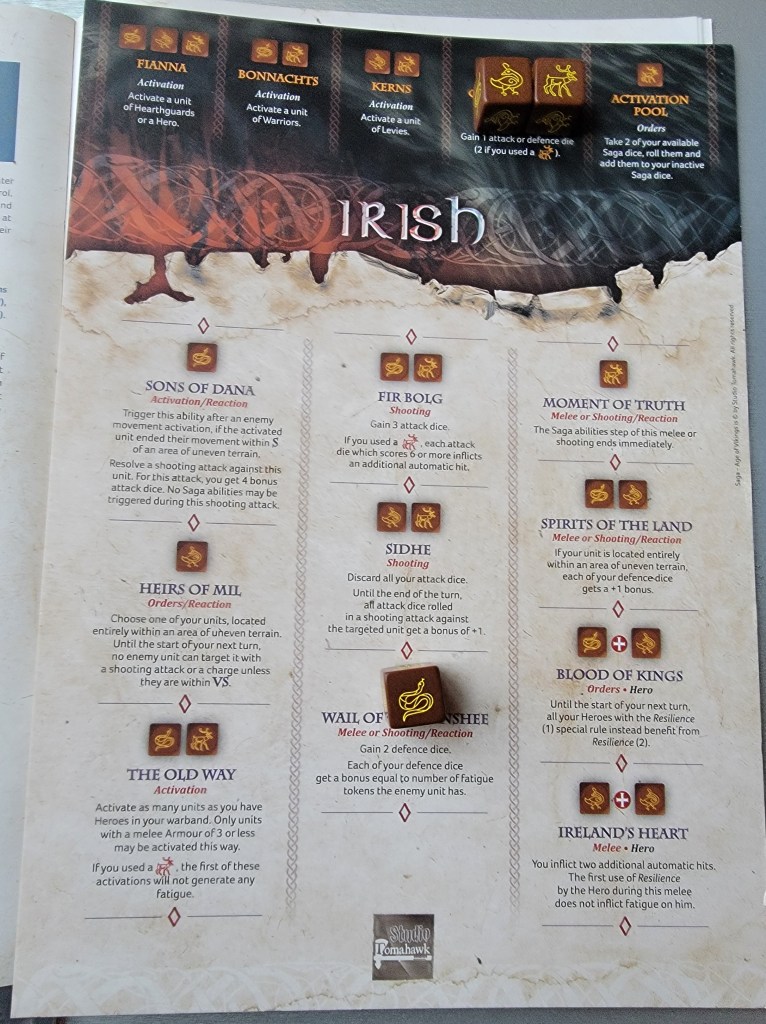
In SAGA, your activation is controlled by a roll of the dice and their subsequent placement onto your battle board. You roll your SAGA dice (one per living unit on your side) and assign them onto the board between Basic Activations (which grant a unit the ability to move, shoot, charge, rally) and Advanced Activations (which buff or debuff units). This creates a Command-and-Control model in which you have imperfect control over not only your units, but their capabilities. As your forces die off, you lose SAGA dice and reduce your ability to control your forces as you want.
The issue becomes: what do your SAGA dice represent? Let’s setup a scenario based on the board above.
I want to charge my Irish Warlord into my opponent’s Warlord. Using my battleboard above, we can see that two abilities really help me: Blood of Kings and Ireland’s Heart (bottom right of the board). They buff my offense and defense and make my Warlord nigh invincible. It costs four total dice to use them—this means if I have less than four units, my Warlord can’t be buffed to this level.
Let’s suppose I have those units to generate the dice—I roll and get exactly what I need! My Warlord is ready to be a God of War because… er… my dice rolled hot and enough of my dudes are alive? See the issue? I can say it’s because he is confident in his victory, or angry at his losses, or whatever narrative reasoning I’d like to impose—but I’m doing just that: I’m imposing this upon the rules.
Let’s suppose I didn’t have the dice. I’m forced to choose between buffing his offense or his defense. Tactically, it’s an interesting decision, but narratively it… doesn’t quite mean anything until I impose meaning upon it.
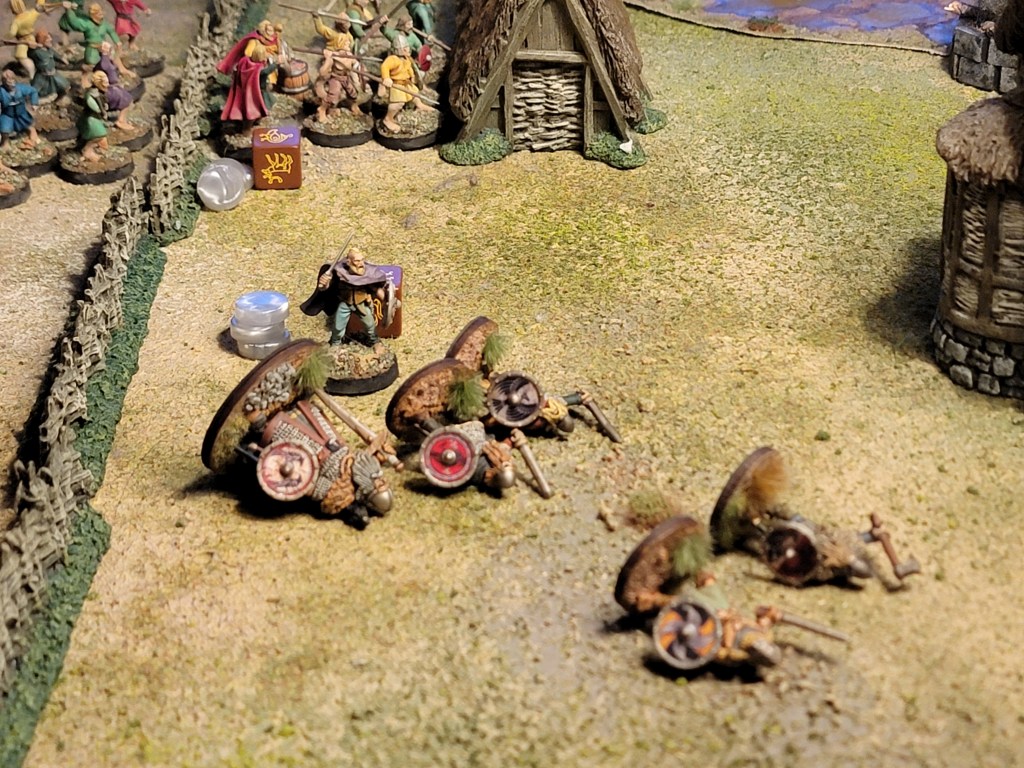
This is not to say you can’t generate a great story from a game of SAGA, it’s saying that you have to impose that story upon the game.
Let’s take a look at another game: Asymmetric Warfare. Here’s an actual scenario from my last game (you can probably skim this part if you read that post already):
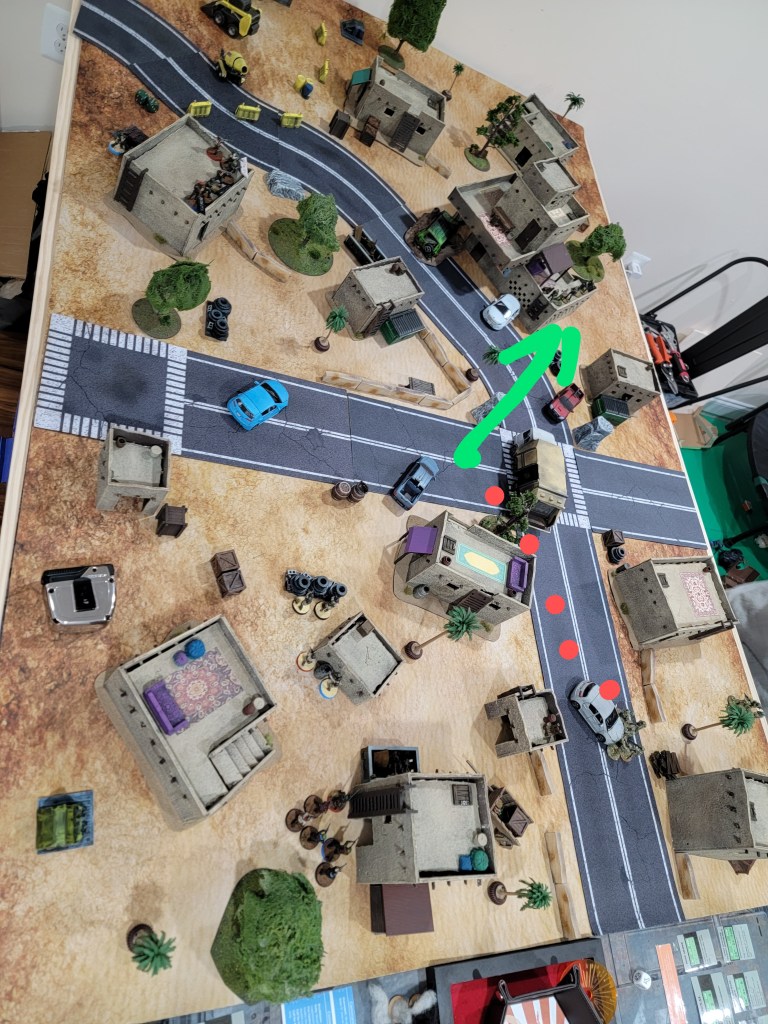
I want to drive my truck across a road to get to a helicopter landing site. My opponent has his soldiers on overwatch waiting for me to do just that. Desperate and low on time, I risk it anyway. I move in front of his line of fire and he shoots a carbine at me.
Based on the rules, the best a carbine can do to my truck is M-Kill it (stop its movement, but not destroy it). He rolls his shot and gets “Driver Hit” as the result. This causes the vehicle to drive in a random direction, which further causes it to crash. I roll and find that my driver is killed by the shot. I then roll on the collision table and find that my vehicle is now nearly immobile after the crash.
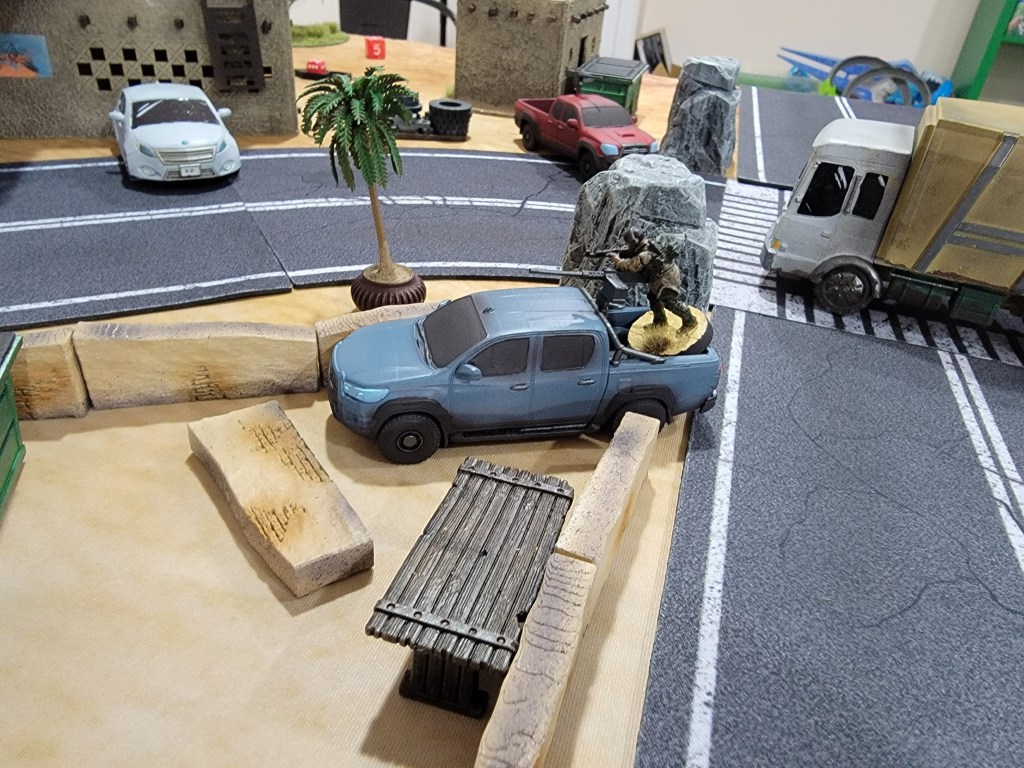
This right here is a clear example of Narrative Generating Adjudication. I don’t have to explain what happened—the narrative is right there. I drove into an open clearing, got my driver killed, and went out of control into a wall which further damaged my truck all in one move. It was all there in the mechanics.
This is not to say that one method is better than the other. They put your focus in different places and as a result are enjoyable for different reasons.
In SAGA, you interact with the rules as much as you interact with your core decisions. You spend much of your time puzzling over your dice placement and buff decisions while also considering what that does to your tactical plan on the battlefield.
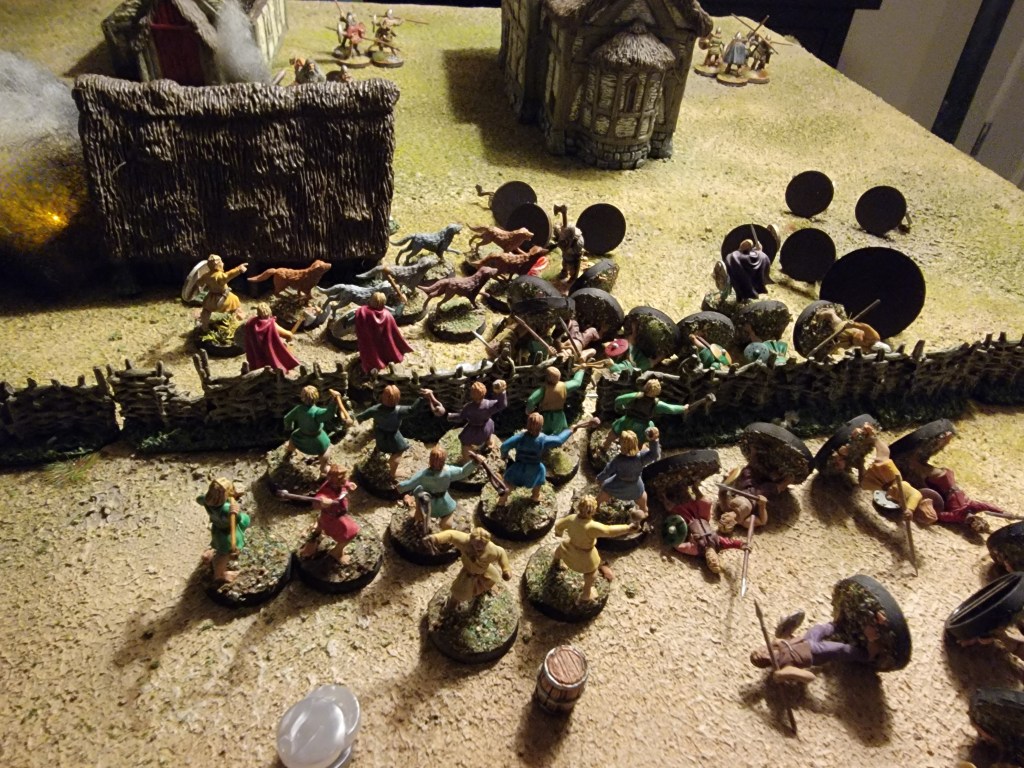
In Asymmetric Warfare, you spend your time considering how you’ll execute your tactical plan on the battlefield, but not especially thinking about how the rules work.
I find SAGA consistently fun (and have for years) because its rules present a fascinating puzzle every turn that I love trying to solve. It’s similar to the appeal of a great board game.
I find Asymmetric Warfare (and other similar games) fun because I get to puzzle over the situation on the board and feel generally more immersed in the narrative of the battle. It’s the appeal of a great narrative.
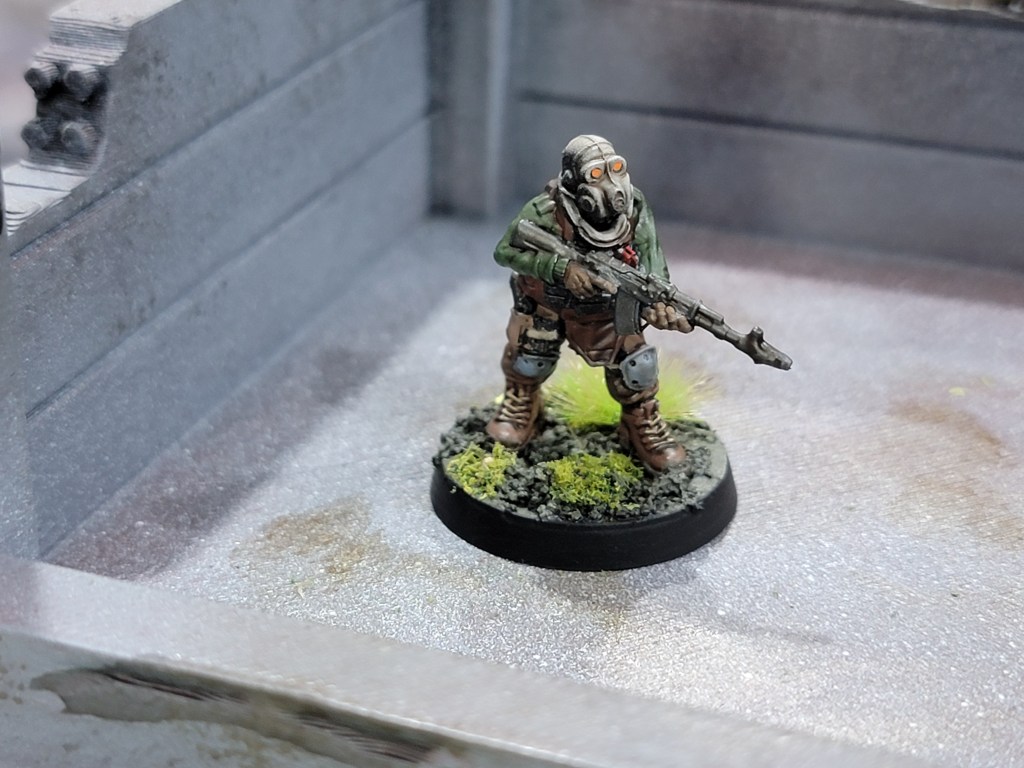
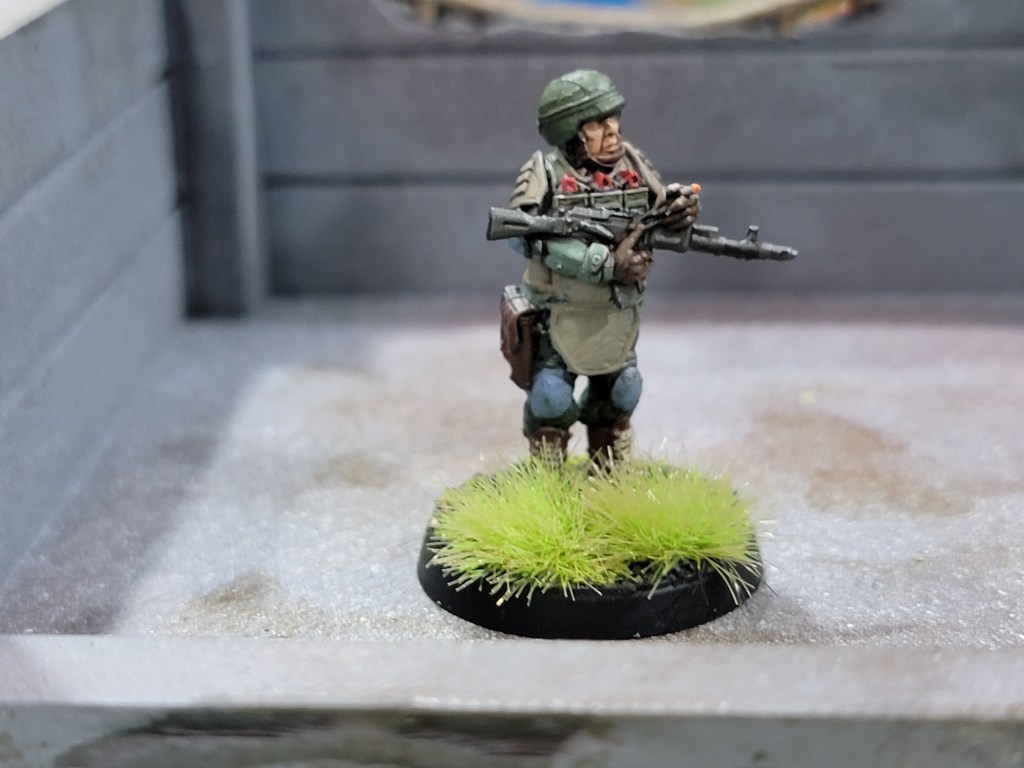
Again, I’m not trying to say one is better than the other. Indeed, I haven’t played enough Asymmetric Warfare to tell you if it’s great or not—it just happens to be a handy example from my recent play with photos that aren’t too deep into my Google photo reel.
I’m also not trying to say a ruleset must be one or the other. Indeed, SAGA has elements of Narrative Generating Adjudication in how combat works outside the SAGA dice. Men collide, roll to hit simultaneously, and then roll to save. You know how they died and if they managed to strike back. There’s a narrative there, however small.
I just find that rules tend to lean one way or the other. Recently, I’ve found myself thinking I prefer Narrative Generating Adjudication, but now I realize that’s not true. Both have different merits and demerits. Both have a place on your gaming table.
*I owe credit to Paul Bussard, my coworker and good friend, who first introduced me to this concept. Our talks over the past six months are what has led me to this post. I make no claim for having thought up/rediscovered this concept. I’m just shifting the name a little.

 Small Scale Victory
Leave a comment