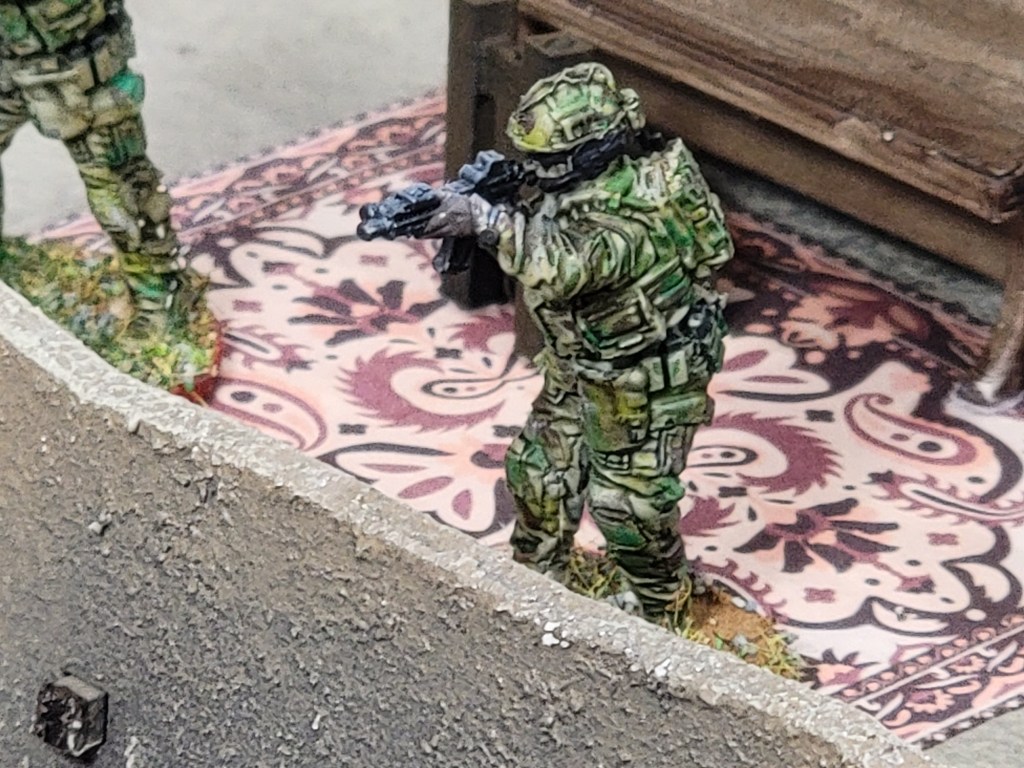
I’ve struggled with setting up this review. Over the past month I’ve played around 15-20 games of InCountry, I’ve hosted a Learn to Play, and I’ve taught around ten total people to play. I have not yet played the game in a true competitive setting (the “tournament” at NOVA Open was not a tournament in earnest), which leads me to hesitate on publishing this review.
Further, the digital version of the ruleset is free. You can buy a $10 rulebook, which I find problematic for reasons that will become clear, but you can technically get this ruleset for free.
Finally, its very stated goal is to be a tournament ruleset and I have yet to play it in a tournament setting.
But I’ve played the heck out of it in a month and I have some serious thoughts.
I’m getting ahead of myself: let’s get into proper review format.
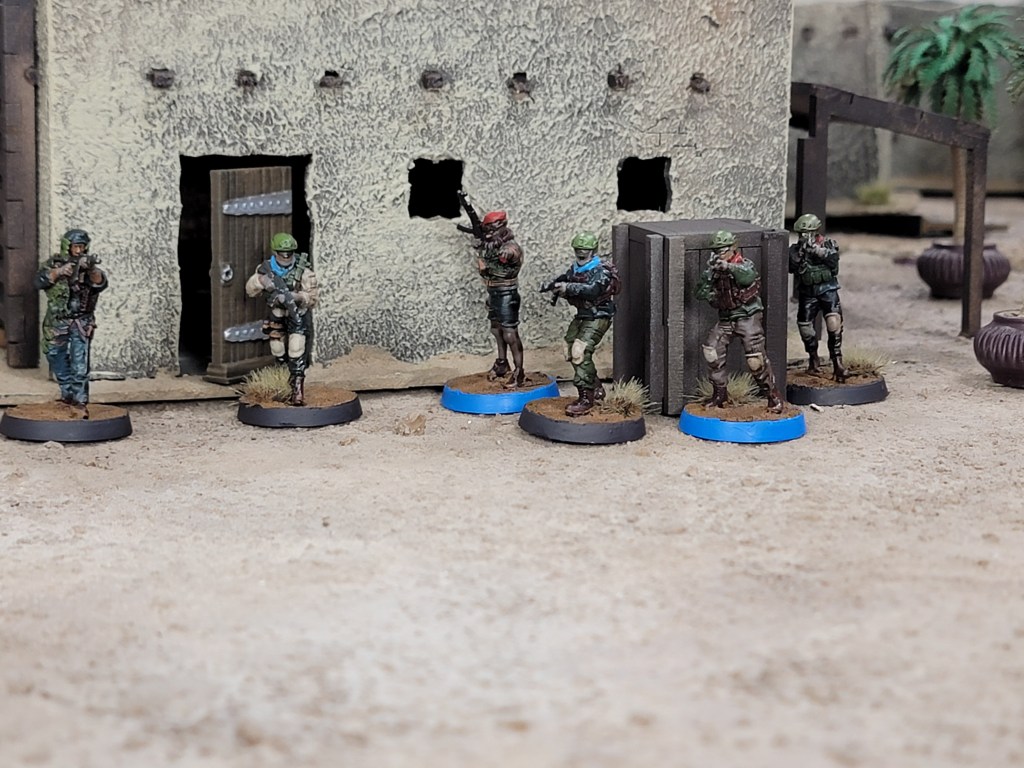
Blunt Line Up Front (BLUF)
InCountry: Recon is a tournament focused ruleset seeking to be streamlined, fast playing, and tactically rich. This is the obvious objective of the ruleset.
The rules are poorly written and difficult to understand. I’ve seen multiple interpretations of the rules, even out of the people running the official event I attended. I had to read and reread the ruleset while also asking multiple questions on the Discord to put together a proper understanding of how the game plays.
The ruleset is not balanced to a tournament level. For casual play it’s great, but as a tournament ruleset it falls short in many ways.
Its core is very tactically engaging and enjoyable, with some great ideas doing a lot of heavy lifting to cover for the flaws of all the missing details.
Ultimately, I think InCountry: Recon is a ruleset that needs more work. It has a great core, and played casually it’s a lot of fun, but as a tournament ruleset it is a mess of difficult to follow rules, poorly thought-out force building, and a detachment from the core objective it set out to achieve.
I recommend the resin miniatures (see my review of the miniatures) and I recommend this, in its current state, as a free ruleset. Do not buy a physical copy of the rules. They need updating—that much is clear.
InCountry: Recon – What is it?
Alright, you’re still reading, so you want more information. InCountry: Recon is a ruleset where you put 4-6 man teams of a modern infantry up against each other to compete over objectives. It is distinct from InCountry: Core, which is a larger narrative ruleset (with its own expansion, even). The game is mostly advertised as taking place on a 2’x2’ board with 2-3 teams per side, but you can play on a 3’x3’ board with 4-6 teams per side if you want. I find the smaller games generally take 45 minutes to an hour to play once you’re familiar.
Each turn you activate one team of four models and give each model individual orders. Each model gets two actions, with the first action being used to Move or Ready, and the second action being used to Move, Ready, or Shoot.
In terms of unique mechanics, we have a few. For starters: if you Ready a model, it goes into what we would traditionally call “Overwatch.” It can shoot at any enemy that completes their first action in 360 degree line of sight of this model. Once a model is Ready, it does not lose that Ready. So you could Ready, Shoot, and then you still keep the Ready status until consumed when your opponent completes their first action in front of your line of sight.
I keep stressing that. I wonder why?
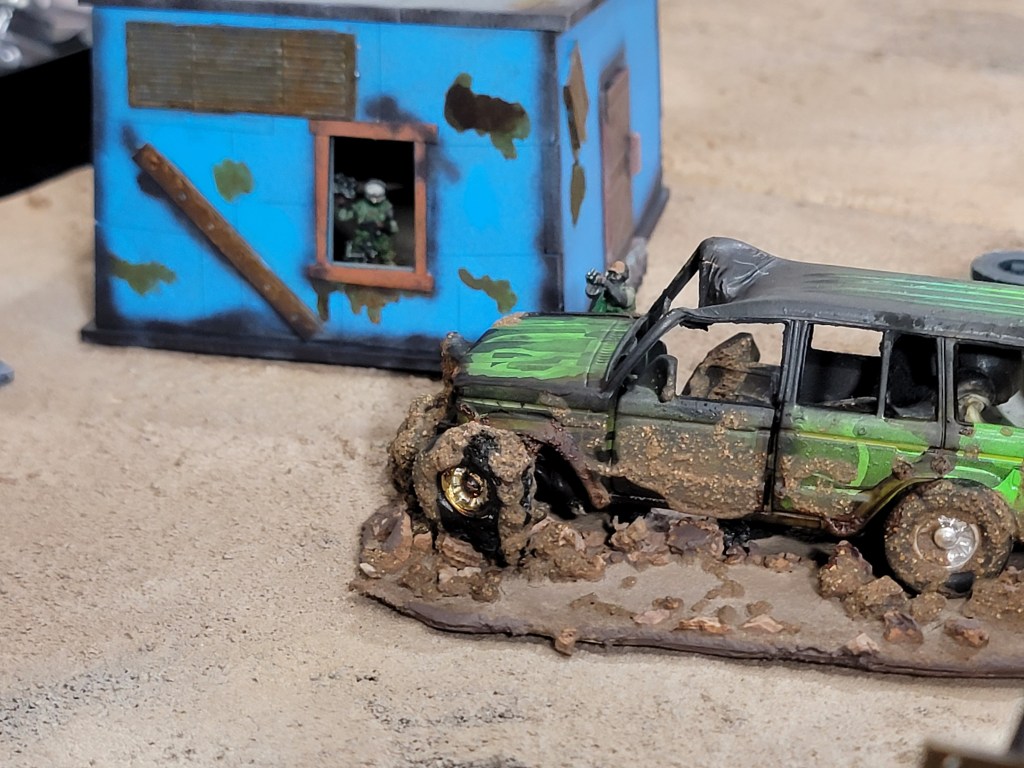
The next interesting mechanic is Conflict. You make a model take their first action, then an opponent expends their Ready status to fire at that model—then you select your second action and both the shooting and that action happen simultaneously. If you choose to shoot back against the Ready model, you go into Conflict.
In Conflict, you both roll to shoot each other. Whoever gets the most successes then rolls and applies wounds first. If you apply wounds to your opponent first, they don’t get to complete their shooting. Due to the prevalence of the Ready status in the game, Conflicts happen often. It’s neat! I love the tension it creates.
Shooting is also interesting. You roll 3D10s to hit an opponent in the open, 2D10s to hit an opponent in concealment, and 1D10 to hit an opponent behind cover. Easy! For each successful hit, you roll to wound. If a model takes two wounds, they die. If they take one wound, they roll a saving roll at the start of the next full game round to see if they recover or die.
Just from these mechanics, we have a ton of tension and a serious density to the tactical decision making in the game. It’s a lot of fun and an excellent core to build on.
The Hook
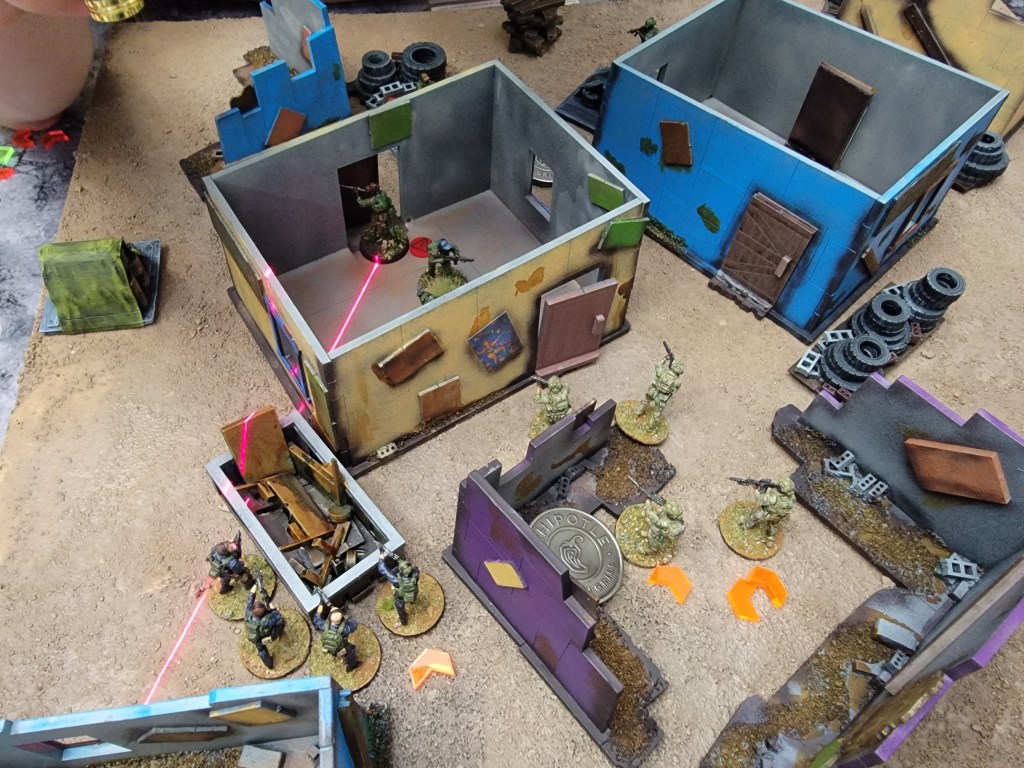
The hook here is obvious: the above mechanics come together to form a very tight core of response-counter-response that is immediately engaging. Combat is tense, fast, and thought provoking without being overwhelming.
Honestly, I’d call the game “Counter Strike on a 2’x2’ board.” It evokes that feel of lethality and focus on dealing with the enemy while handling the mission.
The battles play out in about an hour or less and I’ve had most of my games really come down to the wire, excepting the ones where I really pushed the system like a jerk.
Ah, darn. Getting ahead of myself.
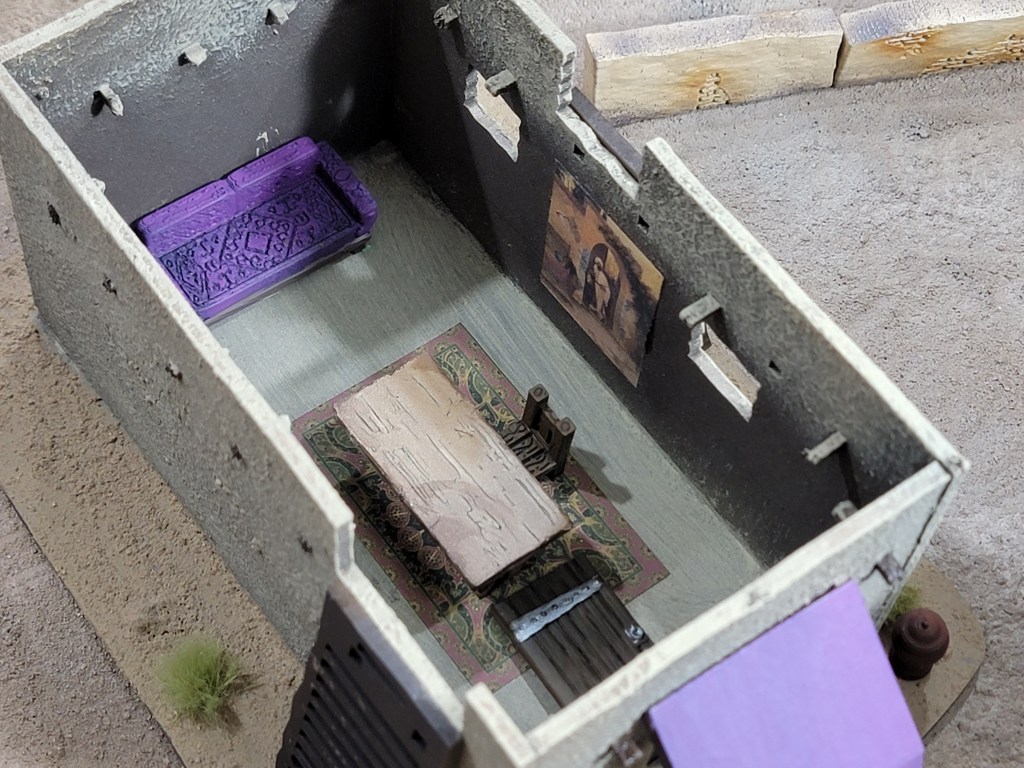
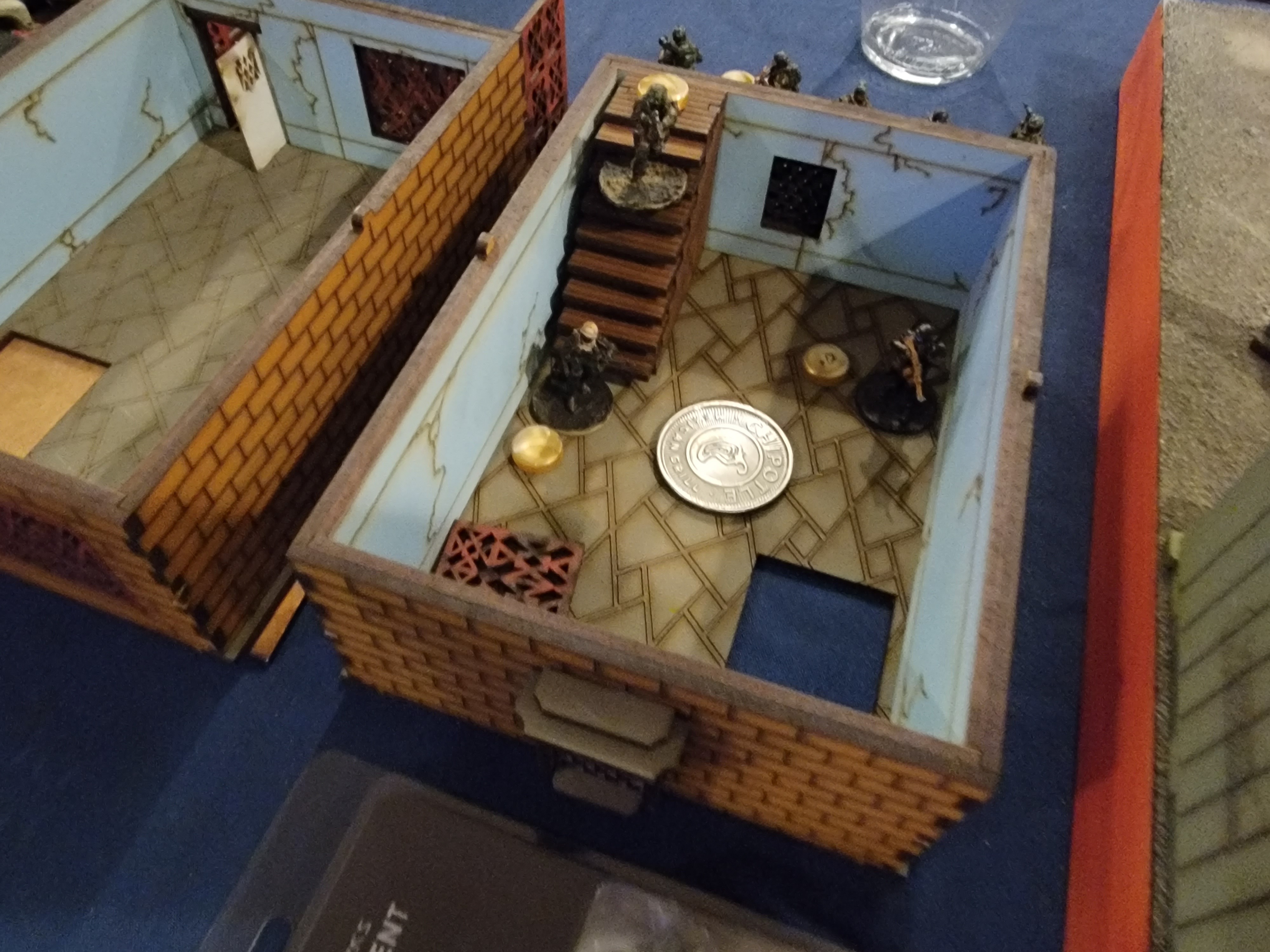
I’ll also say grenades are well handled—they require line of sight and generally only wound on 8+. Smoke is a welcome feature of the game, allowing you to maneuver through tricky situations. Also, terrain is an absolute necessity, and this game is an excellent excuse to produce various beautiful small terrain vignettes. I’ve seen few games take such excellent advantage of terrain sets with interior walls and doors.
The Problem
I have one major issue with the core ruleset: melee plus Ready status. Melee occurs immediately when you touch an opposing model. You both roll 1D10 and whoever gets the higher number wins, defeating or capturing the opposing model. If you have a pistol, you get to roll 2D10 but will always kill the opposing model rather than taking them hostage. Hostages count as tie breakers in most missions.
Here we now have to add in other mechanics and an understanding of missions to explain the core issue in this ruleset. Ready?
For one, you can only use a Ready to respond to the first action an enemy takes. So let’s take the following situation:
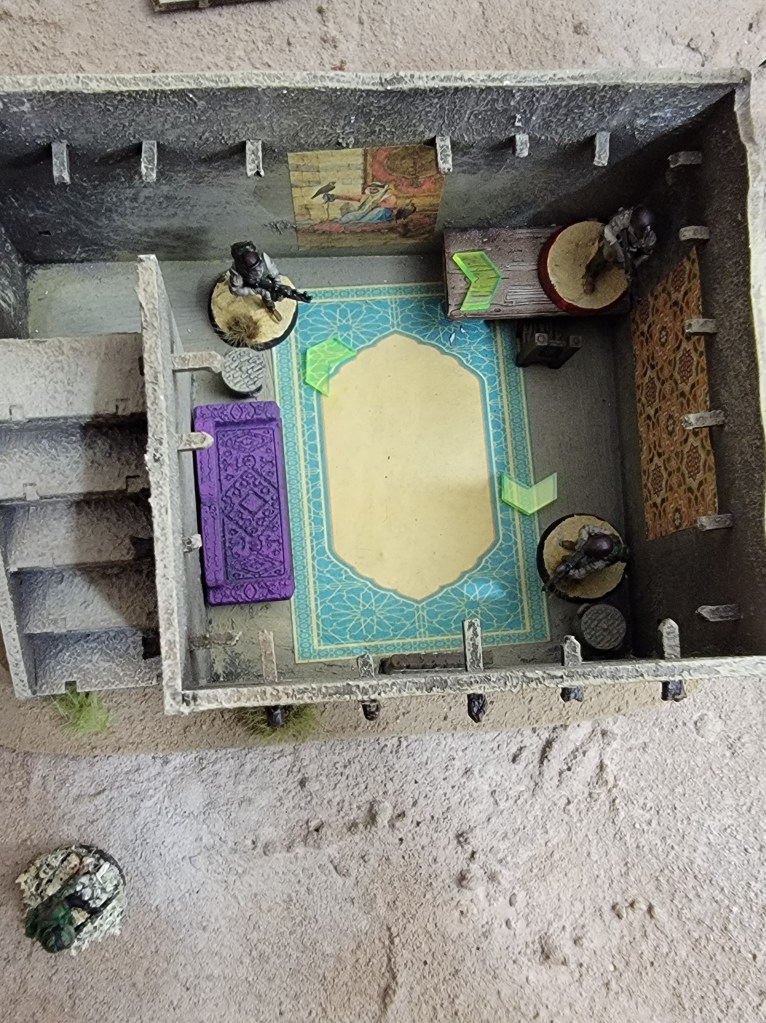
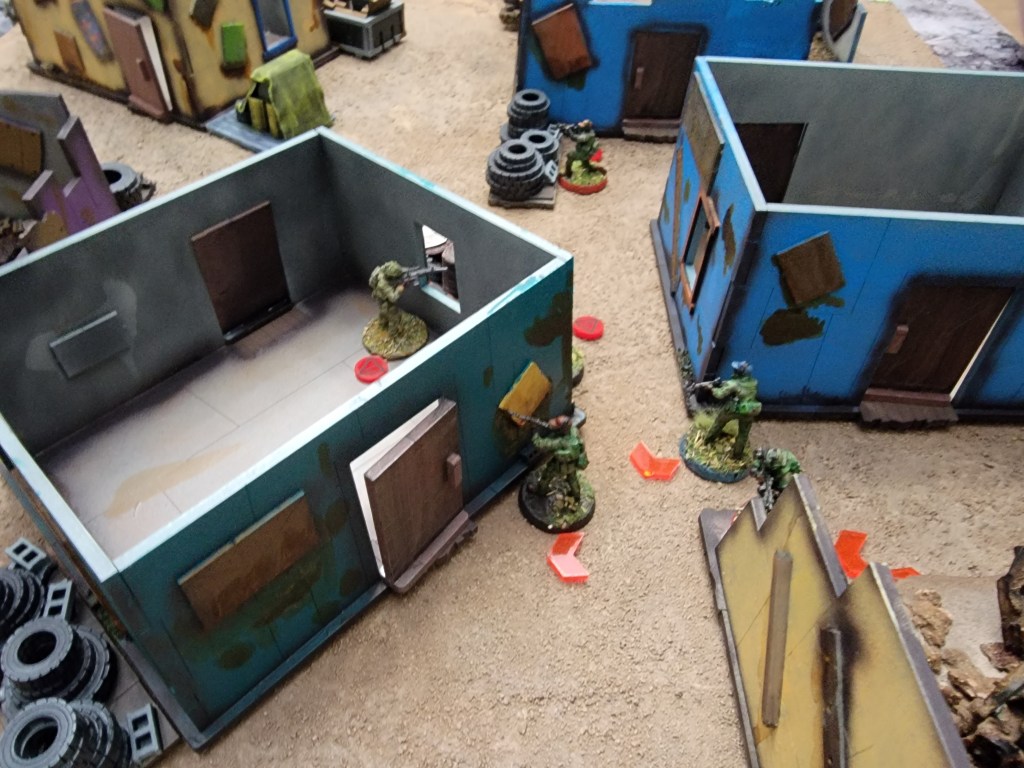
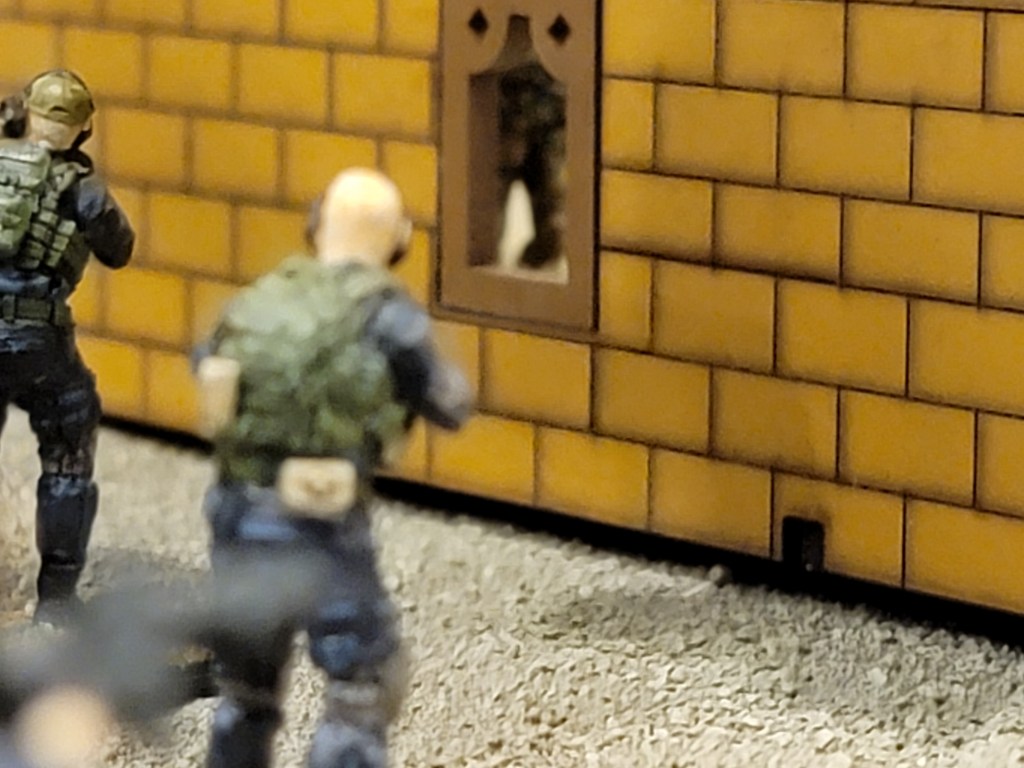
I have models setup in each corner of this house, Ready, watching the door. This should mean I have the house on lockdown. If someone runs in, he’s dead. My opponent chooses to move up to the door without entering on his first action, then run in and melee one of my models with his second action. He wins the melee and then… nothing. That was his second action. I can’t spend my Ready tokens to shoot him now.
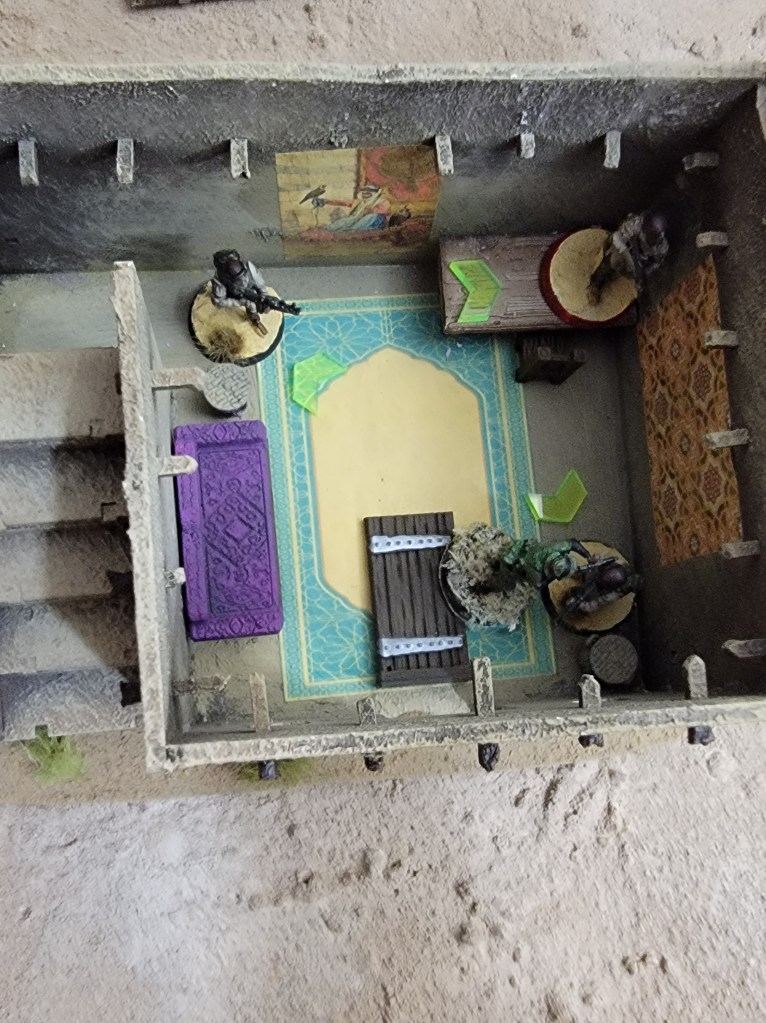
In theory this situation rolls over into the next turn and I have the advantage, but if my opponent wins the initiative roll he retains the advantage and goes first, allowing him to flow more forces into the room. Awkward. Make it even worse: if the model started outside the door, then used Ready on his first action and moved in on his second action, he’d now be in the room with a Ready token after that successful melee.
Further, my opponent won that melee, so he takes a hostage. Good for him. How does that work?
I have no idea. I’ve read the rules and the scenario packet multiple times and it isn’t answered. Does the model have to be carried by him as a token? Do I remove it from the table? If he’s killed, do I regain my miniature since he was held hostage and I theoretically set him free? None of this is answered presently.
Okay, fine. Easy enough—they have some loopholes to fix. I can accept that in a casual rulese—wait. This is a tournament ruleset. One I can pay money to buy.
Now that’s a problem for me.
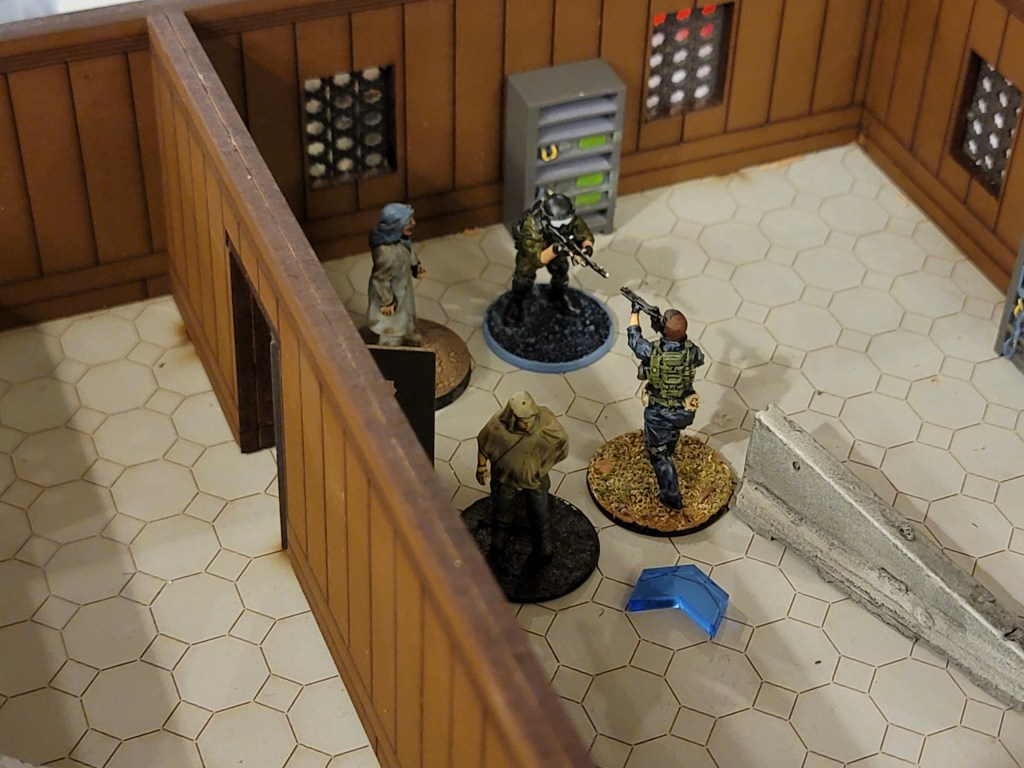
This is clearly not ready for sale, but let’s dive deeper, shall we? Let’s build a force designed to break this game.
Easy enough—go download the forces documentation. Build a team of 18 Local Forces models. Use the second actions to force melee interactions left and right, or even just hold back with your mass of 18 bodies and lock down the map with Ready. Yes, they hit on a worse value. A Tier 1 Team hits on 5+ on a D10. A Tier 3 Local Forces Team hits on a 7+. 20% less hits… but that Tier 1 team is only 8 models. So I hit 20% less on 225% the number of models. Even factoring slightly lower lethality on my guns (generally, equal or 1 point worse) I have a distinct advantage.
You start to see the problem.
Then there’s the board size. There are a few missions where, with the Insertion special rule, you can put a Team 6” in from your Avenue of Approach (deployment edge) which is enough to… land right on top of the objective on turn zero.
Then there’s the Armored Unit Team, which has Protection (8). This makes it so any model shooting you only wounds you on an 8+, which means my heavy armor is more effective the stronger your weapon is. See, if you have a very good weapon that wounds on 5+, now it wounds on 8+. If you have a crappy weapon that wounds on 7+, now it wounds on 8+. Weird how that makes those Tier 1 operators even worse.
Suffice it to say I can go on. We haven’t talked about how the Fireteam Leader special rule trumps all others, or how there’s little-to-no reason to take a grenade launcher over an LMG.
So the game is fraying on the details. It needs a lot more playtesting from people aggressively trying to push the limits of the systems.
The Rules Writing
I hate to write a section on this, but I will give you an example of a small issue I had while reading that is indicative of what’s wrong with the rules writing.
The Kill Team unit can start the game as a Contact Token. Contact Tokens can move in the opening phase of the turn before actions are taken. During the turn, instead of Activating a Team, you can have a contact token Ambush or be Revealed. At present writing this is on page 10 of the ruleset.
So what does the token do in turns where you don’t Ambush or Reveal? Well, nothing. If you go back to page 4 of the ruleset, you’ll see that you activate “Teams.” The token is not a “Team,” it’s a “Token.”
It’s not that hard to understand, but it was confusing on first read through. You have to take a very technical mindset to reading the rules.
The silly thing to me is that this is an obvious question that would come up, and you could write one more sentence in the Contacts section on page 10 to clarify it. The rules are rife with issues like this. Have three people read the rules and ask each one how the pinning system works—you’ll get a different answer from each.
For the record: when pinned, you do not lose your Ready tokens. The next time the team is to be activated, you instead REMOVE the pinned token. In that exact same turn when its your opportunity to activate a team again, you can activate that formerly pinned team.
Why?
Because it doesn’t have an activation token as you didn’t activate it. You can activate teams without activation tokens. Obviously—you did read the rules, right?
That’s sarcasm if it’s unclear. It’s very easy to miss this detail as the concept requires you to understand three different sections of the book to put it together, including reading how Wounds work so you can confirm that the Pinned token doesn’t replace the Ready token.
What Can We Learn?
Playtesting sucks.
No, really. It does. It’s a painful process requiring a lot of thought, engagement, and tedium. Trying to balance out many disparate forces is genuinely hard and requires a lot of focus and effort to do right. This is usually where I see small rulesets break and InCountry: Recon is no exception.
Further, playtesting needs to be done with a focus on the vision of the game. The vision here is to make a tournament ruleset that plays quickly. They have, instead, created a fast playing casual ruleset with some balance issues. I believe this comes from a lack of focus on the main goal: building a tournament ruleset. That should shape a testing plan that involves really digging into every detail and trying to break the systems of the game.
What else can we learn?
Rules writing sucks.
It’s hard to write a ruleset that is clear, concise, and easy for the reader to keep in their head. It’s a genuine skill and as seen in many cases, a difficult one to master. Not enough people respect truly well written rules from a technical perspective.
It’s clear to me that the developer here had some fantastic ideas and got them to paper, even going as far as to have a great (resin) miniature range and actually starting up a business around it. I commend all of this. Unfortunately, more time needs to be spent on the un-sexy parts of the development process to really bring this home and make a great ruleset.
One final lesson?
Having a tight, well thought out core to your rules is absolutely essential and can overcome many problems. I had fun playing this ruleset—I was never bored. When I tried to break it, I succeeded and laughed it off. Outside of a tournament, I would totally play this again with a friend over a beer or two.
Conclusion
I am judging the game on the goal of being a tournament ruleset, to be clear. I am not judging it as being accurate to modern combat (it’s not and isn’t trying to be) or on being a great narrative ruleset. I believe what we have here is a fun, casual ruleset for playing small squad sized tactical firefights with your friends. We have a ruleset worth watching, as with time and investment it can be made into something great.
What we don’t have is a good tournament ruleset. On its very mission, it fails.
If I sound harsh, it’s because I really want to love this ruleset. The core is there, but it needs so much more work to really live up to its potential. I’m also harsh because you can buy the core rules for $10 online, and that just isn’t great when those rules aren’t well written and need a full rewrite to be properly readable.
If what you want is a fun game to play with friends who won’t be jerks and try to break it, go download the rules and have fun. Don’t invest too much solely into this ruleset—or really don’t invest anything solely into this ruleset. If you buy the miniatures, do so to paint modern miniatures or play other modern games, not just to play this game.
I heartily recommend their resin miniatures, and the metals I can also recommend with some caveats. I believe Enemy Spotted Studios is a game developer worth watching, but I suspect they need more time to hit true maturity in their development process.
I also want to stress that this review is a very temporal thing. Today in 2023, I don’t truly recommend this ruleset, but a year down the line they may very well hammer out these issues. I hope they do—because a tight, small skirmish ruleset is something that slots well into my overall stable of games.
Even as I end this review, I still feel my thoughts are vague. I can’t recommend you pursue these miniatures for the sake of playing this ruleset, but I can say it has been fun to play and I really hope it improves.
It’s the classic case of so close, but so far—maybe that’s why it bothers me so much. This game deserves the time and attention to bring it to greatness, but it doesn’t deserve your money just yet.



Leave a comment