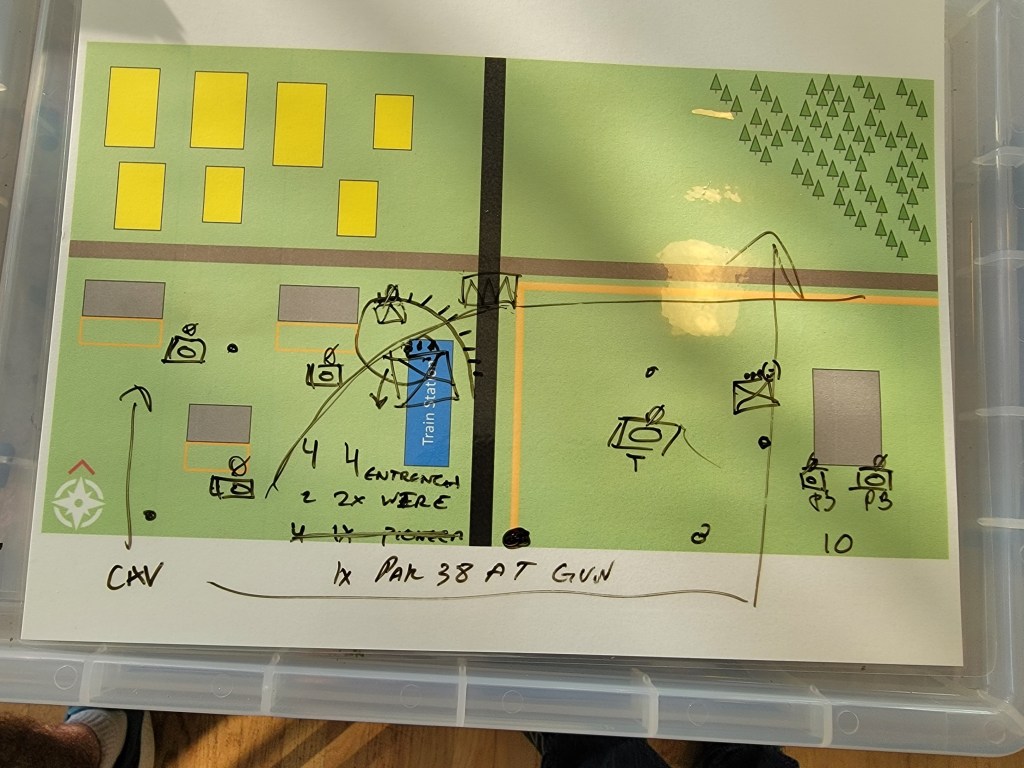
I’ve written a few scenarios for Big Chain of Command thus far and I’d like to think I’m homing in on an actual method to my madness. I must give credit to Paul, my co-conspirator, who has helped greatly in this process and is an excellent scenario writer in general. This post is not a guide, but I hope to make one in the future after running a few more games.
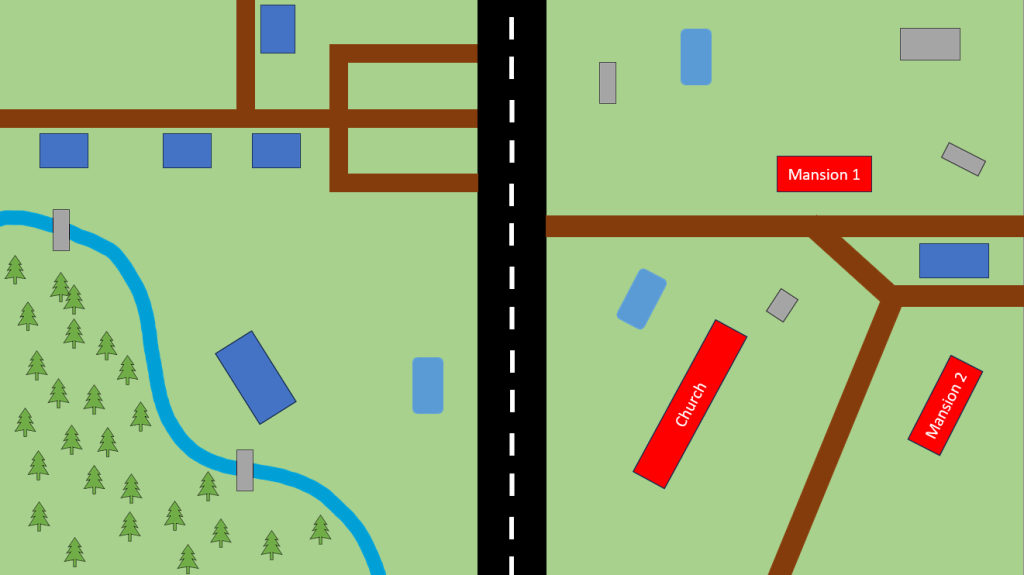
Analyzing the Boot Camp Scenario
A principle I’ve landed on is the idea of giving the attackers multiple objectives from which they must select one. For example, in my latest game, the attackers had to accomplish one of the following:
1. Capture and hold the entire main road (holding meaning no enemies within 12” at the end of a turn and a friendly unit on the road)
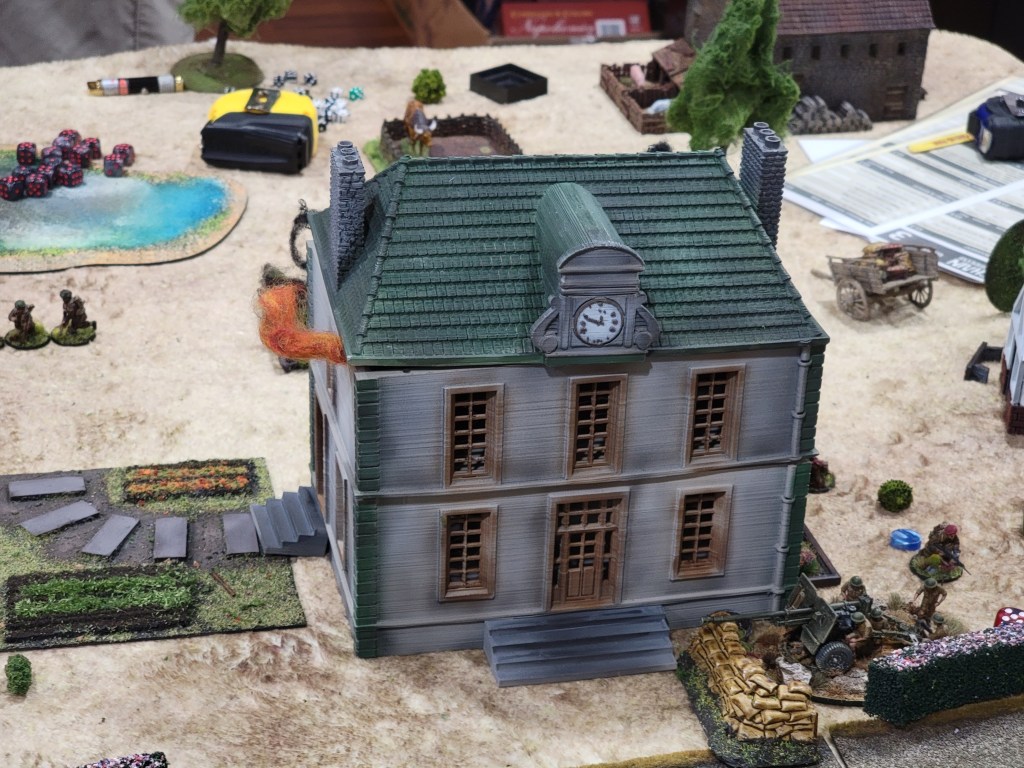
2. Capture and hold one of the three main buildings (holding meaning no enemies within 12” at the end of a turn and a friendly unit inside the building)
3. Destroy all three main buildings
The reason this works so well is it forces both sides to think around multiple problems and creates a lot of hard decisions. The risk to this method is that you’ll rarely get all three objectives to be equally difficult. Let’s break down what brought me to these three.
Holding the road was meant to force the defenders to deploy somewhat forward rather than just hide back. In a sense, it was meant to accelerate the game by bringing both forces into potential assault range of each other. It was also meant to stop the defenders from abandoning the front altogether and just sitting as far back as possible plinking shots off the attackers. I never expected this to be the game winning objective unless someome did something catastrophically wrong.
Capturing a building or blowing up all three were the true decision points. Capturing a building meant a heavy force concentration on one side of the board, whereas blowing up all three buildings benefited more from being spread out. I wanted to create an interesting set of decisions for the attackers, and I feel these two contrasting objectives worked to do so.
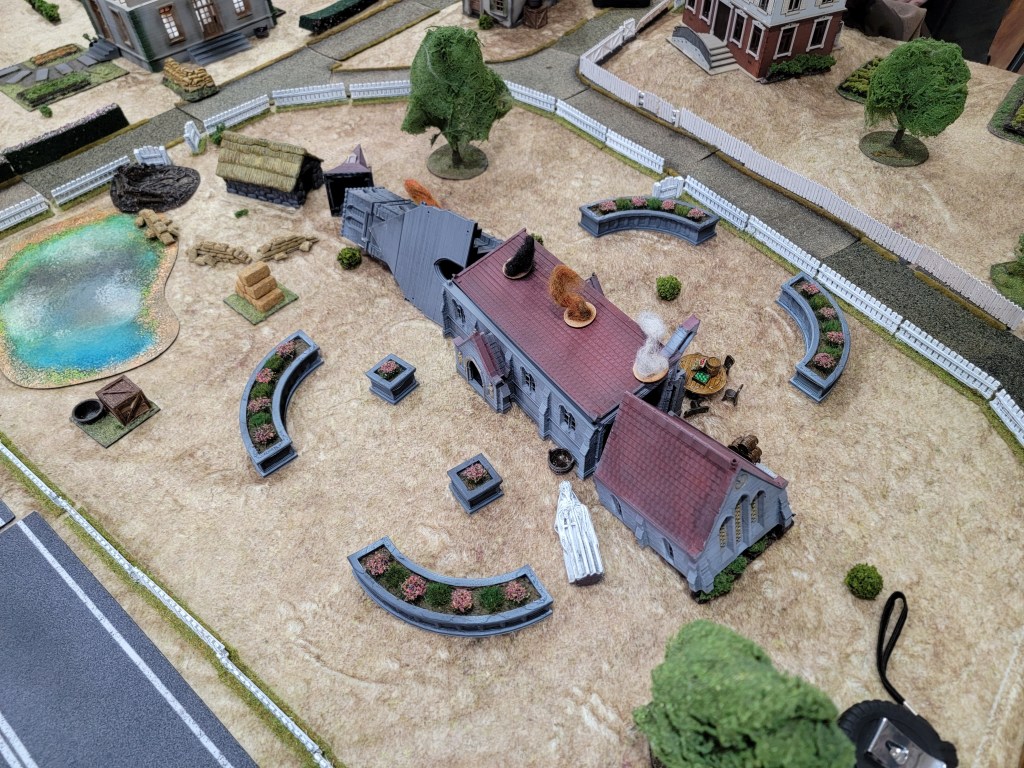
I do think you could criticize the “Blow up the buildings” option for the attackers. It seems obviously exploitable in hindsight. The defenders DID do a great job of countering it, but it was perhaps a bit too easy. In the future, I’d likely pair it with another objective. “Blow up all three buildings and capture an opposing JOP.” This would give something more active than just sitting and shooting at buildings but may also take longer (and as we’ll see I’m concerned with time). More thought is needed.
The defenders could only defend—I’m not entirely happy with this, but it makes rational sense given the limits of the game. I’d think something akin to “Destroy all enemy equipment capable of taking down buildings” would have also worked, but you can’t guarantee the attackers would bring tons of HE weapons. They may have gone all-in on armored carriers charging up toward the buildings ASAP to take one. If the defenders destroy all of the attackers’ options toward victory, the attackers would likely surrender anyway, so these objectives probably don’t need to be explicitly stated.
Another defensive option would have been “Hold off for X number of turns.” This would create a time pressure for the attackers, which I like, but Chain of Command’s turn structure is so variable that this doesn’t quite work. There’s no way of knowing how much can occur in a turn or how long it will last, so it becomes difficult to pin game winning events to the turn structure. Call this the main weakness of the system in my view, albeit very specific.
Defender objectives are, once again, something I need to think more about. I like giving defenders something active to work for.
Another potential solution is to create a system of Victory Points, which I did in our previous game. Multiple objectives for both sides granting points toward victory. This is a common wargaming conceit and it works quite well, but coming up with a reasonably balanced set of objectives in this mindset can be difficult.
I’d likely shape them around a meeting engagement meant to contest control of central objectives. It could be something as simple as “Take, hold, and score at the end of turns” on three central area objectives. This is a generic wargame mission for good reason—it’s fun and it works well. I think it’s worth exploring.
Controlling for Time
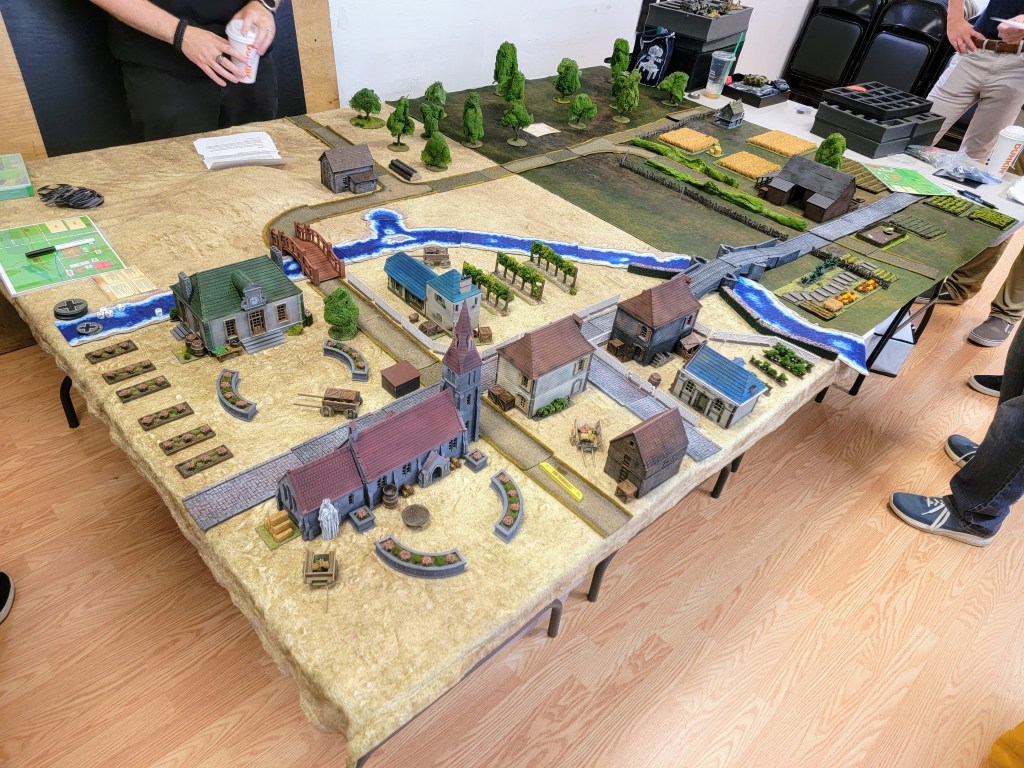
One of the major drawbacks of Big Chain of Command is that often times the best decisions for victory are decisions that extend the game. A large game with many players is inherently a long game, which means these decisions exacerbate the issue further. A few things I will not allow in Big Chain of Command going forward:
1. Preparatory Bombardments – these stall units coming onto the board, which stalls the game. The correct response is to mass force on board, then attack, but… that takes forever.
2. Off board artillery – I love the giant 18” squares of explosives or smoke. They’re game changing and fascinating to play around—and dramatic! Unfortunately, they also do a lot to stall the game if played improperly.
3. Passive objectives – This is more vague, but objectives need to force the players into action so they don’t just sit around.
You also need to keep players moving as a GM, and I DO recommend you have a GM. You can monitor the game and keep everyone pushing forward while quickly settling disputes or confusion. You should time the planning phase, and maybe even the Patrol Phase (experiment pending).
The worst feeling is when you get to the end of the game and people start making decisions “To end things because my wife has dinner on the table.” Honestly, I consider this my biggest obstacle and while no one has minded too much so far, I really want to solve it. I firmly believe a Big Chain of Command game can be executed in 5 hours including planning. I have had games execute in roughly that amount of time. I just need to keep nailing this down.
Lessons Learned
What I’ve learned from running a few Big Chain of Command games can best be summarized in a few major points:
1. Planning is vital. Not only do players enjoy the planning phase before the game, it can help create more cohesive plans of attack and defense which lend themselves to more decisive action. Give the players half an hour to separate into two groups and build Courses of Action—it’s incredibly worthwhile and does a lot to get everyone into the right mindset.
2. 3v3 is likely the sweet spot, but how many players play doesn’t seem to affect overall time much. At 2v2, you often end up taking turns within your own team due to attacking the same person. At 4v4, there’s more to resolve. 3v3 usually lines players up against the person in front of them and keeps things snappy.
3. Again, you have to shape things to get action to happen quickly. No bombardments, no artillery, and you have to have active objectives. It can’t be “Kill each other.” That’ll take forever.
4. The Patrol Phase is unskippable. It may speed things up, but you lose far too much by sacrificing it. I have considered this repeatedly as it would save about 30-45 minutes (seriously!) from the game, but it grants so much I can’t imagine removing it.
5. You really want an active GM and I should write a post on this by itself. An active GM can keep people focused and help settle situations where more than one player is attacking the same opponent. There’s small behaviors a GM can enforce that will keep things running smoothly and this saves a lot of time through a series of small chunks of time saved.
Potential Future Games
I have a few thoughts on future Big Chain of Command game scenarios I’d like to play, so here there are in no particular order.
Stop the Artillery!
Immediately breaking a rule. This game takes place on two separate tables. One table (Table A) has artillery, lightly defended, being assaulted to shut it down. Until the artillery is stopped, it will continue shelling Table B, placing two areas of smoke on the table to shield an assaulting force attacking a defender. In this manner, both sides are attacking and defending. Victory depends on Victory Points so the actions of either table may very well win the game.
I envision this as a 2v2 or 3v3 on one big board and a 1v1 on the artillery board. The obvious issue is timing between boards. I’d let them run independently but affect each other, which could mean the 1v1 wraps up way sooner. A potential solution is to allow the 1v1 forces to join the main board, but that’s hard to time and parse. Another solution is to give the 1v1 to people who have less time to play—or if they’re newer, place them there so the GM can focus attention on helping the newer players play.
This idea is highly experimental for me but carries advantages I really like. I hope to bring it to fruition one day.
Bunker Strike!
I just… really want to make a badass bunker. This one is less likely to ever happen just due to the terrain needed. I’d build a large bunker style complex and have one side defending it as the other breaches. The game would START with the breaching and would likely need secret routes, betrayal, and perhaps some other dramatics to make it move along quickly. It carries a lot of risk time-wise. Penetrating and invading a bunker should take a long time, so I need to solve how to make it quick.
It just… calls to me. I want that bunker. I dream about that bunker.
City Control
This is based on what I said earlier in this post: three area objectives players score points for at the end of in-game turns. This carries the problem of the potential for repeated, tight turn ends causing the game to end inorganically. I could perhaps control this by stating something like “You can’t score two phases in a row.”
The idea would be to have strategically important locations on the map that the players are vying for. End of every turn, you score 1 VP for each point controlled. First team to… 7 VP wins.
Simple, easy to understand, but encourages a lot of planning. The more I think about it, the more I like this one.
Multi-Table Game Day
This is not actually Big Chain of Command, so forgive me. Chain of Command is not a tournament game. It is not tournament-able. There lies folly and pain.
But I’d love to have a casual game day with prizes!
My idea here is to setup 6 tables for 12 players (or more—it’s scalable). Time blocks are 4 hours for each game. You’d play your first game, break, then play a second. Times would likely be 12-2, 3-7. As you play, GMs walk around and pay attention to the various games. When something cool happens, the players (both) get a ticket for a raffle at the end of the day.
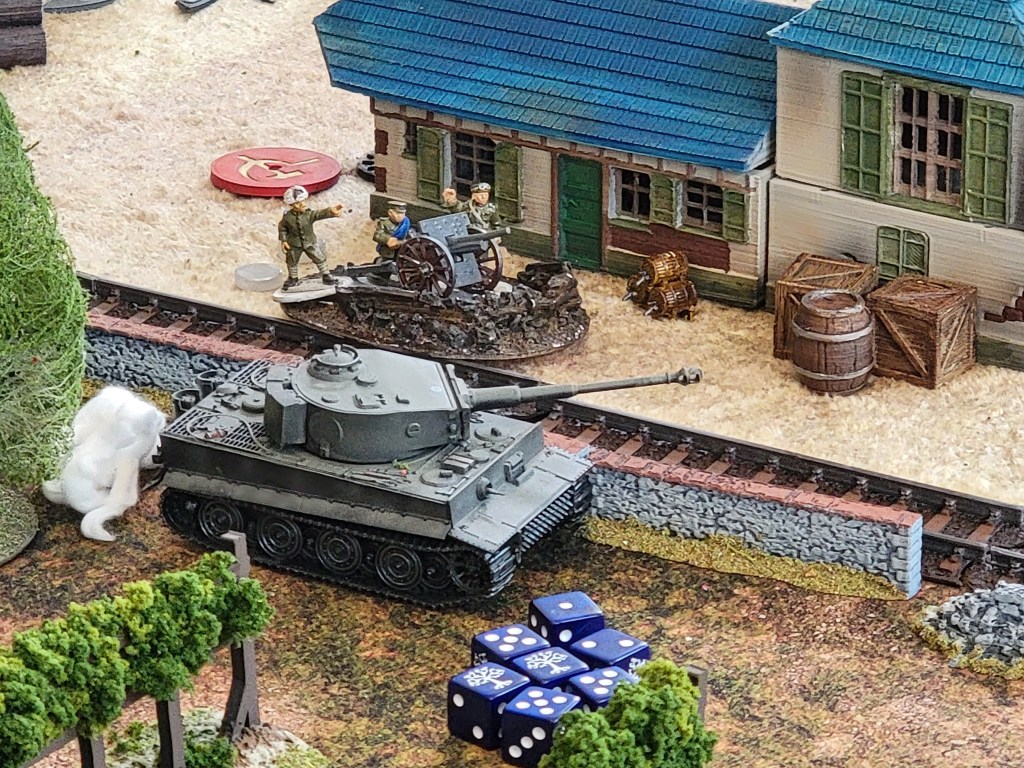
This encourages fun casual play and the generation of narratives. Players could, obviously, call a GM over to tell them about something cool that happened. It also means when your opponent gets lucky, nails three consecutive phases, and obliterates your Tiger I, you don’t feel so bad. At least you got another chance at a prize out of it!
This is the event I will likely aim to run at NOVA Open in the future if I can convince them to let me and convince myself it’s worth solving how to transport so much terrain into DC.
Should YOU Take on Big COC?
I couldn’t resist a pun there. Sorry. I’ve been good this whole series and I had to have one slip up.
My answer is: yes, with planning. Don’t stumble into it. Plan out a scenario thoughtfully and choose your players carefully. I recommend everyone have at least 2-3 games under their belt. Make sure everyone is clear on the time it may take (set aside a day) and plan to be a proper host—food plans and all. A game of Big Chain of Command is a social event as much as it is a wargame, so having the right atmosphere goes a long way toward making it more fun.
Plan around timing and really think about it. I only have a few games under my belt so hopefully what I have here helps, but I’m sure there’s more to learn. One day I’ll get to the point where I can make a guide proper. I plan to do at least one more Big Chain of Command game this year, but my next club event will be something lighter (if they’ll let me).
I think Chain of Command played as Big COC really shines. It’s worth the time and effort to execute it right as it truly shows off the things that make the system special and worth your time. It’s also just an easy way to get a bunch of guys rolling dice, talking tactics, and cheering as a mansion blows up.
It’s fun, thoughtful, and everything I want my hobbyist wargaming to be.
 Small Scale Victory
Leave a comment