The most common question I get from players new to Chain of Command is “How do I build a force?” or “What do I buy to play?”
It’s thankfully not only simple, but easy. My recommendation is you start with the first platoon listed in the core rules for the country you wish to play. You’ll very easily be able to branch out in the future by building a few more minis, but for now just stick with that platoon and a few support options.
Let’s start by reviewing a platoon, then I’ll get to support options.
Base Platoon
This is the force that comes to every game—it’s what you ALWAYS have in every match. Take the standard British Rifle Platoon:
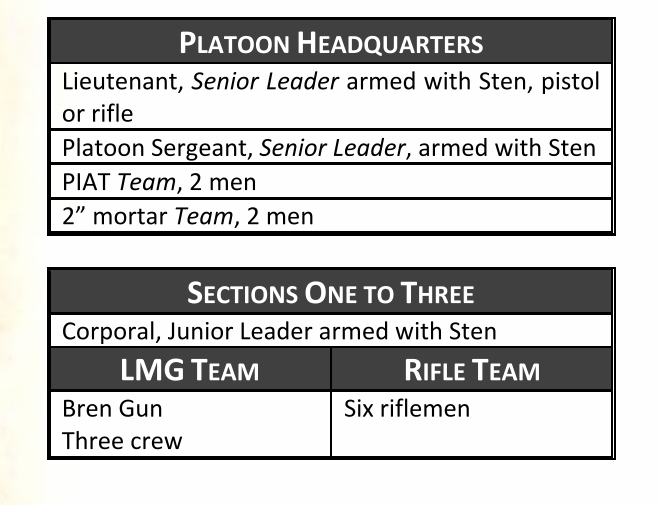
Reading this chart is pretty simple. You get your Headquarters consisting of:
- Two Senior Leaders armed with SMGs (model these however you please—have fun or keep it simple)
- One PIAT Team of two men
- One 2” Mortar Team with two men
Next we have the three sections “Section One to Three.” This is three copies of the same section, so you get in each:
- One Junior Leader with SMG (again, model how you please)
- One Bren LMG Team with three total men (including one holding the gun)
- One Rifle Team including six total men
Add that all up and your core platoon consists of 36 models. I recommend basing each individually at 28mm to make them easy to track, though there’s an argument for basing the PIAT and Mortar Teams on one base or even the LMG + one or two additional men on one base. As a rule LMGs always have at least two men associated with them. At 15mm, I would base the weapons teams on one base and base the riflemen on single bases.
Support
In each game you roll dice to determine how many support points you get before the game starts. You then select what support you’ll bring by spending those points. It’s how you customize your force to the mission at hand. I want to stress this: YOU DO NOT NEED EVERY SUPPORT OPTION! Not just to start, but in general.
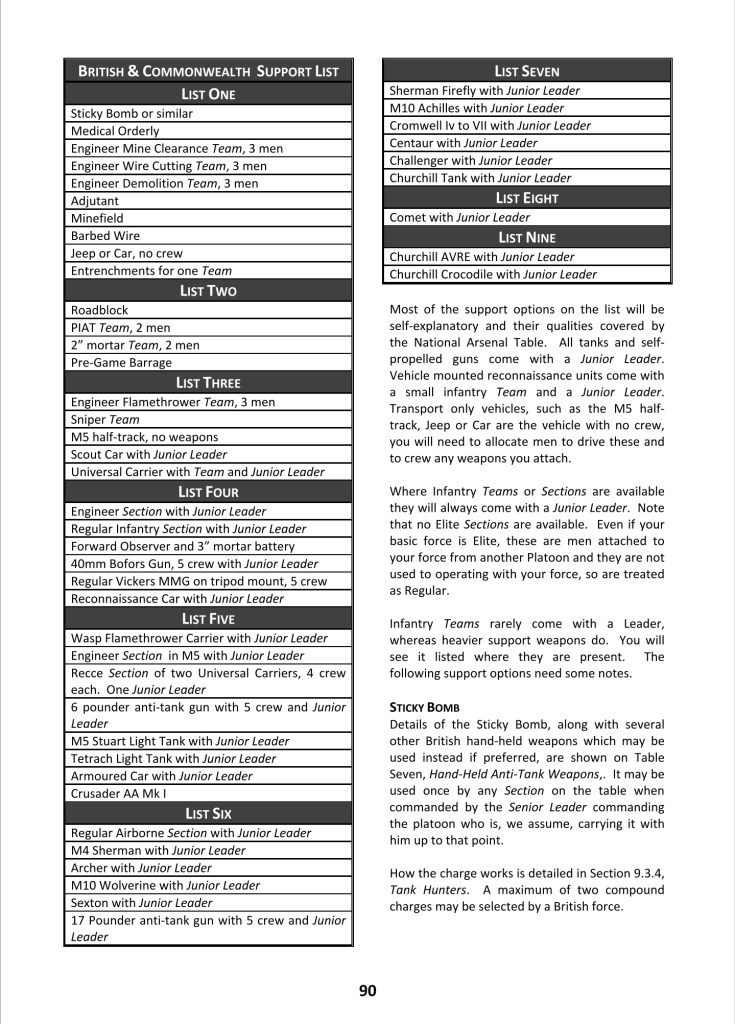
You’ll find each force has a section on support with various numbered lists. Each list is a list of support options that COST that number to bring. So for example: an additional section of infantry costs four points to bring and is on List Four. If we rolled 9 points for the match, I’d maybe bring that section (4 points) and maybe a 6 Pounder Anti-Tank Gun (5 points) for a total of 9 points of support.
As a new player, or whenever starting a new force, I’d acquire the following:
- An additional section of infantry (it’s the same as the base infantry sections for your platoon)
- One lower point tank and MAYBE a higher point tank, but generally not the highest
- One Anti-Tank Gun
- An MMG or a Sniper to have a lower point option to fill out
For Entrenchments, bring a token or acquire some sandbag terrain. They’re a great way to spend extra points. An Anti-Tank Gun in entrenchments is… well, your friends might not like me for teaching you about it.
Basing
I mentioned it above but I want it to be easy to reference: basing in Chain of Command is generally meant to be single basing. This allows for precise positioning. As a result, you want to keep your multi-basing minimal. I’d multi-base weapons teams (Mortars, Anti-Tank Guns, LMG teams) but not entire sections. Even at smaller scale, I wouldn’t multi-base a whole section, and I’d try to avoid multi-basing entire rifle teams. The spare single based models make things easier.
That said, yes, you can abstract and use multi-basing if you really want or need to. Just realize you’ll have to discuss how you’re going to handle cover and you won’t be able to take advantage of the four inch range available between models in the same sections, which means you won’t really be able to spread out realistically across your board.
15, 20, or 28mm?
The age old historical question: what scale do I play?
This is tough—genuinely. Each scale brings something different. My advice, however, is simple: pick whatever your group is most likely to play. You want to be able to play games. Don’t worry too much about the size.
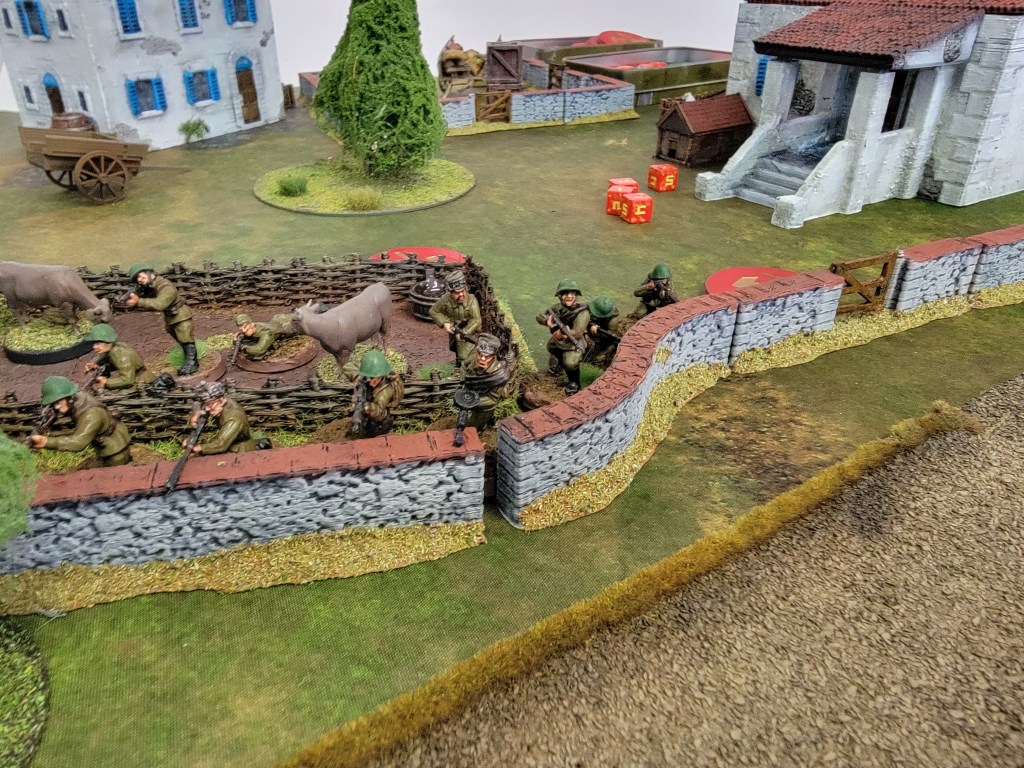
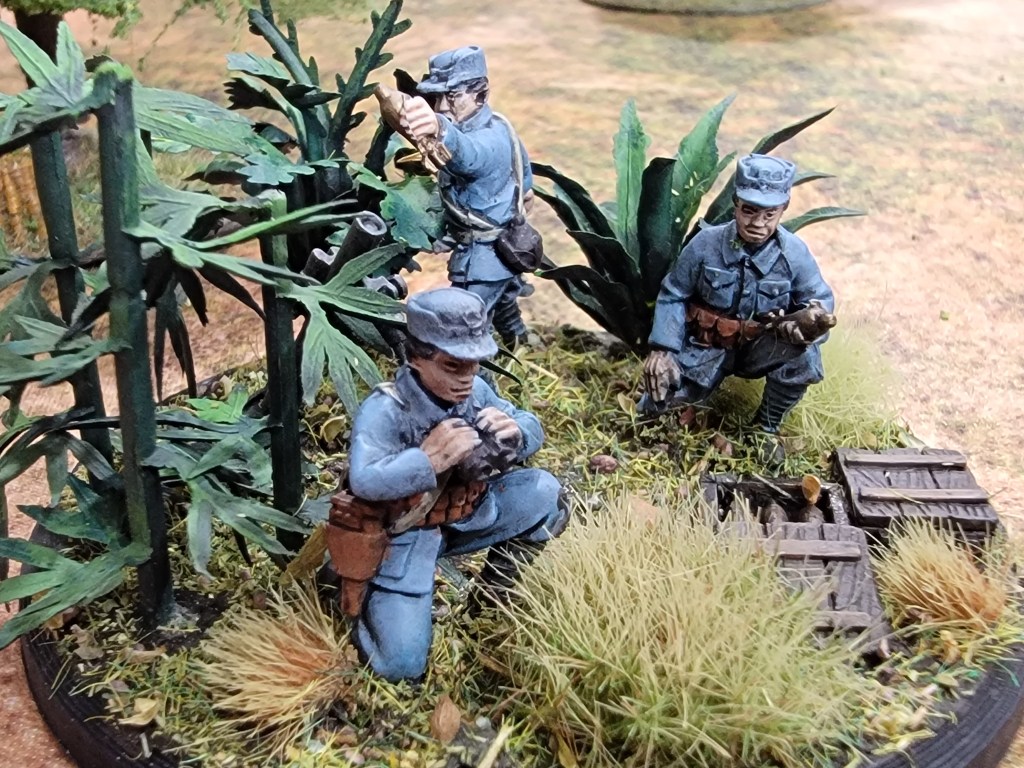
At 28mm you can use Bolt Action forces. 28mm forces are easy to build up, fun to hobby out, and look great on table. Your matches will feel a little bit tighter, but will still be very satisfying. As of writing this guide I’ve only played in 28mm.
15mm/20mm are better reflective of the ground scale of the game and allow you to better portray the footprint of a platoon. Since your buildings are smaller, your platoon takes up a more realistic amount of space. Fields are larger, empty space is more prominent.
And really, that’s the core difference: your boards. At 28mm I strongly recommend you abstain from putting down entire villages every game. I’d use 3-4 buildings maximum and spread them out. At 15 or 20mm, I’d say you can place a few buildings in one place on the map and still have believable space dedicated to fields and greenery. More of your terrain should likely be green than any other color.
Between 15mm and 20mm, the choice comes down to what else you want to use your forces for. More people tend to own 15mm forces, so it’s a more flexible scale between systems. Both scales have a ton of available miniatures, especially from Plastic Soldier Company, who sell affordable batches of minis. A full company from them in 15mm is $30, which is crazy good even factoring that you’ll need to buy bases for it.
Buying Miniatures
28mm
Warlord Games – Generally good, especially with their bundles. Never buy direct from them—their direct prices are ridiculous. Look at the Infantry sprues in photos—if the guns aren’t attached to hands, avoid it like the plague. Having to glue a gun into BOTH hands is a nightmare.
Wargames Atlantic – An ever expanding range. I love their quality, but they tend not to pose LMGs very well. I strongly recommend them, and you can always buy a box of Warlord and a box of Wargames Atlantic and put them in the same force.
Perry – Limited range, but high quality. Personally a big fan.
Metals – Too many manufacturers to list, but I will say: Offensive Miniatures is 100% worth a look. Great quality metals, my favorite in fact, and great designs. I’ve also loved Eureka’s minis in the past.
15mm
Peter Pig – Commonly recommended, great quality. Metal.
Plastic Soldier Company – Insanely inexpensive. Slightly lower quality, but much lower price. I’d go with these 100% of the time at a glance. Caveat: I have several boxes but haven’t gotten to them yet, so this is not a personally informed opinion.
Flames of War Miniatures – Pricy, but excellent quality. You’ll want to see what comes in each Platoon box to make sure it matches with what you need.
20mm
I’m not familiar with this space, but I’d point you to Plastic Soldier Company to start.
Get Going
Hopefully this helped. I know starting any new historical is daunting, but I find Chain of Command to be graciously simple. You build the core platoon, get a few support options, and go. No list building, no pouring over a million options and fretting about the best list.
Just play—the stressful decisions happen on the battlefield, not on your hobby bench.
 Small Scale Victory
Leave a comment